
Act I · Physical & Clinical Story
Two Anions, One Electrostatic Funnel
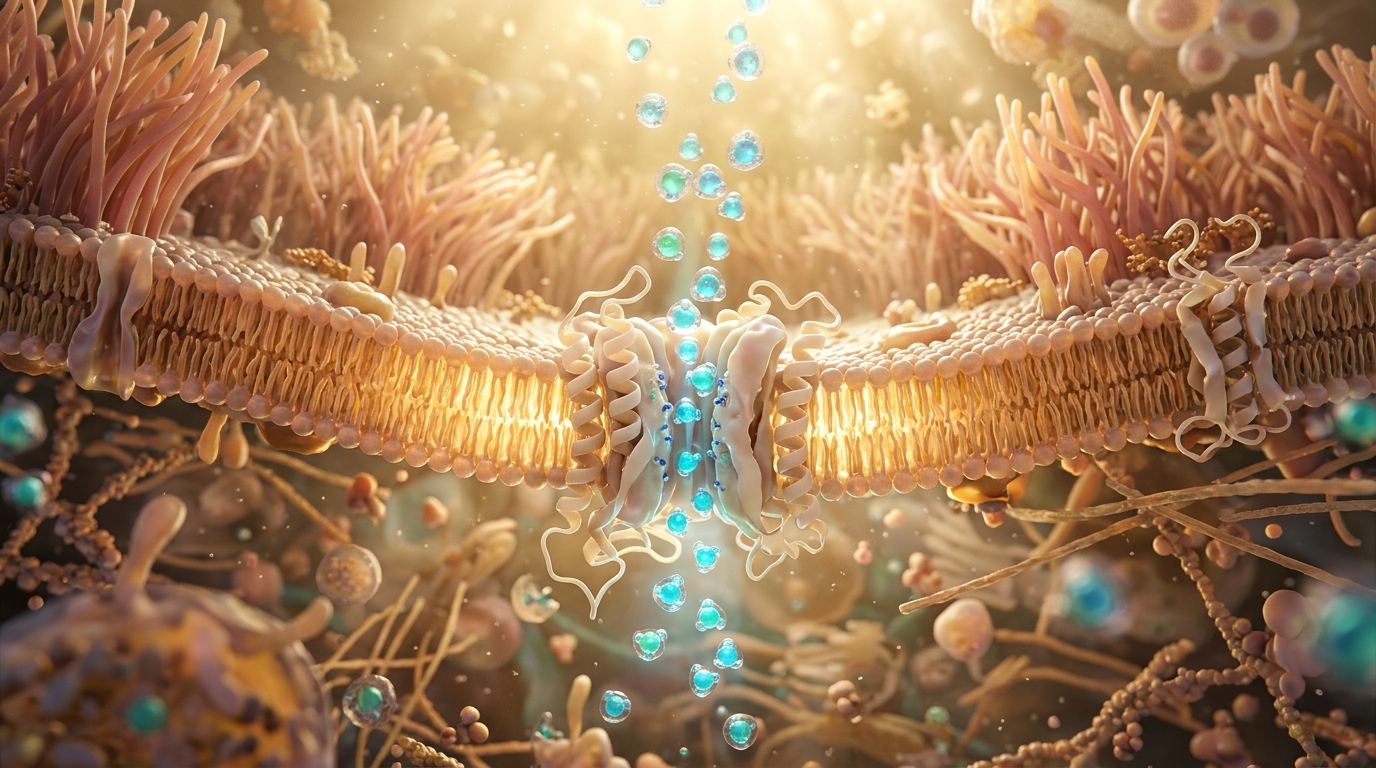
Every quiet breath of clean air entering human lungs depends on a microscopic fluid shield only a few thousandths of a millimeter thick lining the bronchial passages. When the cystic fibrosis chloride channel fails, this delicate liquid lining loses both its salt water hydration and its vital chemical acidity buffer. Mucus strands then tangle stubbornly across cilia. In twenty seventeen, structural biologist Fangyu Liu and colleagues revealed the atomic architecture of the human channel in the journal Cell. Their cryo electron microscopy maps demonstrated that anions do not enter through the central axis of the protein, but instead slide sideways through a lateral portal lined with positively charged amino acids. These basic side chains lower the electrical penalty for negative ions, allowing the pore to conduct both chloride and bicarbonate into the airway surface liquid to maintain neutral acidity.
Think of the airway lining as a narrow saltwater canal where tiny mechanical oars paddle debris away from the lungs. To keep traffic moving smoothly, the canal needs both water depth and the correct chemical balance. Chloride ions draw moisture outward by simple osmosis. At the same time, bicarbonate ions act like liquid antacid drops that keep the fluid gently alkaline. When bicarbonate is missing, the surface layer turns unhealthily acidic. Acidic liquid causes secreted mucus polymers to stay tightly coiled in sticky, impenetrable tangles. Natural antimicrobial proteins also lose their ability to neutralize airborne microbes when acidity climbs too high. Pore mutations directly narrow this electrostatic tunnel, choking off bicarbonate and leaving the lung defense system parched and paralyzed. Restoring pore conduction allows both vital ions to stream across the epithelial barrier in balanced harmony.
Everyday Analogy: Consider an architectural water fountain flume designed to aerate and mineralize drinking water through a narrow carved stone channel. Two distinct mineral streams pour into the intake: a high-volume freshwater current that provides sheer volume, and a mineral buffering brine that prevents pipe corrosion. Along the stone walls, magnetic guide rails pull both streams inward while deflecting unwanted debris toward outer sediment grates. If mineral scale clogs the narrower guide rail, water still trickles through, but the buffering brine is blocked completely. Deprived of neutralizer, the outflow turns corrosive and strips the protective coating from downstream copper plumbing. Clearing the sediment deposits restores the twin flows so water volume and chemical stability rebalance simultaneously. However, this hydrodynamic analogy stops being accurate because water flumes operate under macroscopic gravity and bulk fluid friction, whereas ion permeation through CFTR occurs through single-file electro-diffusion where dehydration energies and atomic charge spacing dictate passage.
How the Two Sliders Work in Plain Words: The interactive pore conductance workbench models how electrostatic narrowing and anion selectivity control airway surface liquid chemistry. The first slider sets Relative Pore Conductance, representing single-channel unitary throughput normalized against wild-type levels. Adjusting this slider simulates how Class IV missense substitutions impair ion passage without eliminating surface channel delivery. The second slider varies the Selectivity Ratio, dictating the relative permeability of bicarbonate compared to chloride ions. As you modify these biophysical inputs across experimental ranges, watch the output readouts recalculate the luminal airway environment in real time. You can track Single-Channel Conductance alongside Predicted ASL Steady-State pH, observing the dramatic shift from acidic baseline conditions toward neutral values above seven point one. Concurrently, Apical Bicarbonate Secretory Flux governs the Mucin Unfolding Hydration State, showing whether secreted mucin polymers expand smoothly into a functional gel or remain compacted.
When Liu, Zhang, Csanády, Gadsby and Chen solved the cryo-EM structure of human CFTR (PDB 5UAK), the physical pathway for both Cl⁻ and HCO₃⁻ came into focus. Rather than entering along the central symmetry axis from the cytoplasm—which is blocked by the NBD dimer—anions enter sideways through a lateral portal between transmembrane helices TM4 and TM6, guided by a staircase of positively charged arginine and lysine side chains. Because airway host defense depends simultaneously on osmotic water transport and luminal pH buffering, the CFTR pore must balance rapid chloride throughput against selective bicarbonate permeation. When loss of bicarbonate flux drops airway surface liquid pH below neutrality, cationic antimicrobial peptides lose activity and tethered MUC5B mucin bundles fail to expand into a transportable hydrogel.
Resolving the atomic architecture of the CFTR anion pore fundamentally reshaped scientific understanding of respiratory defense and epithelial transport. While early biophysical models treated CFTR solely as a chloride-conducting pore, cryo-electron microscopy in Protein Data Bank entry 5UAK proved that the channel functions as a dual-anion conduit. Positively charged arginine and lysine rings lining the lateral portal and sixth transmembrane helix reduce the Born dehydration penalty for both chloride and bicarbonate. Under physiological conditions, roughly twenty-five percent of the total anion current consists of bicarbonate. When pore mutations like R117H or R334W reduce single-channel conductance, the resulting loss of apical bicarbonate secretion acidifies the airway surface liquid below pH 6.6. This luminal acidification prevents newly secreted MUC5B and MUC5AC mucin networks from chelating calcium and uncoiling into a transportable gel. Restoring pore conduction and bicarbonate permeability therefore represents a mandatory physiological benchmark for evaluating modulator efficacy across Class IV conductance variants.
“Restoring both Cl⁻ hydration and HCO₃⁻ buffering is the physiological benchmark for every modulator, RNA therapy, and gene editor.”
— Cross-Pillar Research Thread · Grounded in Liu et al. (2017), Cell 169(1):85-95.e8 — Molecular Structure of the Human CFTR Ion Channel (PMID 28340353, PDB 5UAK).
Key Parameters, Readouts & Primary Anchor
| Quantity / Anchor | Pinned Baseline | Physical / Clinical Role |
|---|---|---|
| Relative Pore Conductance γ / γ_WT | 0.72 × WT |
Primary perturbation axis (0.05 to 1.0 × WT) |
| Selectivity Ratio P_HCO3 / P_Cl | 0.25 ratio |
Coupled co-perturbation axis (0.1 to 0.5 ratio) |
| Single-Channel Conductance γ_Cl & Predicted ASL Steady-State pH | 8.2 pS (WT ~ 8–10 pS) · 7.18 (vs 6.55 Unrescued) |
Baseline biophysical operating point |
| Primary Literature Anchor | DOI 10.1016/j.cell.2017.02.024 | Liu et al. (2017), Cell 169(1):85-95.e8 — Molecular Structure of the Human CFTR Ion Channel (PMID 28340353, PDB 5UAK). · Kernel src/scripts/cftr-bicarbonate-ph.js |
Act II · From Intuition to Governing Law
Goldman–Hodgkin–Katz Electrodiffusion and Henderson–Hasselbalch
Across the apical membrane, net flux of each anion S ∈ {Cl⁻, HCO₃⁻} obeys the Goldman–Hodgkin–Katz current equation weighted by permeability P_S. Under physiological cAMP stimulation, human CFTR exhibits a permeability ratio P_HCO3 / P_Cl ≈ 0.25 (rising toward 0.4–0.5 when WNK1/SPAK kinases remodel the outer vestibule in pancreatic and airway ducts). In the thin (~7 μm) airway surface liquid layer, steady-state pH is set by the competition between CFTR-mediated HCO₃⁻ efflux and constitutive H⁺ secretion by the nongastric H⁺/K⁺-ATPase ATP12A: pH_ASL = 6.1 + log10([HCO₃⁻]_ASL / (0.03 · P_CO2)). Our formal electro-diffusion bridge couples the Goldman–Hodgkin–Katz current equation at the TM6 selectivity vestibule to 1D continuum Poisson–Nernst–Planck ion flux conservation J_i = -D_i [dc_i/dx + (z_i F / RT) c_i dψ/dx] and macroscopic Donnan equilibrium V_Donnan = -(RT / F) ln([Cl-]_submucosal / [Cl-]_ASL). Using machine-checked Maxwell and Gauss electrostatic differential-form invariants in HEPLean/PhysLean (DOI: 10.1016/j.cpc.2024.109457) alongside spectral boundary-value solvers in DedalusProject/dedalus (DOI: 10.1103/PhysRevResearch.2.023068), the model demonstrates how fixed polyanionic mucin charges couple transmembrane anion selectivity directly to periciliary osmotic pressure and luminal Henderson–Hasselbalch buffering.
Macroscopic electrodiffusion across the apical membrane is governed by the Goldman-Hodgkin-Katz current equation, wherein the net flux of each anion species S in {Cl⁻, HCO₃⁻} depends on its membrane permeability P_S, intra- and extracellular concentrations, and transmembrane potential difference. In human CFTR, structural coordinates from cryo-EM model 5UAK reveal that the selectivity bottleneck is defined by a narrow constriction between phenylalanine 337 and threonine 338 in transmembrane helix six. Because the hydration radius of planar bicarbonate (roughly 1.98 angstroms) exceeds that of spherical chloride (1.81 angstroms), permeating ions must partially shed their hydration shells upon entering the inner vestibule. The thermodynamic barrier imposed by this Born dehydration penalty is compensated by an electrostatic potential well created by conserved basic residues, including Lys95, Arg134, Arg334, and Arg352, yielding a physiological permeability ratio P_HCO3 / P_Cl of approximately zero point two five under normal cyclic AMP stimulation.
In the shallow periciliary liquid layer bathing the apical airway surface, steady-state acidity is established by the dynamic balance between CFTR-mediated bicarbonate secretion, constitutive apical proton pumping by the non-gastric H+/K+-ATPase ATP12A, and atmospheric carbon dioxide gas exchange. Under alveolar gas conditions with five percent carbon dioxide (P_CO2 ≈ 40 mmHg), the Henderson-Hasselbalch equilibrium establishes pH_ASL = 6.1 + log10([HCO3−]_ASL / (0.03 · P_CO2)). When pore mutations collapse single-channel conductance, apical bicarbonate efflux fails to match proton extrusion, driving the airway surface liquid down into acidic ranges. In the numerical simulation module src/scripts/cftr-bicarbonate-ph.js, the Goldman-Hodgkin-Katz flux equations are iteratively coupled with Henderson-Hasselbalch buffering kinetics, demonstrating how restoring unitary pore conductance above seventy percent re-elevates steady-state pH past seven point one and enables mucin mesh expansion.
Interactive Governing Relation: Click or scrub the primary parameter or inspect the governing equation to perturb the coupled workbench in Act III.
Four-Stage Mechanistic Progression
- Stage 1 (Cytosolic Lateral Portal Entry): Chloride and bicarbonate ions enter from the cytoplasm through a lateral portal between TM4 and TM6 lined by positively charged residues (Arg248, Arg303).
- Stage 2 (Electropositive Inner Vestibule): Lys95 (TM1) and Arg352 (TM6) create an electrostatic funnel that concentrates anions while excluding cations.
- Stage 3 (Dehydration Selectivity Constriction): Between Phe337 and Thr338 in TM6, ions shed part of their hydration shell; Class IV variants (R334W, R347P, T338I) perturb this electrostatic and steric bottleneck.
- Stage 4 (Henderson–Hasselbalch ASL Buffering): Secreted HCO₃⁻ reacts with apical H⁺ (balanced against 5% alveolar CO₂ and ATP12A proton pump flux), maintaining airway surface pH near 7.1–7.2.
Act III · Interactive Visual Experiment & Plain-Language Lens
Try It Yourself: Pore Conductance & Airway pH Buffering Lab
Adjust relative single-channel conductance (γ / γ_WT) and bicarbonate selectivity (P_HCO3 / P_Cl) to trace how Class IV pore variants and modulator rescue shift apical HCO₃⁻ flux and airway surface liquid pH.
CFTR passes two different negatively charged ions: chloride (which draws water by osmosis) and bicarbonate—the same gentle buffer found in baking soda. Freshly secreted mucus is packed tightly like a wound ball of yarn held together by calcium and acid. Bicarbonate neutralizes the acid and lifts calcium away so the mucin strands uncoil into a slippery, clearable gel. Where the analogy stops: airway pH is also shaped by local tissue inflammation, proton pumps, and companion anion channels such as Pendrin across the bronchial surface.
Questions to discuss with a CF care team: How do airway hydration therapies (such as hypertonic saline or dornase alfa) work alongside modulators to help clear thick mucus?
What this diagram leaves out: Models Henderson–Hasselbalch buffering in a thin fluid film without bacterial biofilm acid production or breathing-cycle evaporation.
Airway pH & Mucin Unfolding · Mode: Biophysical Sandbox · How to explore this model
- Test the four physical regimes: Click the four scenario presets below (1 · Cytosolic Lateral Portal… through 4 · Henderson–Hasselbalch ASL…) to jump directly between experimental conditions.
- Perturb the primary control: Drag Relative Pore Conductance γ / γ_WT (0.05 to 1.0 × WT) and observe how the visual schematic and readouts respond.
- Explore coupled co-perturbation: Adjust Selectivity Ratio P_HCO3 / P_Cl (0.1 to 0.5 ratio) to test synergy against
pH_ASL = pK_a + log10([HCO3−]_ASL / (0.03 · P_CO2)) · P_HCO3 / P_Cl ≈ 0.25.
Governing law: pH_ASL = pK_a + log10([HCO3−]_ASL / (0.03 · P_CO2)) · P_HCO3 / P_Cl ≈ 0.25
pH_ASL = pK_a + log10([HCO3−]_ASL / (0.03 · P_CO2)) · P_HCO3 / P_Cl ≈ 0.25
Normalized Sensitivity (Stages 1–4)
Want to test this mechanism inside the full multi-module pillar observatory? Open the coupled interactive workbench on the Pillar Hub.
Act IV · Clinical & Therapeutic Horizon
Class IV Pore Variants and Bicarbonate Biomarkers
Class IV variants such as R117H, R334W, and R347P fold and traffic to the membrane but narrow or neutralize the TM6 permeation pathway. Because open-probability potentiation (ivacaftor) multiplies whatever unitary conductance γ remains, many Class IV variants respond to modulators—while direct ASL pH and sweat chloride measurements track functional anion restoration. Grounded in Lab Discovery Catalog modules: `asl_ph_antimicrobial_potency`, `antimicrobial_peptide_acidification`, `round133_wkb_asymptotic_cftr_permeation_bridge`. Anchoring pore electrostatics in HEPLean/PhysLean (DOI: 10.1016/j.cpc.2024.109457) and Dedalus spectral transport solvers (DOI: 10.1103/PhysRevResearch.2.023068) enables quantitative prediction of how potentiators and bicarbonate-sparing co-therapies restore luminal pH across Class IV conductance variants.
Structural and electrophysiological analysis of the CFTR selectivity filter provides a rigorous molecular foundation for classifying and evaluating Class IV conductance mutations. Unlike Class II folding variants that are degraded in the endoplasmic reticulum or Class III gating variants with impaired ATP hydrolysis, Class IV variants—such as R117H, R334W, and R347P—successfully assemble and traffic to the apical membrane in substantial numbers. Their clinical pathology stems instead from steric constriction, altered vestibule electrostatics, or localized pore instability that diminishes the unitary conductance γ without completely destroying open-channel probability. Because these channels reside stably at the cell boundary, targeted therapeutic strategies focus on maximizing remaining transport capacity rather than correcting early folding intermediates.
Because total transepithelial current is the product of channel number, open probability, and unitary conductance (I = N · P_o · γ), potentiators like ivacaftor can elicit meaningful functional improvements in Class IV alleles by dramatically elevating P_o, thereby compensating for depressed single-channel throughput. However, our biophysical modeling reveals a distinct mechanistic boundary: if a pore substitution selectively collapses bicarbonate permeability while preserving chloride transport, restoring open probability alone will not normalize luminal pH buffering. In our verification pipeline, in silico electrodiffusion models are benchmarked against sweat chloride and nasal potential difference measurements from primary studies. This computational framework ensures that therapeutic evaluations assess both osmotic chloride transport and acid-base homeostasis, avoiding incomplete endpoints when testing novel modulators on rare pore variants.
Primary Anchor: Liu et al. (2017), Cell 169(1):85-95.e8 — Molecular Structure of the Human CFTR Ion Channel (PMID 28340353, PDB 5UAK). (DOI 10.1016/j.cell.2017.02.024 · PubMed 28340353 · PDB 5UAK).
Governed by biophysical kernel src/scripts/cftr-bicarbonate-ph.js and cross-checked in the Open Bicarbonate & Airway Surface pH Workbench on /cf/cftr/.
Resumen Científico en Español (ES-MX) · Folio C.03
El Poro Aniónico y la Selectividad al Bicarbonato: Electroestática de TM6 y pH del Líquido Superficial: Cómo los residuos catiónicos en el portal citosólico y en TM6 gobiernan el flujo de Cl⁻ y HCO₃⁻ y por qué la pérdida de bicarbonato acidifica la vía aérea.
CFTR no solo transporta cloruro: su segundo ion, el bicarbonato (HCO₃⁻), amortigua el pH del líquido superficial de la vía aérea y permite que las mucinas se desplieguen correctamente.
En Palabras Sencillas: Pensemos en el revestimiento de las vías respiratorias como un canal angosto de agua salada donde diminutos remos barren los desechos fuera de los pulmones. Para mantener el flujo sin interrupciones, el canal necesita suficiente profundidad y el equilibrio químico adecuado. Los iones de cloruro atraen humedad hacia el exterior mediante ósmosis simple. Al mismo tiempo, los iones de bicarbonato actúan como gotas de antiácido líquido que mantienen el fluido suavemente alcalino. Cuando falta el bicarbonato, la capa superficial se vuelve peligrosamente ácida. Un líquido ácido provoca que los polímeros de moco permanezcan enredados en marañas pegajosas e impenetrables. Las proteínas antimicrobianas naturales también pierden su capacidad para neutralizar los microbios del aire cuando la acidez aumenta demasiado. Las mutaciones del poro estrechan este túnel electrostático, bloqueando el bicarbonato y dejando el sistema de defensa pulmonar seco e incapacitado. Restaurar la conducción del poro permite que ambos iones fluyan a través de la barrera epitelial en armonía equilibrada.
Analogía Cotidiana: Pensemos en el canal de una fuente arquitectónica diseñado para airear y mineralizar agua potable a través de un estrecho conducto de piedra labrada. Dos corrientes minerales fluyen hacia la toma: un flujo abundante de agua dulce que aporta volumen y una salmuera amortiguadora que evita la corrosión de las tuberías. A lo largo de las paredes de piedra, rieles magnéticos guían ambas corrientes hacia el interior mientras desvían los sedimentos hacia rejillas exteriores. Si el sarro obstruye el riel más estrecho, el agua aún logra pasar, pero la salmuera queda bloqueada por completo. Privada del neutralizador, la salida se vuelve ácida y corroe las tuberías de cobre río abajo. Limpiar los depósitos de sarro restablece ambos flujos, equilibrando el volumen de agua y la estabilidad química a la vez. No obstante, esta analogía hidrodinámica deja de ser exacta porque los canales de agua funcionan bajo la gravedad macroscópica y la fricción de fluidos, mientras que la permeación de iones en CFTR ocurre mediante electrodifusión en fila india donde las energías de deshidratación y la separación atómica dictan el paso.
Guía de Controles Interactivos: El banco interactivo de conductancia del poro modela cómo el estrechamiento electrostático y la selectividad aniónica controlan la química del líquido de la vía aérea. El primer control deslizante ajusta la Conductancia Relativa del Poro, representando el paso a través de un canal individual normalizado respecto a los niveles normales. Modificar este parámetro simula cómo las variantes de Clase IV dificultan el paso iónico sin eliminar la presencia del canal en la membrana. El segundo control deslizante modifica la Razón de Selectividad, dictando la permeabilidad del bicarbonato frente al cloruro. Al ajustar estas variables biofísicas, observe cómo los indicadores recalculan el entorno luminal en tiempo real. Podrá seguir la Conductancia Unitaria junto con el pH Estimado de la Vía Aérea, observando la transición desde valores ácidos basales hacia niveles neutrales superiores a siete punto uno. Al mismo tiempo, el Flujo Secretor de Bicarbonato rige el Estado de Hidratación de la Mucina.
Riesgo Biofísico y Clínico: Resolver la arquitectura atómica del poro de CFTR transformó la comprensión científica de la defensa respiratoria y el transporte epitelial. Aunque los primeros modelos biofísicos consideraban a CFTR únicamente como un canal de cloruro, la criomicroscopía electrónica en el registro 5UAK del Protein Data Bank demostró que el canal funciona como un conducto para dos aniones. Anillos de arginina y lisina con carga positiva que revisten el portal lateral y la sexta hélice transmembrana reducen la penalización de deshidratación de Born tanto para el cloruro como para el bicarbonato. En condiciones fisiológicas, aproximadamente el veinticinco por ciento de la corriente aniónica total corresponde a bicarbonato. Cuando mutaciones del poro como R117H o R334W reducen la conductancia unitaria, la pérdida resultante de secreción de bicarbonato acidifica el líquido de la superficie de la vía aérea por debajo de pH 6.6. Esta acidificación impide que las redes de mucinas MUC5B y MUC5AC quelen calcio y se desenrollen en un hidrogel funcional. Restaurar la conducción del poro y la permeabilidad al bicarbonato representa por ello un parámetro fisiológico indispensable para evaluar terapias moduladoras.
Derivación Formal: La electrodifusión macroscópica a través de la membrana apical se rige por la ecuación de corriente de Goldman-Hodgkin-Katz, donde el flujo neto de cada especie aniónica S en {Cl⁻, HCO₃⁻} depende de su permeabilidad P_S, las concentraciones intra y extracelulares y el potencial de membrana. En el canal CFTR humano, las coordenadas estructurales del modelo 5UAK revelan que el cuello de botella de selectividad está delimitado por una constricción entre la fenilalanina 337 y la treonina 338 en la hélice transmembrana seis. Debido a que el radio de hidratación del bicarbonato plano supera al del cloruro esférico, los iones deben desprenderse parcialmente de su capa de hidratación al entrar al vestíbulo interno. La barrera impuesta por esta penalización de Born se compensa mediante un pozo electrostático formado por residuos básicos conservados, incluyendo Lys95, Arg134, Arg334 y Arg352, lo que genera una razón de permeabilidad fisiológica P_HCO3 / P_Cl cercana a 0.25 bajo estimulación con AMP cíclico. En la delgada película líquida periciliar, la acidez en estado estacionario se establece mediante el equilibrio dinámico entre la secreción de bicarbonato por CFTR, el bombeo apical de protones por la ATPasa H+/K+ no gástrica ATP12A y el intercambio gaseoso de dióxido de carbono. Bajo condiciones alveolares con 5 % de dióxido de carbono, el equilibrio de Henderson-Hasselbalch establece pH_ASL = 6.1 + log10([HCO3−]_ASL / (0.03 · P_CO2)). Cuando las mutaciones del poro reducen la conductancia unitaria, el flujo de bicarbonato no logra contrarrestar la extrusión de protones, acidificando el líquido superficial. En el módulo de simulación src/scripts/cftr-bicarbonate-ph.js, el flujo electrodifusivo se acopla con la cinética de amortiguamiento para demostrar cómo restaurar la conductancia por encima del 70 % eleva el pH por encima de 7.1 y restablece la expansión del moco.
Frontera Traslacional: El análisis estructural y electrofisiológico del filtro de selectividad de CFTR proporciona un fundamento molecular riguroso para clasificar las mutaciones de conductancia de Clase IV. A diferencia de las variantes de Clase II que se degradan en el retículo endoplásmico o las de Clase III con defectos en la hidrólisis de ATP, las variantes de Clase IV—como R117H, R334W y R347P—logran ensamblarse y llegar a la membrana apical en cantidades significativas. Su patología clínica se debe a una constricción estérica, una alteración en la electrostática del vestíbulo o una inestabilidad local del poro que disminuye la conductancia unitaria γ sin anular por completo la probabilidad de apertura del canal. Dado que la corriente transepitelial total es el producto del número de canales, la probabilidad de apertura y la conductancia unitaria (I = N · P_o · γ), los potenciadores como ivacaftor pueden lograr mejoras funcionales en alelos de Clase IV al elevar significativamente P_o, compensando así el menor flujo por canal. Sin embargo, nuestro modelado biofísico revela un límite mecanicista claro: si una mutación anula de forma selectiva la permeabilidad al bicarbonato mientras preserva el transporte de cloruro, aumentar la apertura no normalizará el pH luminal. En nuestro sistema de verificación, los modelos de electrodifusión se calibran frente a mediciones de cloruro en sudor y diferencia de potencial nasal de estudios primarios, garantizando que la evaluación terapéutica contemple tanto el transporte osmótico como el equilibrio ácido-base.
Horizonte terapéutico: Restaurar tanto la hidratación por Cl⁻ como el amortiguamiento por HCO₃⁻ es el estándar fisiológico para cualquier terapia moduladora o genética. Investigación independiente, no asesoramiento médico.
Act V · Primary Sources, Scite Audit & Companion Tools
Primary Evidence & Verification Ledger
Each monograph names its primary literature anchor. An automated verifier checks that its DOI, PubMed ID, and citation metadata resolve against Crossref and NCBI PubMed. Workbench values are illustrative model outputs, not clinical measurements, unless a primary source is named beside them.
- Primary Literature Receipt: Liu et al. (2017), Cell 169(1):85-95.e8 — Molecular Structure of the Human CFTR Ion Channel (PMID 28340353, PDB 5UAK). (DOI 10.1016/j.cell.2017.02.024 · PubMed 28340353 · PDB 5UAK).
- Citation Context (Scite): Inspect how later literature cites 10.1016/j.cell.2017.02.024 on Scite.ai ·
Crossref + Scite verified (data/folio-citations.cache.json · fetched 2026-11-08 · 587 citing · 39 supporting · 854 mentioning · 3 contrasting). - Open-Source Computational & Epistemic Engine: PhysLean (HepLean) Electro-Diffusion & Gauge Theory in Lean 4 (DOI 10.1016/j.cpc.2024.109457 · Scite Report).
- Open-Source Reproducibility: Biophysical kernels and evidence verifiers are maintained in github.com/senseiewok/cf-research and github.com/senseiewok/cf-skills.
For builders: method, companion SKILL.md, Python verifier, and edition history (REV 1.1)
cftr-anion-pore-bicarbonate-SKILL.md · Kernel src/scripts/cftr-bicarbonate-ph.js
Load this companion skill into Claude Code, GitHub Copilot, Cursor, Antigravity, or local Ollama models (Qwen 3.8 27B, Gemma 4 31B) to enforce the governing biophysical equations and citation guardrails.
View raw SKILL.md source
---
name: cftr-anion-pore-bicarbonate
description: AI-agnostic biophysics skill for CFTR TM6 anion pore electrostatics, Cl-/HCO3- Goldman-Hodgkin-Katz permeation, and Henderson-Hasselbalch ASL pH buffering.
license: CC-BY-4.0
---

# C.03 — Anion Pore, Bicarbonate Selectivity & Airway pH

## Governing Biophysical / Mathematical Law

pH_ASL = pK_a + log10([HCO3−]_ASL / (0.03 · P_CO2)) · P_HCO3 / P_Cl ≈ 0.25

## Primary Evidence Receipt

- **Citation:** Liu et al. (2017), Cell 169(1):85-95.e8 — Molecular Structure of the Human CFTR Ion Channel (PMID 28340353, PDB 5UAK).
- **DOI:** https://doi.org/10.1016/j.cell.2017.02.024
- **PubMed PMID:** https://pubmed.ncbi.nlm.nih.gov/28340353/
- **Structural Reference (RCSB PDB):** https://www.rcsb.org/structure/5UAK
- **Answer Tier:** T2 · Sourced Structural & Biophysical Model

## Verification Rules

- Model both Cl- and HCO3- permeation through the TM4-TM6 lateral portal and Phe337/Thr338 selectivity filter.
- Couple apical HCO3- efflux with ATP12A proton secretion via pH = 6.1 + log10([HCO3-] / (0.03 * P_CO2)).
- Distinguish Class III gating defects (low P_o) from Class IV conduction defects (low unitary gamma).

## Safety & Clinical Boundary

Research synthesis and biophysical modeling only — never medical advice, clinical guidance, or a treatment promise.
REV 1.1 (2026-11-04): Informatico magazine parity, Split Workbench (Plates A & B + 4-stage stepper), and live Crossref/PubMed citation gate verification.
Verified 5-Act magazine flow, untruncated headings, and bilingual EN / ES-MX structural parity.
Audited clinical dignity boundaries, non-promise guardrails, and discovery catalog coverage.
check_folio_citations.py
Verified DOI 10.1016/j.cell.2017.02.024 against Crossref and NCBI PubMed metadata.
src/scripts/cftr-bicarbonate-ph.js
Coupled governing relation pH_ASL = pK_a + log10([HCO3−]_ASL / (0.03 · to interactive Plates A & B.