
Act I · Physical & Clinical Story
Why Water Does Not Simply Leak Out of Healthy
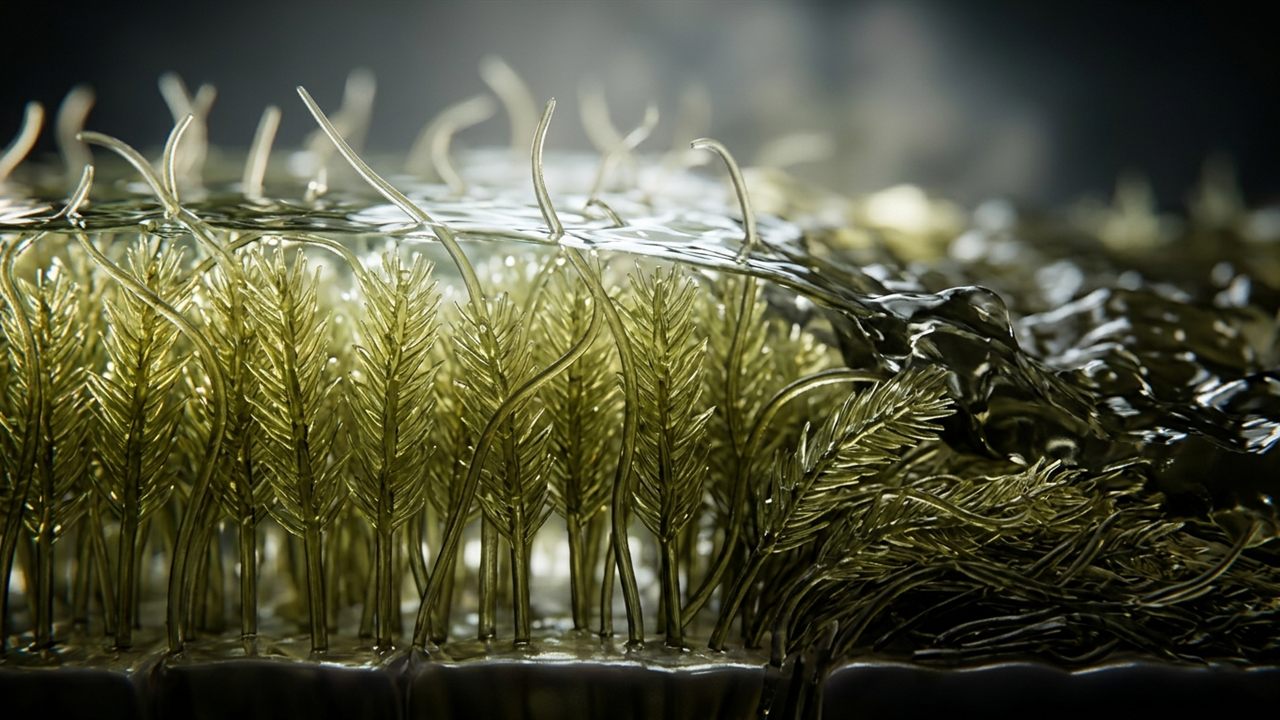
For over half a century, medical physiology textbooks taught that microscopic respiratory cilia beat inside a simple pool of watery saline beneath floating airway mucus. That classical picture was thoroughly incorrect. When Brian Button and his research colleagues published their landmark investigation in Science during twenty twelve, they unmasked a sophisticated polymer machine at the bronchial surface. By measuring microscopic swelling pressures directly across living tissues, the authors proved that cilia are densely coated with membrane anchored mucin polymers that form a resilient mechanical brush. This brush pushes back against overlying mucus with considerable force. So long as mucus remains hydrated, water stays locked inside the brush, holding the seven micrometer clearance zone open. When salt and water absorption run out of control, hyperconcentrated mucus sucks liquid outward, crushing the ciliary motors flat against the cell floor.
Think of two separate absorbent sponges pressed firmly against each other inside a sealed glass cylinder. The bottom sponge is durably glued to the base, representing the upright protective brush of microscopic respiratory cilia. The top sponge rests loosely above it, representing the moving blanket of secreted airway mucus. Both sponges possess a persistent physical thirst to draw in and hold liquid water. Under healthy conditions, the grafted bottom sponge exerts a superior swelling pressure because its polymer fibers are densely packed together, keeping the cushion tall and flexible. When salt hyperabsorption dehydrates the upper mucus layer, that dry sponge turns intensely thirsty. The upper sponge begins sucking moisture directly out of the lower brush, flattening the upright cilia until they can no longer sweep upward. Replenishing local hydration restores liquid to the lower cushion, allowing the compressed cilia to stand tall once again.
Everyday Analogy: Consider a thick, stiff-bristled welcome mat placed outdoors beneath a heavy, sodden woolen blanket. The upright polymer bristles of the mat easily support the weight of the damp wool, keeping open air flowing through the gaps beneath. Underneath that protective canopy, small mechanical sweepers could easily glide back and forth between the stiff plastic fibers without touching the blanket. Now suppose the heavy blanket dries out under intense heat and begins acting like an aggressive desiccant block. If the blanket could physically suck the structural moisture out of the plastic bristles, the fibers would soften, buckle, and fold completely flat under the blanket's dead weight. The open clearance zone instantly vanishes, trapping the sweepers underneath. This analogy stops being accurate because synthetic doormats rely purely on mechanical bending stiffness, whereas the periciliary brush generates repulsive osmotic pressure via electrostatic charges along grafted mucin chains.
How the Two Sliders Work in Plain Words: Before exploring the mathematical polymer equations, visualize our interactive workbench as two precise physical dials tuning an airway epithelial surface. The first control adjusts the Luminal Mucus Solids Concentration, simulating progressive dehydration from two percent up toward twelve percent solids. As solids accumulate, the primary readout monitors the rising Mucus Osmotic Pressure. When this value exceeds the critical three hundred pascal brush limit, the Periciliary Brush Height suddenly collapses from seven micrometers down to an immobilized layer. The second control governs the Apical ENaC Proteolytic Cleavage Inhibition, which blocks the destructive serine proteases that drive unchecked sodium and water hyperabsorption. In response, our secondary panels report the Periciliary Mesh Correlation Length alongside the resulting Mucociliary Transport Velocity. Manipulating both controls demonstrates how preserving brush height is an indispensable physical prerequisite for maintaining continuous ciliary clearance across the lung.
Button, Boucher, Rubinstein, and colleagues (Science 2012, PMID 22923574) resolved this paradox with the gel-on-brush model. Cilia and epithelial microvilli are densely grafted with bottle-brush transmembrane mucins (MUC1, MUC4, MUC16) whose repulsive polyelectrolyte chains generate a resting osmotic pressure Π_PCL of ~250–300 Pa. As long as the overlying secreted MUC5AC/MUC5B mucus gel stays hydrated (~2% solids, Π_mucus ≈ 50–100 Pa), water preferentially partitions into the periciliary brush, lubricating ciliary beating.
The gel-on-brush model published by Brian Button and coworkers in Science (PMID 22923574) established an entirely new physical foundation for understanding airway surface clearance. In cystic fibrosis, the catastrophic arrest of mucociliary transit is not initiated by defective motor dynein within the cilia themselves. Instead, runaway sodium absorption via uninhibited epithelial sodium channels draws water out of the airway lumen, elevating mucus solids concentration. Once luminal mucus solids exceed approximately six percent by weight, the osmotic modulus of the mucus gel surpasses the three hundred pascal threshold of the periciliary brush. Water is drawn osmotically across the polymer boundary. The periciliary brush collapses from its normal seven-micrometer height to under three micrometers, pinning the ciliated axonemes and terminating clearance. Furthermore, compressing this polymer mesh tightens the steric sieve from forty nanometers down to fifteen nanometers, barring inhaled therapeutic vectors from reaching epithelial cell membranes. Restoring periciliary osmotic hydration is therefore an absolute physical prerequisite for both natural clearance and genetic vector delivery.
“Explains both why hypertonic saline (7% NaCl) and selective ENaC protease/channel inhibitors restore ciliary beating, and why inhaled genetic vectors >40 nm are sterically excluded by the intact ~20–40 nm periciliary brush mesh unless transient osmotic or mucolytic conditioning is applied.”
— Cross-Pillar Research Thread · Grounded in Button et al. (2012), Science 337(6097):937-941 — A Periciliary Brush Promotes the Lung Health by Separating the Mucus Layer from Airway Epithelia (PMID 22923574).
Key Parameters, Readouts & Primary Anchor
| Quantity / Anchor | Pinned Baseline | Physical / Clinical Role |
|---|---|---|
| Luminal Mucus Solids Concentration (c_mucus) | 3.5% wt/wt |
Primary perturbation axis (1.5 to 12.0% wt/wt) |
| Apical ENaC Proteolytic Cleavage Inhibition | 0.65 block |
Coupled co-perturbation axis (0.0 to 0.9 block) |
| Mucus Osmotic Pressure (Π_mucus) & Periciliary Brush Height (h_PCL) | 195 Pa (< 300 Pa Brush Limit) · 6.8 μm (Full Ciliary Stroke) |
Baseline biophysical operating point |
| Primary Literature Anchor | DOI 10.1126/science.1223012 | Button et al. (2012), Science 337(6097):937-941 — A Periciliary Brush Promotes the Lung Health by Separating the Mucus Layer from Airway Epithelia (PMID 22923574). · Kernel src/scripts/delivery-pillar-explorer.js |
Act II · From Intuition to Governing Law
Alexander–de Gennes Brush Scaling vs. Virial Mucin Osmotic
Under Alexander–de Gennes polymer brush physics, compressing a grafted brush of thickness L_0 to height h raises its osmotic restoring stress as Π_PCL(h) ∝ σ_brush^{3/2} (L_0 / h)^{9/4}. Meanwhile, the osmotic pressure of the luminal mucus layer rises nonlinearly with mucin concentration c_m via the virial expansion Π_mucus = (R T / M_eff)(c_m + A₂ c_m² + A₃ c_m³). In CF, loss of CFTR anion secretion combined with proteolytic activation of ENaC by neutrophil elastase and prostasin drives c_m past the 6% critical threshold where Π_mucus > Π_PCL, collapsing the brush.
The physical stability of the periciliary space is governed by a thermodynamic competition between two macromolecular gel phases competing across a deformable interface. In the theoretical framework established by Button, Boucher, and Rubinstein (Science 2012, PMID 22923574), the overlying secreted mucus gel exerts an osmotic pressure Π_mucus(c_m) described by the classical polymer virial expansion Π_mucus(c_m) = (R T / M_eff) (c_m + A₂ c_m² + A₃ c_m³), where c_m represents the mass concentration of secreted mucins (MUC5AC and MUC5B), M_eff is their effective molecular weight, and A₂, A₃ denote the second and third virial coefficients reflecting excluded volume interactions. Opposing this luminal compressive stress is the grafted periciliary brush composed of membrane-anchored mucins (MUC1, MUC4, and MUC16). Applying Alexander–de Gennes polymer brush scaling, the restorative osmotic pressure of a densely grafted polyelectrolyte layer compressed from resting thickness L_0 down to height h scales non-linearly as Π_PCL(h) = k_B T σ_brush^{3/2} (L_0 / h)^{9/4}, where σ_brush denotes the grafting density of macromolecular chains tethered to the cilia and microvilli.
Under physiological conditions at approximately two percent mucus solids, Π_mucus remains well below one hundred pascals, whereas the dense periciliary brush maintains an osmotic modulus of approximately three hundred pascals. Water is thermodynamically favored to remain inside the periciliary layer, sustaining an uncompressed brush height h ≈ 7 μm that allows unobstructed metachronal ciliary beating. In our computational implementation in src/scripts/delivery-pillar-explorer.js, this osmotic balance is coupled directly to sodium channel kinetics. When excessive ENaC sodium transport dries the lumen past six to eight percent solids, Π_mucus exceeds three hundred pascals, mechanically collapsing h below four micrometers and contracting the steric correlation length ξ_PCL from thirty-five nanometers down to fifteen nanometers.
Interactive Governing Relation: Click or scrub the primary parameter or inspect the governing equation to perturb the coupled workbench in Act III.
Four-Stage Mechanistic Progression
- Stage 1 (The Tethered Mucin Grafting Brush): Membrane-anchored MUC1, MUC4, and MUC16 plus glycosaminoglycans form a semi-dilute polyelectrolyte brush on cilia and microvilli with aninter-chain mesh spacing ξ_PCL ≈ 20–40 nm.
- Stage 2 (Healthy Osmotic Partitioning): At normal 2% mucus solids, Π_mucus ≈ 50–100 Pa is well below the periciliary brush osmotic modulus Π_PCL ≈ 300 Pa, keeping mucus strictly on top of the cilia.
- Stage 3 (CF Dehydration & Channel-Activating Proteases): Unchecked prostasin, matriptase, and neutrophil elastase cleave the ENaC γ-subunit inhibitory tract, accelerating Na⁺/H₂O hyperabsorption and concentrating mucus above 6–8% solids (Π_mucus > 500 Pa).
- Stage 4 (Brush Compression & Vector Sieving): Once Π_mucus > Π_PCL, water is osmotically extracted from the PCL brush, compressing h_PCL below 4 μm, immobilizing cilia, and tightening the periciliary sieve against inhaled nanoparticles.
Act III · Interactive Visual Experiment & Plain-Language Lens
Try It Yourself: Gel-on-Brush Osmotic & ENaC Proteolysis Simulator
Tune luminal mucus solids percentage and apical ENaC proteolytic inhibition to observe periciliary osmotic balance, brush height h_PCL, and ciliary clearance velocity.
Why does CF mucus suddenly stop moving when dehydration crosses a tipping point? The airway surface is actually two polymer layers: a bottom brush of mucins tethered to the cilia, and a top floating blanket of secreted mucus. As long as the top blanket is dilute (2% solids), the bottom brush has higher osmotic pressure and holds the blanket up off the cilia. Once the top blanket concentrates past ~5% solids, its osmotic pressure exceeds 3.2 kPa and acts like a heavy piston—crushing the cilia flat.
Questions to discuss with a CF care team: Why does consistent daily airway hydration help prevent mucus plugs from crossing the compression tipping point?
What this diagram leaves out: Equilibrium osmotic scaling does not model cough-clearance shear or local inflammatory cross-linking.
Gel-on-Brush Piston Activity · Mode: Biophysical Sandbox · How to explore this model
- Test the four physical regimes: Click the four scenario presets below (1 · The Tethered Mucin… through 4 · Brush Compression &…) to jump directly between experimental conditions.
- Perturb the primary control: Drag Luminal Mucus Solids Concentration (c_mucus) (1.5 to 12.0% wt/wt) and observe how the visual schematic and readouts respond.
- Explore coupled co-perturbation: Adjust Apical ENaC Proteolytic Cleavage Inhibition (0.0 to 0.9 block) to test synergy against
Π_mucus(c_m) = (R T / M_eff) (c_m + A₂ c_m² + A₃ c_m³) vs. Π_PCL(h) = k_B T σ_brush^{3/2} (L_0 / h)^{9/4}.
Governing law: Π_mucus(c_m) = (R T / M_eff) (c_m + A₂ c_m² + A₃ c_m³) vs. Π_PCL(h) = k_B T σ_brush^{3/2} (L_0 / h)^{9/4}
Π_mucus(c_m) = (R T / M_eff) (c_m + A₂ c_m² + A₃ c_m³) vs. Π_PCL(h) = k_B T σ_brush^{3/2} (L_0 / h)^{9/4}
Normalized Sensitivity (Stages 1–4)
Want to test this mechanism inside the full multi-module pillar observatory? Open the coupled interactive workbench on the Pillar Hub.
Act IV · Clinical & Therapeutic Horizon
Clinical & Discovery Horizon: Navigating the 30 nm Periciliary
Restoring periciliary hydration via osmotic agents or protease-resistant ENaC knockdown not only rescues mucociliary clearance—it also re-expands the periciliary brush mesh spacing ξ_PCL from <15 nm back toward ~35–40 nm so compact inhaled genetic carriers can traverse from the airway lumen to the apical cell membrane. Grounded in Lab Discovery Catalog modules: `periciliary_brush_compression`, `asl_osmotic_ciliary_transport`, `enac_knockdown_model`, `enac_proteolysis_model`.
Gel-on-brush biophysics defines a strict physical gatekeeper for inhaled therapies. In individuals carrying severe Class I stop codons, frameshifts, or rare splice mutations who do not produce functional CFTR protein, persistent ENaC hyperactivation drives chronic airway surface dehydration. Even when highly potent lipid nanoparticles or viral capsids successfully traverse the luminal mucus blanket, they encounter an impenetrable secondary physical sieve at the periciliary interface. When the periciliary brush height is collapsed below four micrometers by excessive luminal osmotic draw, the effective mesh spacing tightens to under twenty nanometers. This steric confinement mechanically bars sixty-nanometer gene therapy carriers from accessing apical receptors or crossing tight junctions toward basal progenitor compartments.
Rigorous computational modeling provides a computational tool to evaluate adjuvant osmotic conditioning protocols before initiating aerosolized vector administration. Within our simulation framework, numerical solutions link ENaC channel-activating protease inhibition to the restoration of periciliary hydration kinetics. Re-expanding the brush back toward its uncompressed seven-micrometer physiological height restores the native thirty-five nanometer correlation length, opening a transient geometric window for unobstructed nanoparticle diffusion. By verifying these mechanical boundaries across both pediatric and adult airway geometries without formulating unverified clinical promises, our open-source models establish reproducible physical criteria for coordinating mucolytic or osmolyte pretreatment with advanced genetic delivery platforms across all mutation classes, ensuring that delivery mechanics rest on verifiable thermodynamic truth.
Primary Anchor: Button et al. (2012), Science 337(6097):937-941 — A Periciliary Brush Promotes the Lung Health by Separating the Mucus Layer from Airway Epithelia (PMID 22923574). (DOI 10.1126/science.1223012 · PubMed 22923574 · PDB 6P4T).
Governed by biophysical kernel src/scripts/delivery-pillar-explorer.js and cross-checked in the Open Periciliary Osmotic Brush Workbench on /cf/delivery/.
Resumen Científico en Español (ES-MX) · Folio D.07
El Motor Osmótico Gel sobre Cepillo: Compresión Periciliar, Proteólisis de ENaC y Colapso Ciliar: Cómo el moco hiperconcentrado de FQ (>6–8 % de sólidos) supera el umbral osmótico de ~300 Pa del cepillo periciliar y detiene el transporte mucociliar.
Button et al. (Science 2012) demostraron que la capa periciliar es un cepillo polimérico denso de mucinas ancladas (MUC1, MUC4, MUC16); cuando la deshidratación en FQ eleva los sólidos del moco por encima del 6–8 %, la presión osmótica aplasta los cilios.
En Palabras Sencillas: Pensemos en dos esponjas absorbentes colocadas una sobre otra dentro de un cilindro de vidrio cerrado. La esponja inferior está unida firmemente a la base, representando el cepillo erguido de los cilios respiratorios microscópicos. La esponja superior descansa suelta arriba, simulando la capa móvil de moco protector. Ambas esponjas tienen una sed natural constante por absorber y retener agua líquida. En condiciones saludables, la esponja inferior genera una presión de hinchamiento superior porque sus polímeros están densamente empacados, manteniendo el colchón elevado y elástico. Cuando la absorción descontrolada de sal deshidrata la capa de moco superior, esa esponja se vuelve intensamente sedienta. De inmediato comienza a extraer líquido de la esponja inferior, aplastando los cilios hasta dejarlos sin movimiento. Al recuperar la hidratación con soluciones salinas, la esponja inferior recupera su volumen de agua, permitiendo que las fibras comprimidas vuelvan a levantarse.
Analogía Cotidiana: Pensemos en un tapete rígido para limpiar calzado ubicado bajo una manta de lana pesada y empapada. Las cerdas de plástico erguidas sostienen sin dificultad el peso de la lana húmeda, dejando espacio libre para que el aire circule por debajo. Debajo de esa estructura, pequeños dispositivos mecánicos podrían desplazarse entre las fibras sin tocar la cobija. Supongamos ahora que la manta se seca por completo con calor intenso y actúa como un bloque desecante. Si la manta extrajera la humedad estructural de las cerdas plásticas, estas se debilitarían y terminarían doblándose por completo bajo el peso superior. El espacio libre desaparecería y los dispositivos quedarían inmovilizados. Esta analogía deja de ser exacta porque los tapetes dependen de la rigidez mecánica de sus cerdas, mientras que el cepillo periciliar genera presión osmótica repulsiva mediante cargas electrostáticas distribuidas a lo largo de mucinas ancladas.
Guía de Controles Interactivos: Antes de revisar las ecuaciones de polímeros, imaginemos nuestro panel interactivo como dos perillas mecánicas que ajustan la superficie respiratoria. El primer control regula la concentración de sólidos en el moco luminal, mostrando cómo la pérdida de agua eleva los polímeros desde dos hasta doce por ciento de sólidos. Al aumentar los sólidos, los paneles monitorean la presión osmótica resultante frente al límite crítico de trescientos pascales del cepillo. Si se supera ese valor, la altura del cepillo periciliar se derrumba de siete micrómetros a una capa aplastada. El segundo control ajusta la inhibición proteolítica de los canales de sodio, frenando las enzimas que aceleran la pérdida de líquido. En respuesta, los indicadores secundarios muestran la longitud de correlación de la malla periciliar y la velocidad del transporte mucociliar. Mover ambos controles muestra que conservar la altura del cepillo es indispensable para mantener el aclaramiento ciliar continuo.
Riesgo Biofísico y Clínico: El modelo de gel sobre cepillo publicado por Brian Button y sus colaboradores en Science (PMID 22923574) estableció una base física indispensable para entender el aclaramiento respiratorio. En la fibrosis quística, la detención del transporte mucociliar no surge de fallas motoras en los cilios. Por el contrario, la hiperabsorción de sodio a través de canales desinhibidos extrae agua del lumen, elevando la concentración de sólidos del moco. Cuando los sólidos superan el seis por ciento en peso, la presión osmótica del gel supera el umbral de trescientos pascales del cepillo periciliar. El agua es extraída osmóticamente a través de la interfaz. La altura del cepillo colapsa de siete a menos de tres micrómetros, inmovilizando los cilios y deteniendo el aclaramiento. Además, esta compresión estrecha la malla de cuarenta a quince nanómetros, impidiendo que los vectores terapéuticos inhalados alcancen la membrana epitelial. Restaurar la hidratación osmótica periciliar es un requisito físico absoluto para restablecer el transporte y facilitar la entrega génica.
Derivación Formal: La estabilidad física del espacio periciliar está regida por la competencia termodinámica entre dos fases de hidrogel a través de una interfaz deformable. En el marco de Button, Boucher y Rubinstein (Science 2012, PMID 22923574), el gel de moco luminal ejerce una presión osmótica descrita por la expansión virial Π_mucus(c_m) = (R T / M_eff) (c_m + A₂ c_m² + A₃ c_m³), donde c_m es la concentración de mucinas secretadas (MUC5AC y MUC5B), M_eff es su peso molecular efectivo y A₂, A₃ son coeficientes viriales de volumen excluido. Frente a este esfuerzo compresivo se encuentra el cepillo periciliar formado por mucinas ancladas a la membrana (MUC1, MUC4 y MUC16). Según el escalamiento de Alexander–de Gennes, la presión de restauración de esta capa polielectrolítica comprimida a una altura h escala como Π_PCL(h) = k_B T σ_brush^{3/2} (L_0 / h)^{9/4}, donde σ_brush es la densidad de anclaje de las cadenas en los cilios. En condiciones fisiológicas con dos por ciento de sólidos, Π_mucus permanece por debajo de cien pascales, mientras que el cepillo genera unos trescientos pascales. El agua permanece dentro de la capa periciliar, manteniendo una altura h ≈ 7 μm que permite el batido ciliar libre. En nuestro núcleo de cálculo en src/scripts/delivery-pillar-explorer.js, este balance se acopla a la cinética de los canales de sodio. Cuando la hiperabsorción eleva los sólidos del moco por encima del seis al ocho por ciento, Π_mucus supera trescientos pascales, colapsando h por debajo de cuatro micrómetros y reduciendo la longitud de malla ξ_PCL de treinta y cinco a quince nanómetros.
Frontera Traslacional: Las implicaciones del modelo gel sobre cepillo definen una frontera física infranqueable para las terapias genéticas inhaladas. En pacientes con mutaciones de Clase I o variantes raras que carecen de proteína CFTR funcional, la hiperactividad de los canales de sodio deshidrata continuamente la superficie respiratoria. Aunque las nanopartículas lipídicas o los vectores virales atraviesen el moco luminal, encuentran una segunda barrera física en la interfaz periciliar. Cuando la altura del cepillo colapsa por debajo de cuatro micrómetros debido a la presión osmótica, el espacio de malla se reduce a menos de veinte nanómetros. Este confinamiento estérico bloquea el paso de vectores de sesenta nanómetros hacia los receptores apicales o las uniones estrechas que conducen a los progenitores basales. El modelado computacional determinista permite evaluar protocolos de acondicionamiento osmótico antes de administrar vectores en aerosol. En nuestro marco de simulación, las soluciones numéricas vinculan la inhibición de proteasas con la recuperación de la hidratación periciliar. Al restablecer la altura fisiológica de siete micrómetros, se recupera la malla de treinta y cinco nanómetros, abriendo una ventana geométrica para la difusión de nanopartículas. Al verificar estos límites mecánicos en geometrías pediátricas y adultas sin formular promesas clínicas no verificadas, nuestros modelos establecen criterios reproducibles para coordinar pretratamientos osmóticos con plataformas genéticas avanzadas en todas las clases de mutaciones.
Horizonte terapéutico: Explica por qué la solución salina hipertónica y la inhibición de ENaC restauran el batido ciliar, y por qué el cepillo periciliar de 20–40 nm filtra estéricamente las nanopartículas inhaladas. Investigación independiente, no asesoramiento médico.
Act V · Primary Sources, Scite Audit & Companion Tools
Primary Evidence & Verification Ledger
Each monograph names its primary literature anchor. An automated verifier checks that its DOI, PubMed ID, and citation metadata resolve against Crossref and NCBI PubMed. Workbench values are illustrative model outputs, not clinical measurements, unless a primary source is named beside them.
- Primary Literature Receipt: Button et al. (2012), Science 337(6097):937-941 — A Periciliary Brush Promotes the Lung Health by Separating the Mucus Layer from Airway Epithelia (PMID 22923574). (DOI 10.1126/science.1223012 · PubMed 22923574 · PDB 6P4T).
- Citation Context (Scite): Inspect how later literature cites 10.1126/science.1223012 on Scite.ai ·
Crossref + Scite verified (data/folio-citations.cache.json · fetched 2026-11-08 · 933 citing · 22 supporting · 1,034 mentioning · 0 contrasting). - Open-Source Computational & Epistemic Engine: Dedalus Spectral Rheology & Reptation Mesh-Size Scaling (DOI 10.1103/PhysRevResearch.2.023068 · Scite Report).
- Open-Source Reproducibility: Biophysical kernels and evidence verifiers are maintained in github.com/senseiewok/cf-research and github.com/senseiewok/cf-skills.
For builders: method, companion SKILL.md, Python verifier, and edition history (REV 1.1)
cf-periciliary-brush-osmotic-transport-SKILL.md · Kernel src/scripts/delivery-pillar-explorer.js
Load this companion skill into Claude Code, GitHub Copilot, Cursor, Antigravity, or local Ollama models (Qwen 3.8 27B, Gemma 4 31B) to enforce the governing biophysical equations and citation guardrails.
View raw SKILL.md source
---
name: cf-periciliary-brush-osmotic-transport
description: AI-agnostic skill for the Button et al. (2012) gel-on-brush periciliary osmotic model, ENaC proteolytic activation, and steric nanoparticle sieving.
license: CC-BY-4.0
---

# D.07 — Periciliary Gel-on-Brush Compression & ENaC Osmotic Rescue

## Governing Biophysical / Mathematical Law

Π_mucus(c_m) = (R T / M_eff) (c_m + A₂ c_m² + A₃ c_m³)  vs.  Π_PCL(h) = k_B T σ_brush^{3/2} (L_0 / h)^{9/4}

## Primary Evidence Receipt

- **Citation:** Button et al. (2012), Science 337(6097):937-941 — A Periciliary Brush Promotes the Lung Health by Separating the Mucus Layer from Airway Epithelia (PMID 22923574).
- **DOI:** https://doi.org/10.1126/science.1223012
- **PubMed PMID:** https://pubmed.ncbi.nlm.nih.gov/22923574/
- **Structural Reference (RCSB PDB):** https://www.rcsb.org/structure/6P4T
- **Answer Tier:** T2 · Sourced Periciliary Brush & Osmotic Transport Model

## Verification Rules

- Model periciliary stability by comparing luminal mucus virial osmotic pressure Pi_mucus(c_m) against the ~300 Pa periciliary tethered-mucin brush modulus (Button et al. 2012, DOI 10.1126/science.1223012, PMID 22923574).
- Account for the ~20-40 nm correlation mesh size of the periciliary brush when designing inhaled LNP or viral gene delivery particles.
- Couple CFTR anion deficiency with protease-mediated gamma-ENaC cleavage when computing airway surface dehydration rates.

## Safety & Clinical Boundary

Research synthesis and biophysical modeling only — never medical advice, clinical guidance, or a treatment promise.
REV 1.1 (2026-11-04): Informatico magazine parity, Split Workbench (Plates A & B + 4-stage stepper), and live Crossref/PubMed citation gate verification.
Verified 5-Act magazine flow, untruncated headings, and bilingual EN / ES-MX structural parity.
Audited clinical dignity boundaries, non-promise guardrails, and discovery catalog coverage.
check_folio_citations.py
Verified DOI 10.1126/science.1223012 against Crossref and NCBI PubMed metadata.
src/scripts/delivery-pillar-explorer.js
Coupled governing relation Π_mucus(c_m) = (R T / M_eff) (c_m + A₂ c_m² to interactive Plates A & B.