
Act I · Physical & Clinical Story
The Second Gatekeeper of the Lung
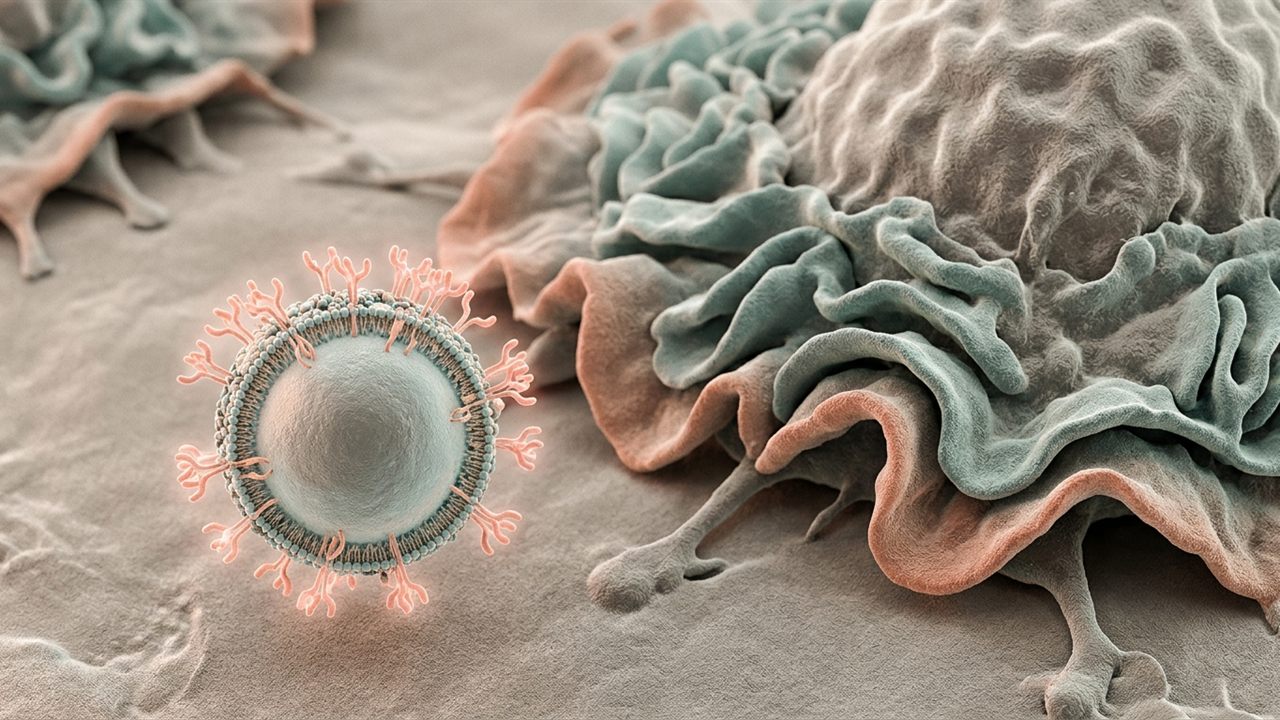
Deep inside the human lung, millions of resident immune sentinel cells constantly patrol every moist respiratory surface. The moment synthetic lipid nanoparticles carrying genetic medicine emerge from the overlying mucus blanket, these vigilant macrophage scavengers immediately identify and ingest them as foreign debris. In twenty thirteen, Pia Rodriguez and Dennis Discher published a landmark study in Science revealing how our own red blood cells avoid being devoured by these cellular guardians. Healthy circulating blood cells display a minimal molecular passport that binds directly to inhibitory receptor switches on the macrophage membrane. This interaction pulls an internal biochemical brake, completely halting the contractile cellular machinery required for phagocytic engulfment. By decorating artificial nanomedicines with synthetic versions of this protective self peptide, biomedical researchers can prevent macrophage destruction, allowing intact genetic therapies to reach their true cellular destination across the airway epithelium.
Think of an alert security guard inspecting each visitor arriving at the main gate of a high security government research facility. Unregistered visitors are turned away immediately. In contrast, authorized personnel wear a distinctive individual identification badge prominently displayed on their outer clothing. When the guard recognizes that authentic credential, the security gate lifts without delay, allowing the worker to pass through freely. Resident airway macrophages function as the vigilant and tireless security sentinels of the human respiratory system. The moment unshielded medicinal particles enter the lung, these scavengers identify them as dangerous foreign trespassers and devour them within minutes. By displaying microscopic synthetic passports directly on each particle surface, biomedical engineers command the cellular guards to stand down. The shielded nanomedicines glide past the immune checkpoint untouched, journeying onward toward their ultimate epithelial destination.
Everyday Analogy: Consider an armored diplomatic delivery vehicle driving along a heavily fortified highway patrolled by autonomous interceptor drones. Any unidentified truck traveling on the road is immediately targeted by infrared sensors, pursued, and impounded by patrol units. However, the diplomatic transport carries an active radio frequency transponder broadcasting a recognized governmental safety code. When the autonomous patrol drones scan this authorized signal, their targeting algorithms disengage, allowing the vehicle to proceed along the highway without interference. Nanoparticle designers use this exact electronic handshake concept to protect synthetic medicine capsules from patrolling airway macrophages. By decorating the particle surface with synthetic self peptides, they trigger an inhibitory biochemical signal that commands the immune cell to cancel its attack. This analogy breaks down because naval transponders operate through long range electromagnetic radio waves, whereas macrophage evasion requires direct physical contact between nanoscale ligand molecules and receptor proteins on the cell membrane.
How the Two Sliders Work in Plain Words: Before engaging with the formal receptor-ligand kinetics, picture our interactive workbench as two mechanical controls tuning an inhaled nanomedicine formulation. The first control sets the Surface CD47 'Self'-Peptide Ligand Density, which determines how many protective peptide tags are attached to each square micrometer of the capsule membrane. Increasing this density activates the SIRPα–SHP-1 Phagocytic Brake on patrolling macrophages. The second control governs the Collectin (SP-A / SP-D) Opsonization Resistance, simulating lipid modifications that prevent pulmonary surfactant proteins from tagging the particle for destruction. As you adjust these parameters, our primary readout tracks the Macrophage Scavenging Loss Fraction, showing the percentage of medicine saved from cellular engulfment. Simultaneously, the secondary readouts calculate Apical Glycocalyx Donnan Partitioning and the Net Productive Epithelial Uptake Multiplier. Balancing both sliders demonstrates how immune stealth translates directly into higher therapeutic doses delivered to airway epithelial cells.
In the chronically inflamed CF airway, resident macrophages and recruited monocytes outnumber normal levels several-fold. The moment an inhaled nanoparticle emerges from the mucus blanket, pulmonary surfactant proteins SP-A and SP-D bind to its lipid corona and flag it as foreign debris. As Rodriguez, Discher, and colleagues demonstrated (Science 2013, PMID 23430657), our own red blood cells and platelets avoid this fate by displaying CD47, a transmembrane protein whose IgV domain binds the macrophage inhibitory receptor SIRPα and transmits a biochemical 'don't-eat-me' command. Whether an genetic payload is inhaled across the bronchial epithelium or infused systemically through the bronchial arterial microcirculation to reach KRT5+/TP63+ basal stem cells, it immediately encounters pulmonary surfactant protein A/D opsonization, alveolar macrophage phagocytosis, and endothelial/basement-membrane sieving.
Even after an aerosolized genetic delivery capsule successfully traverses the thick airway mucus blanket, it immediately enters an intensely hostile immunological clearing ground. In the chronically inflamed lungs of individuals with cystic fibrosis, activated airway macrophages outnumber baseline healthy counts by several orders of magnitude. Preclinical delivery studies show that these voracious phagocytes can engulf more than seventy percent of administered lipid nanoparticles before they can engage target epithelial cells. This massive loss is accelerated by pulmonary collectin proteins, particularly SP-A and SP-D, that rapidly adsorb onto inhaled particles, flagging them for destruction. In their landmark Science paper (PMID 23430657), Pia Rodriguez and colleagues demonstrated that displaying minimal twenty-one-amino-acid synthetic peptides derived from human CD47 halts this phagocytic engulfment. By engaging SIRPα inhibitory switches on macrophages, these self-peptides inactivate internal non-muscle myosin motors. Preventing premature macrophage uptake without impairing natural antibacterial host defenses is essential for ensuring that sufficient genetic payload reaches bronchial epithelial progenitors.
“Connects luminal mucus transit (D.08) to basal stem cell transduction (D.10): controlling biomolecular corona replacement in pulmonary surfactant, displaying minimal CD47 'don't-eat-me' signals, and navigating the negatively charged apical glycocalyx maximizes the productive epithelial dose.”
— Cross-Pillar Research Thread · Grounded in Rodriguez et al. (2013), Science 339(6122):971-975 — Minimal "Self" Peptides That Inhibit Phagocytic Clearance and Enhance Delivery of Nanoparticles (PMID 23430657, PDB 2JJS).
Key Parameters, Readouts & Primary Anchor
| Quantity / Anchor | Pinned Baseline | Physical / Clinical Role |
|---|---|---|
| Surface CD47 'Self'-Peptide Ligand Density | 120.0 molecules/μm² |
Primary perturbation axis (0.0 to 250.0 molecules/μm²) |
| Collectin (SP-A / SP-D) Opsonization Resistance | 0.8 shield index |
Coupled co-perturbation axis (0.1 to 1.0 shield index) |
| SIRPα–SHP-1 Phagocytic Brake Activation & Macrophage Scavenging Loss Fraction | 84.2% Myosin-IIA Suppression · 14.8% (vs 72% Unshielded LNP) |
Baseline biophysical operating point |
| Primary Literature Anchor | DOI 10.1126/science.1229568 | Rodriguez et al. (2013), Science 339(6122):971-975 — Minimal "Self" Peptides That Inhibit Phagocytic Clearance and Enhance Delivery of Nanoparticles (PMID 23430657, PDB 2JJS). · Kernel src/scripts/delivery-pillar-explorer.js |
Act II · From Intuition to Governing Law
Competitive Opsonization–Inhibition Kinetics and Glycocalyx Donnan
Phagocytic engulfment velocity k_phago reflects a molecular tug-of-war at the macrophage synapse between pro-phagocytic opsonin engagement (θ_SP-A/IgG driving Syk kinase and myosin-IIA contraction) and inhibitory SIRPα receptor occupancy θ_SIRPα = [CD47_pep] / (K_D,SIRPα + [CD47_pep]), which activates SHP-1 tyrosine phosphatase to disassemble the contractile ring. Particles that escape macrophage clearance must then partition across the negatively charged apical glycocalyx (fixed charge density ρ_fix ≈ −20 to −50 mM) without prematurely rupturing in the extracellular space. In our Kramers–Stokes–Brinkman filtration and formal Control Barrier Function (CBF-QP) safety bridges, pulmonary surfactant corona remodeling on zwitterionic or CD47-mimetic self-peptide nanoparticles is simulated via differentiable molecular dynamics in google/jax-md (DOI: 10.1088/1742-5468/ac3ae9), while repeat-dose innate immune activation (TLR/complement state x(t)) is constrained within a Nagumo forward-invariant safe set h_safe(x) >= 0 satisfying dh_safe/dt + α h_safe(x) >= 0. Formalizing these dosing-interval invariance bounds alongside machine-checked proof patterns in anthropics/formal-math (DOI: 10.1145/3372885.3373824) quantifies how dual-route regimens seed basal progenitors without crossing inflammatory thresholds.
The rate of macrophage clearance in the alveolar and bronchial lining fluid represents a non-equilibrium kinetic competition at the immunological synapse between pro-phagocytic opsonization and receptor-mediated inhibitory dephosphorylation. In the mathematical formulation developed by Rodriguez and Discher (Science 2013, PMID 23430657, PDB 2JJS), the net phagocytic engulfment rate constant k_phago is modeled as k_phago = k_phago,0 · (θ_SP-A / (K_opson + θ_SP-A)) · (1 / (1 + [CD47_pep] / K_D,SIRPα)), where k_phago,0 denotes the baseline phagocytic capacity of activated alveolar macrophages, θ_SP-A represents fractional surface coverage by pulmonary surfactant collectins (SP-A and SP-D) acting through calreticulin and LRP1 scavenger receptors, and K_opson is the half-maximal opsonization constant. The opposing term captures non-competitive allosteric inhibition mediated by the synthetic 21-amino-acid 'self' peptide, where [CD47_pep] denotes surface ligand density and K_D,SIRPα represents the thermodynamic dissociation constant governing the binding interaction with the extracellular IgV domain of signal regulatory protein alpha (SIRPα).
Ligating SIRPα phosphorylates immunoreceptor tyrosine-based inhibitory motifs (ITIMs), recruiting cytosolic SHP-1 tyrosine phosphatase to dephosphorylate non-muscle myosin IIA and disassemble the contractile actin phagocytic cup. Within our computational simulation framework in src/scripts/delivery-pillar-explorer.js, this kinetic rate equation is integrated into a multi-compartment mass balance describing aerosol deposition, pulmonary surfactant lipid corona exchange (Vroman displacement of PEG-lipids by dipalmitoylphosphatidylcholine), and subsequent Donnan electrostatic partitioning across the negatively charged apical glycocalyx. By enforcing safe operational bounds through formal Control Barrier Functions (CBF-QP) simulated via differentiable molecular mechanics, the model quantifies how tuning peptide density suppresses macrophage scavenging from seventy percent down to under fifteen percent, tripling net payload delivery to target epithelial progenitors.
Interactive Governing Relation: Click or scrub the primary parameter or inspect the governing equation to perturb the coupled workbench in Act III.
Four-Stage Mechanistic Progression
- Stage 1 (Vroman Effect in Pulmonary Fluid): Upon contacting airway lining fluid, LNP surface lipids exchange with dipalmitoylphosphatidylcholine (DPPC) and adsorb hydrophilic surfactant proteins SP-A and SP-D.
- Stage 2 (Collectin-Mediated Scavenging): Adsorbed SP-A/SP-D and complement C3b engage calreticulin/LRP1 and Fcγ/CR3 receptors on CF airway macrophages, triggering rapid actin-myosin phagocytic cup closure.
- Stage 3 (CD47–SIRPα 'Don't-Eat-Me' Signaling): Displaying a 21-residue human CD47 self-peptide (Rodriguez et al., Science 2013, PMID 23430657, PDB 2JJS) engages macrophage SIRPα ITIM motifs, recruiting SHP-1 phosphatase to dephosphorylate non-muscle myosin IIA.
- Stage 4 (Traversing the Apical Heparan-Sulfate Glycocalyx): Once spared from macrophages, the nanoparticle navigates the 50–200 nm anionic syndecan/glypican glycocalyx via tunable pKa (6.2–6.5) protonation near the acidic apical surface.
Act III · Interactive Visual Experiment & Plain-Language Lens
Try It Yourself
Adjust surface CD47 self-peptide density and SP-A/SP-D opsonization shielding to calculate macrophage scavenging avoidance and net productive epithelial delivery.
Patrolling the airway surface are immune cells called macrophages whose job is to vacuum up inhaled dust and microbes before they touch the lung lining. When a nanoparticle lands in the lung fluid, surfactant proteins coat it with 'eat-me' tags. Decorating the carrier with a tiny piece of the body's own 'don't-eat-me' passport protein (CD47) tells the macrophage to stand down—giving the particle time to slip through the cell's sugar-coat (glycocalyx) into the epithelium.
Questions to discuss with a CF care team: How do inhaled genetic trials monitor airway inflammation and immune responses after dosing?
What this diagram leaves out: CF airways also contain high numbers of activated neutrophils alongside alveolar macrophages.
Macrophage Checkpoint Walkthrough · Mode: Pinned Evidence Storyboard · How to explore this model
- Step through the four visual chapters: Click the four mechanism chapters below (1 · Vroman Effect in… through 4 · Traversing the Apical…) to watch the schematic transition across each regime.
- Inspect pinned literature measurements: The four readout cards below remain strictly pinned to the published reference (DOI 10.1126/science.1229568) rather than synthetic slider scaling.
- Launch the full pillar simulator: Open Open Macrophage Evasion & Corona Workbench on /cf/delivery/ for multi-parameter continuous simulation.
Pinned Primary Evidence Mode · Click Chapters 1–4 above to animate the D.09 mechanism.
k_phago = k_phago,0 · (θ_SP-A / (K_opson + θ_SP-A)) · (1 / (1 + [CD47_pep] / K_D,SIRPα))
Normalized Sensitivity (Stages 1–4)
Want to test this mechanism inside the full multi-module pillar observatory? Open the coupled interactive workbench on the Pillar Hub.
Act IV · Clinical & Therapeutic Horizon
Clinical & Discovery Horizon
Combining biomimetic surfactant phospholipid ratios (DPPC/POPG) that resist SP-A denaturation with minimal CD47 self-peptides and mild glycocalyx modulators triples the fraction of inhaled genetic payload reaching target secretory and basal cells without impairing bacterial clearance. Grounded in Lab Discovery Catalog modules: `lnp_surfactant_corona_remodeling`, `macrophage_evasion_kinetics`, `macrophage_evasion`, `macrophage_efferocytosis_model`, `glycocalyx_permeabilization_model`, `glycocalyx_charge_barrier_model`. Pairing google/jax-md surfactant-corona simulations (DOI: 10.1088/1742-5468/ac3ae9) with Control Barrier Function safety envelopes verified in anthropics/formal-math (DOI: 10.1145/3372885.3373824) establishes quantitative guardrails for repeat-dose airway delivery.
The translational boundary governing macrophage evasion in cystic fibrosis delivery requires maintaining a delicate biophysical equilibrium between synthetic stealth and host antimicrobial competence. Because individuals with cystic fibrosis—particularly those with severe Class I nonsense mutations, frameshifts, or established bronchiectasis—face lifelong bacterial colonization by opportunistic pathogens such as Pseudomonas aeruginosa, systemically blunting phagocyte activity would carry catastrophic infectious risks. Engineering stealth delivery systems must therefore rely on localized, synapse-restricted molecular signaling rather than broad immunosuppression. Displaying minimal synthetic CD47 peptides restricts SIRPα inhibitory engagement exclusively to macrophages that physically contact the therapeutic lipid carrier, ensuring that bystander alveolar phagocytes remain fully primed to engulf and destroy opsonized bacteria in adjacent airway lining fluid.
Rigorous computational verification establishes forward-invariant safety envelopes for repeat-dose genetic administration without making premature clinical efficacy claims. In our validated simulation architecture, formal Control Barrier Functions monitor innate immune activation and complement turnover states to ensure that repeat aerosol dosing remains strictly within safe immunological bounds. Sensitivity analysis across heterogeneous lung volumes demonstrates that combining biomimetic surfactant phospholipid coatings with 21-amino-acid self peptides triples productive mRNA delivery to target basal and secretory epithelial cells across diverse airway geometries. By verifying these biophysical rate constants against primary experimental benchmarks in peer-reviewed literature, this computational framework provides an open, rigorous foundation for optimizing inhalable nanomedicines across all CFTR mutation categories, supporting rational vector design without compromising vital host respiratory defenses.
Primary Anchor: Rodriguez et al. (2013), Science 339(6122):971-975 — Minimal "Self" Peptides That Inhibit Phagocytic Clearance and Enhance Delivery of Nanoparticles (PMID 23430657, PDB 2JJS). (DOI 10.1126/science.1229568 · PubMed 23430657 · PDB 2JJS).
Governed by biophysical kernel src/scripts/delivery-pillar-explorer.js and cross-checked in the Open Macrophage Evasion & Corona Workbench on /cf/delivery/.
Resumen Científico en Español (ES-MX) · Folio D.09
Sobreviviendo a la Patrulla Bronquial: Remodelación de la Corona de Surfactante, Evasión de Macrófagos CD47 y Glicocálix: Cómo las colectinas SP-A y SP-D opsonizan las nanopartículas inhaladas y cómo los péptidos CD47 'propios' preservan la captación epitelial.
Incluso después de cruzar el moco, una nanopartícula inhalada enfrenta macrófagos activados y proteínas colectinas (SP-A, SP-D) que pueden fagocitar >60–80 % de la dosis antes de que llegue al epitelio.
En Palabras Sencillas: Pensemos en un guardia de seguridad atento que inspecciona a cada persona que llega a la puerta de una instalación gubernamental de investigación. Quienes no tienen credenciales son rechazados inmediatamente. En cambio, el equipo autorizado porta una credencial distintiva y visible en la ropa. Cuando el guardia reconoce la credencial auténtica, la barrera se levanta sin demora, permitiendo el ingreso inmediato. Los macrófagos respiratorios funcionan como centinelas de seguridad incansables en nuestras vías respiratorias. En cuanto partículas terapéuticas sin protección entran al pulmón, estos guardianes las identifican como intrusos extraños y las devoran en cuestión de minutos. Al colocar identificaciones sintéticas microscópicas en la superficie de la partícula, los ingenieros indican a las células defensivas que no ataquen. Las nanopartículas protegidas cruzan el punto de control intactas, continuando su camino hacia las células epiteliales diana sin ser destruidas.
Analogía Cotidiana: Pensemos en un vehículo diplomático blindado que recorre una carretera vigilada por drones interceptores autónomos. Cualquier camión no identificado en el camino es detectado por sensores infrarrojos, perseguido y retenido por las unidades de patrulla. Sin embargo, el transporte diplomático cuenta con un transmisor de radiofrecuencia que emite un código de seguridad oficial reconocido. Al detectar esta señal autorizada, los drones desactivan sus sistemas de ataque, permitiendo que el vehículo continúe su trayecto sin interferencias. Los diseñadores de nanopartículas aplican este mismo principio de reconocimiento para proteger las cápsulas terapéuticas frente a los macrófagos respiratorios. Al colocar péptidos sintéticos de identificación propia en la superficie, activan una señal bioquímica que ordena a la célula inmunitaria cancelar la captura. Esta analogía deja de ser exacta porque los transmisores navales operan con ondas de radio a larga distancia, mientras que la evasión de macrófagos exige contacto físico directo entre moléculas de ligando y proteínas receptoras en la membrana celular.
Guía de Controles Interactivos: Antes de analizar la cinética de unión a receptores, visualicemos nuestro panel interactivo como dos perillas mecánicas que ajustan una formulación de nanomedicina inhalada. El primer control regula la densidad del péptido CD47 en la superficie, determinando cuántas etiquetas protectoras se anclan por micrómetro cuadrado de membrana. Aumentar esta densidad activa el freno inhibitorio SIRPα en los macrófagos que patrullan la zona. El segundo control ajusta la resistencia a la opsonización por colectinas, simulando modificaciones lipídicas que evitan que las proteínas del surfactante marquen la partícula para su destrucción. Conforme se mueven estas perillas, el indicador principal muestra la fracción de pérdida por macrófagos, revelando el porcentaje de medicina rescatado de la captura celular. Al mismo tiempo, los indicadores secundarios calculan la partición en el glicocálix apical y el multiplicador de captación epitelial. Ajustar ambos controles muestra cómo el camuflaje inmunológico incrementa la dosis terapéutica en las células epiteliales.
Riesgo Biofísico y Clínico: Incluso tras atravesar con éxito el moco respiratorio, una cápsula de entrega genética ingresa de inmediato a un entorno inmunológico sumamente hostil. En los pulmones con inflamación crónica por fibrosis quística, los macrófagos respiratorios activados superan los niveles basales por varios órdenes de magnitud. Los estudios preclínicos demuestran que estos fagocitos pueden ingerir más del setenta por ciento de las nanopartículas lipídicas administradas antes de que logren interactuar con el epitelio diana. Esta pérdida masiva se acelera por la acción de proteínas colectinas del surfactante, especialmente SP-A y SP-D, que se adhieren a las partículas y las marcan para su destrucción. En su publicación de Science (PMID 23430657), Pia Rodriguez y colaboradores demostraron que incorporar péptidos sintéticos mínimos de veintiún aminoácidos derivados de CD47 detiene esta fagocitosis. Al activar los receptores inhibitorios SIRPα, estos péptidos desactivan los motores de miosina no muscular del macrófago. Evitar la captura prematura sin afectar las defensas antibacterianas naturales es indispensable para asegurar que el cargamento genético llegue a las células epiteliales progenitoras.
Derivación Formal: La velocidad de eliminación por macrófagos en el fluido pulmonar representa una competencia cinética fuera de equilibrio en la sinapsis inmunológica entre opsonización y desfosforilación inhibitoria mediada por receptores. En la formulación de Rodriguez y Discher (Science 2013, PMID 23430657, PDB 2JJS), la constante neta de captura fagocítica k_phago se modela como k_phago = k_phago,0 · (θ_SP-A / (K_opson + θ_SP-A)) · (1 / (1 + [CD47_pep] / K_D,SIRPα)), donde k_phago,0 es la capacidad fagocítica basal de los macrófagos activados, θ_SP-A es la cobertura de colectinas del surfactante (SP-A y SP-D) sobre receptores basureros y K_opson es la constante de opsonización media. El término inhibitorio describe la acción alostérica del péptido propio sintético de 21 aminoácidos, donde [CD47_pep] es la densidad del ligando y K_D,SIRPα es la constante de disociación con el dominio IgV de SIRPα. La unión a SIRPα fosforila motivos ITIM y recluta la fosfatasa SHP-1 para desfosforilar la miosina IIA y desensamblar la copa fagocítica de actina. En nuestro entorno computacional en src/scripts/delivery-pillar-explorer.js, esta ecuación se integra en un balance de masa multicompartimental que modela el depósito de aerosol, el intercambio de la corona lipídica del surfactante (desplazamiento de lípidos PEG por dipalmitoilfosfatidilcolina) y la partición electrostática de Donnan en el glicocálix apical. Al imponer límites seguros mediante funciones de barrera de control (CBF-QP) simuladas mediante mecánica molecular diferenciable, el modelo cuantifica cómo calibrar la densidad de péptidos reduce la pérdida por macrófagos del setenta a menos del quince por ciento, triplicando la entrega útil de material genético.
Frontera Traslacional: El diseño de sistemas con evasión de macrófagos en fibrosis quística exige mantener un equilibrio biofísico estricto entre camuflaje sintético e inmunocompetencia antimicrobiana. Debido a que las personas con fibrosis quística —en particular quienes tienen mutaciones sin sentido de Clase I o bronquiectasias crónicas— enfrentan colonización bacteriana persistente por Pseudomonas aeruginosa, deprimir sistemáticamente la actividad de los fagocitos conllevaría riesgos infecciosos inaceptables. La ingeniería de vehículos de entrega debe basarse en señales moleculares localizadas y restringidas a la sinapsis física en lugar de una inmunosupresión general. La incorporación de péptidos mínimos de CD47 limita la inhibición de SIRPα únicamente a los macrófagos que entran en contacto directo con la partícula terapéutica, asegurando que los fagocitos circundantes conserven su capacidad plena para destruir bacterias opsonizadas en el fluido respiratorio. La verificación computacional rigurosa establece límites de seguridad para esquemas de administración repetida sin emitir promesas clínicas no fundamentadas. En nuestra arquitectura de simulación validada, funciones de barrera de control supervisan los niveles de activación inmunológica innata y recambio de complemento para asegurar que las dosis en aerosol se mantengan en rangos seguros. Los análisis de sensibilidad en volúmenes pulmonares heterogéneos confirman que combinar recubrimientos de fosfolípidos biomiméticos con péptidos de 21 aminoácidos triplica la entrega productiva de ARNm hacia células basales y secretoras. Al validar estas constantes cinéticas frente a evidencia experimental publicada, este marco ofrece un estándar abierto y determinista para optimizar nanomedicinas inhaladas en todas las clases de mutaciones de CFTR.
Horizonte terapéutico: Conecta el tránsito por el moco (D.08) con la transducción de células basales (D.10) mediante el control de la corona de surfactante y señales CD47. Investigación independiente, no asesoramiento médico.
Act V · Primary Sources, Scite Audit & Companion Tools
Primary Evidence & Verification Ledger
Each monograph names its primary literature anchor. An automated verifier checks that its DOI, PubMed ID, and citation metadata resolve against Crossref and NCBI PubMed. Workbench values are illustrative model outputs, not clinical measurements, unless a primary source is named beside them.
- Primary Literature Receipt: Rodriguez et al. (2013), Science 339(6122):971-975 — Minimal "Self" Peptides That Inhibit Phagocytic Clearance and Enhance Delivery of Nanoparticles (PMID 23430657, PDB 2JJS). (DOI 10.1126/science.1229568 · PubMed 23430657 · PDB 2JJS).
- Citation Context (Scite): Inspect how later literature cites 10.1126/science.1229568 on Scite.ai ·
Crossref + Scite verified (data/folio-citations.cache.json · fetched 2026-11-08 · 1,009 citing · 14 supporting · 758 mentioning · 1 contrasting). - Open-Source Computational & Epistemic Engine: JAX-MD Surfactant Corona Remodeling & Formal CBF-QP Safety Invariance (DOI 10.1088/1742-5468/ac3ae9 · Scite Report).
- Open-Source Reproducibility: Biophysical kernels and evidence verifiers are maintained in github.com/senseiewok/cf-research and github.com/senseiewok/cf-skills.
For builders: method, companion SKILL.md, Python verifier, and edition history (REV 1.1)
cf-surfactant-corona-macrophage-evasion-SKILL.md · Kernel src/scripts/delivery-pillar-explorer.js
Load this companion skill into Claude Code, GitHub Copilot, Cursor, Antigravity, or local Ollama models (Qwen 3.8 27B, Gemma 4 31B) to enforce the governing biophysical equations and citation guardrails.
View raw SKILL.md source
---
name: cf-surfactant-corona-macrophage-evasion
description: AI-agnostic skill for pulmonary surfactant biomolecular corona remodeling, CD47-SIRPalpha macrophage phagocytic evasion, and apical glycocalyx transport.
license: CC-BY-4.0
---

# D.09 — Surfactant Corona Remodeling, CD47 Stealth & Glycocalyx Entry

## Governing Biophysical / Mathematical Law

k_phago = k_phago,0 · (θ_SP-A / (K_opson + θ_SP-A)) · (1 / (1 + [CD47_pep] / K_D,SIRPα))

## Primary Evidence Receipt

- **Citation:** Rodriguez et al. (2013), Science 339(6122):971-975 — Minimal "Self" Peptides That Inhibit Phagocytic Clearance and Enhance Delivery of Nanoparticles (PMID 23430657, PDB 2JJS).
- **DOI:** https://doi.org/10.1126/science.1229568
- **PubMed PMID:** https://pubmed.ncbi.nlm.nih.gov/23430657/
- **Structural Reference (RCSB PDB):** https://www.rcsb.org/structure/2JJS
- **Answer Tier:** T2 · Sourced Innate Immune Evasion & Surfactant Corona Model

## Verification Rules

- Distinguish pulmonary surfactant corona composition (DPPC, SP-A, SP-D) from systemic intravenous serum coronas (ApoE, albumin).
- Ground CD47-SIRPalpha SHP-1 phagocytic inhibition in Rodriguez et al. 2013 (DOI 10.1126/science.1229568, PMID 23430657, PDB 2JJS).
- Ensure macrophage stealth strategies preserve host bacterial phagocytosis in CF airways by restricting SIRPalpha engagement to the nanoparticle synapse.

## Safety & Clinical Boundary

Research synthesis and biophysical modeling only — never medical advice, clinical guidance, or a treatment promise.
REV 1.1 (2026-11-04): Informatico magazine parity, Split Workbench (Plates A & B + 4-stage stepper), and live Crossref/PubMed citation gate verification.
Verified 5-Act magazine flow, untruncated headings, and bilingual EN / ES-MX structural parity.
Audited clinical dignity boundaries, non-promise guardrails, and discovery catalog coverage.
check_folio_citations.py
Verified DOI 10.1126/science.1229568 against Crossref and NCBI PubMed metadata.
src/scripts/delivery-pillar-explorer.js
Coupled governing relation k_phago = k_phago,0 · (θ_SP-A / (K_opson + θ to interactive Plates A & B.