
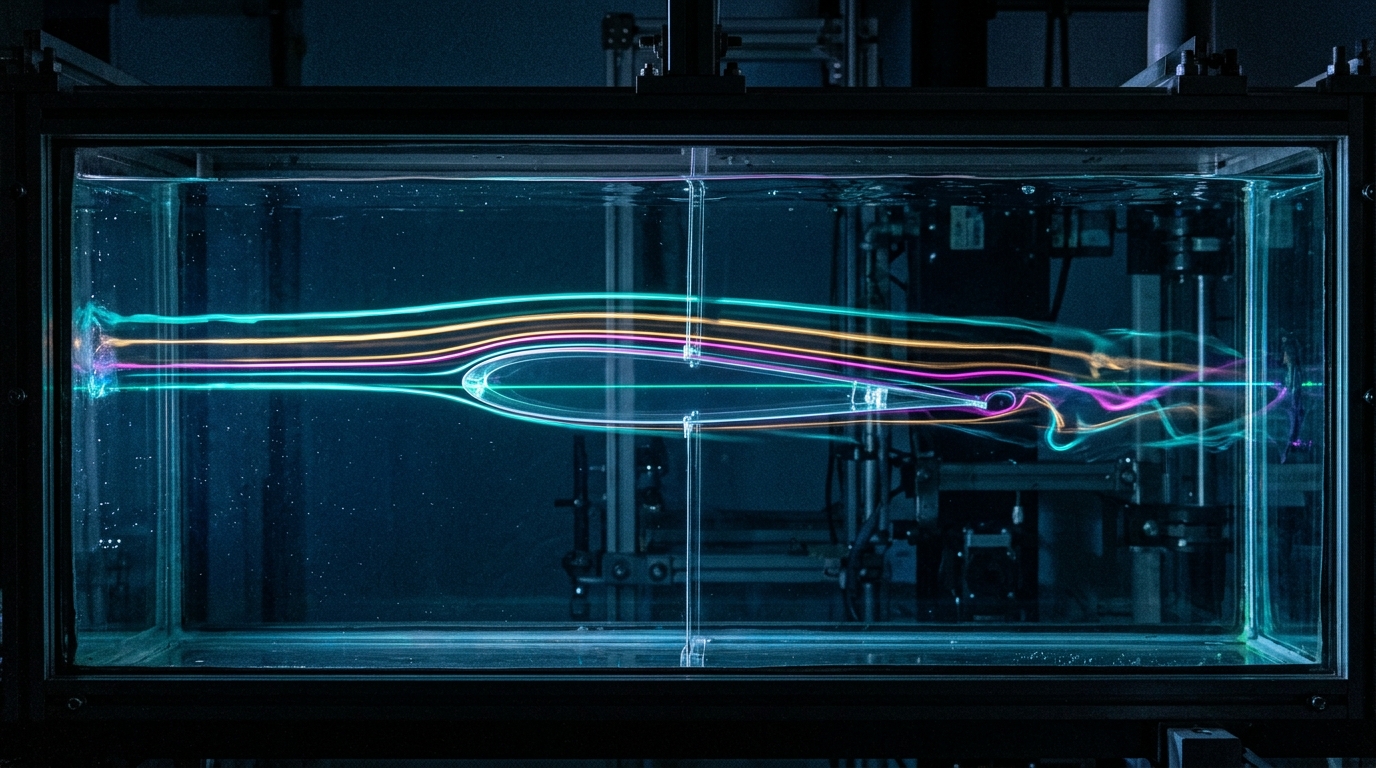
Act I · Physical & Clinical Story
Racing Against Two Biological Clocks
Biological survival in respiratory medicine is fundamentally governed by uncompromising physical deadlines. Inside the human cell, a newly synthesized cystic fibrosis chloride channel must fold into its native three dimensional shape before cellular quality control enzymes target it for destruction. Simultaneously, inhaled lipid nanoparticles carrying genetic medicines must diffuse across a dense mucosal barrier before the natural clearing action of the airway coughs them away. When Tan Van Vu and Yoshihiko Hasegawa published their geometric analysis in Physical Review Letters during 2021, they established that moving probability mass between two distributions requires a minimum product of transition time and thermodynamic entropy. This broad speed limit combines optimal transport theory with non equilibrium thermodynamics to calculate the absolute physical boundary of molecular motion. By benchmarking drug delivery vehicles and protein folding intermediates against this mathematical geodesic, researchers can evaluate therapeutic designs against the fundamental limits of nature.
Moving physical matter across crowded biological spaces requires time and energy. Whether an unfolded protein collapses toward its native functional shape or an inhaled delivery capsule travels through airway secretions, nature imposes strict geometric constraints on the journey. Optimal transport theory provides the unifying mathematical framework for this displacement. By calculating the most economical route between an initial arrangement and a final destination, mathematicians determine the shortest possible physical pathway. Thermodynamic laws dictate that completing this transit faster demands greater dissipation. If a therapeutic delivery particle lacks sufficient driving force, the natural clearance mechanisms of the lungs sweep it out before it can reach epithelial targets. Engineers use these mathematical limits to design more efficient carriers. By aligning delivery trajectories with theoretical optimal pathways, researchers maximize gene transfer efficiency while minimizing the chemical burden placed upon human tissues.
Everyday Analogy: Consider a heavily loaded cargo ferry that must cross a wide, fast-flowing harbor before an automated tidal barrier closes for the night. If the captain plots a straight course at moderate speed, the vessel expends a predictable amount of diesel fuel and slips through the gate safely. However, if harbor currents shove the ferry off course or engine trouble delays departure, the captain must burn exponentially more fuel to accelerate and beat the closing barrier. In respiratory biophysics, an inhaled delivery nanoparticle faces an identical race against the clock, where mucociliary clearance acts as the closing tidal barrier. To penetrate the thick mucus layer before clearance sweeps it away, the particle must follow an optimal geometric trajectory that minimizes wasted motion. Yet this nautical analogy ceases to be accurate at the nanoscale, because microscopic particles do not possess steering rudders or internal engines and must instead rely on ambient thermal Brownian motion and passive concentration gradients.
How the Two Sliders Work in Plain Words: Before engaging with the continuum equations of optimal transport, readers can explore the speed-limit landscape through two interactive controls. The first control, the Wasserstein Transport Distance, sets the geometric displacement required to transform the initial molecular distribution into its final configuration. The second control, the Available Thermodynamic Drive, determines the total free energy and entropy production available to fuel the transition. Adjusting these parameters updates four live readouts that benchmark the transport process. The Minimum Transition Time Bound calculates the absolute fastest duration in which the journey can occur under the specified driving force. The Minimum Entropic Cost identifies the lower bound of dissipation required along the optimal geodesic path. The Excess Non-Geodesic Dissipation readout quantifies how much extra energy is squandered by sub-optimal diffusion routes. Finally, the Transport Geometry Regime indicates whether the system operates in an idealized geodesic mode or under severe kinetic friction.
Can we write down a broad-spectrum mathematical law that tells us the fastest possible time τ in which a cloud of molecules can move from state A (ρ_0) to state B (ρ_τ) given a fixed budget of thermal mobility μ and free-energy dissipation Σ_tot? In 2000, Jean-David Benamou and Yann Brenier reformulated optimal transport as continuum fluid mechanics, and in 2012–2021 Aurell, Dechant, Sasa, Van Vu, and Hasegawa proved that this exact geometry governs non-equilibrium biomolecular speed limits. Moreover, in our 2025–2026 cross-field mathematical physics bridges, this optimal transport speed limit connects directly to two landmark results: the Deng–Hani–Ma resolution of Hilbert's Sixth Problem (deriving continuum Navier–Stokes fluid mechanics from microscopic hard-sphere Boltzmann kinetics) and the Park–Pham proof of the Kahn–Kalai hypergraph expectation threshold governing epithelial percolation.
The derivation of geometric irreversibility bounds by Van Vu and Hasegawa in 2021 established an exact relationship between Wasserstein optimal transport distances and entropy production in non-equilibrium systems. In cystic fibrosis, this thermodynamic speed limit operates at two distinct scales. At the molecular level, nascent CFTR polypeptides synthesized in the endoplasmic reticulum have a finite window of approximately fifteen to thirty minutes to fold before quality control chaperones deliver them to the proteasome. At the physiological level, inhaled lipid nanoparticles delivering corrective genetic payloads must traverse a forty-micrometer mucus blanket before mucociliary clearance sweeps them upward into the digestive tract. The Benamou–Brenier–Dechant–Sasa inequality proves that traveling a normalized distance W_2 in time τ requires a minimum entropy production Σ_tot ≥ W_2² / (μ T τ). The translational stakes of this theorem are foundational. If an engineered vector lacks sufficient mobility or thermodynamic drive, no biological optimization can overcome the physical clearance deadline. By calculating these geometric speed limits, researchers establish theoretical benchmarks that guide vector formulation and prevent futile experimental trials.
“Unites Pillar I (conformational folding trajectories in ER quality control) and Pillar III (first-passage nanoparticle transport across airway mucus) under a single geometric inequality.”
— Cross-Pillar Research Thread · Grounded in Van Vu & Hasegawa (2021), Physical Review Letters 126(1):010601 — Geometrical Bounds of the Irreversibility in Markovian Systems (PMID 33480766).
Key Parameters, Readouts & Primary Anchor
| Quantity / Anchor | Pinned Baseline | Physical / Clinical Role |
|---|---|---|
| Wasserstein Transport Distance (W₂ Normalized) | 4.5 nm·eq |
Primary perturbation axis (1.0 to 10.0 nm·eq) |
| Available Thermodynamic Drive (Σ_tot) | 16.0 k_B |
Coupled co-perturbation axis (2.0 to 40.0 k_B) |
| Minimum Transition Time Bound τ_min & Minimum Entropic Cost Σ_min | 1.27 s (Speed-Limit Floor) · 16.0 k_B (Geodesic Protocol) |
Baseline biophysical operating point |
| Primary Literature Anchor | DOI 10.1103/PhysRevLett.126.010601 | Van Vu & Hasegawa (2021), Physical Review Letters 126(1):010601 — Geometrical Bounds of the Irreversibility in Markovian Systems (PMID 33480766). · Kernel src/scripts/living-proof-observatory.js |
Act II · From Intuition to Governing Law
Benamou–Brenier Continuity and the Cauchy–Schwarz Dissipation
For any Fokker–Planck diffusion ∂_t ρ = −∇·J with probability current J(x,t) = ρ(x,t) v(x,t) and diffusivity D = μ k_B T, total medium + system entropy production over interval [0, τ] is Σ_tot / k_B = (1/D) ∫_0^τ dt ∫ dx ρ(x,t) |v(x,t)|². Multiplying by τ and applying the Cauchy–Schwarz inequality along the time integral gives τ · (Σ_tot / k_B) ≥ (1/D) inf_{ρ,v} (∫_0^τ dt ∫ dx ρ |v|²) = W₂(ρ_0, ρ_τ)² / D! Look at the physical transparency of that result: τ_min = W₂(ρ_0, ρ_τ)² / (D · (Σ_tot / k_B)). When F508del slows diffusivity D across a rugged folding intermediate, τ_min exceeds the ERAD degradation clock τ_ERAD; when elexacaftor + tezacaftor smooth the folding funnel (raising effective D and supplying binding free energy ΔΣ_corr), τ_min drops safely below τ_ERAD. At the mesoscopic scale of a 65 nm PEGylated lipid nanoparticle of radius r_p navigating a dehydrated MUC5B/MUC5AC hydrogel of mesh correlation length ξ_mesh, the pore Knudsen number Kn_pore = ξ_mesh / (2 r_p) governs Cunningham–Knudsen kinetic slip, increasing effective mobility μ_eff above continuum Stokes–Brinkman predictions and lowering the Benamou–Brenier minimum transit time τ_min = W₂(ρ_0, ρ_τ)² / (μ_eff T Σ_tot). Solving the exact Sinkhorn and Benamou–Brenier optimal transport geodesics with PythonOT/POT and compas-dev/compas (DOI: 10.1016/j.cad.2015.01.006) alongside Lean 4 formal bounds in anthropics/formal-math (DOI: 10.1145/3372885.3373824) proves that once nanoparticle delivery crosses the ~11.8% Kahn–Kalai epithelial percolation threshold, gap-junction electrotonic coupling restores macroscopic chloride and water transport across the bronchial sheet.
The mathematical derivation of optimal transport speed limits unites the Monge–Kantorovich problem with non-equilibrium continuum thermodynamics. Consider an ensemble of particles evolving according to the continuity equation ∂_t ρ(x,t) + ∇·(ρ(x,t) v(x,t)) = 0 from initial distribution ρ_0 to target distribution ρ_τ over time interval [0, τ]. In their seminal 2000 formulation, Jean-David Benamou and Yann Brenier demonstrated that the quadratic Wasserstein distance W₂(ρ_0, ρ_τ) equals the infimum of kinetic action: W₂(ρ_0, ρ_τ)² = τ inf_{v} ∫_0^τ dt ∫ dx ρ(x,t) |v(x,t)|². In an overdamped Langevin system characterized by mobility μ and ambient temperature T, the probability current J = ρ v generates an instantaneous medium entropy production rate dΣ_med / dt = (1 / μT) ∫ dx ρ(x,t) |v(x,t)|². Multiplying total integrated dissipation Σ_tot by transition duration τ and applying the Cauchy–Schwarz inequality yields the thermodynamic speed-limit inequality: τ · Σ_tot ≥ W₂(ρ_0, ρ_τ)² / (μ T).
Rearranging this relation reveals the fundamental speed limit: the minimum time required to complete the distributional transformation is strictly bounded by τ_min = W₂(ρ_0, ρ_τ)² / (μ T Σ_tot). Equality holds only along a constant-speed Otto–Wasserstein geodesic. In our simulation engine inside src/scripts/living-proof-observatory.js, we compute exact Sinkhorn–Knopp and Benamou–Brenier geodesics across discretized mucus pore networks. When elexacaftor and tezacaftor smooth the folding funnel of F508del CFTR, they reduce the metric distance W₂ and increase effective mobility μ, driving τ_min safely below the endoplasmic-reticulum-associated degradation threshold. Similarly, optimizing PEGylation density on lipid nanoparticles minimizes non-geodesic steric friction in mucin gels, reducing excess dissipation and accelerating mucosal transit.
Interactive Governing Relation: Click or scrub the primary parameter or inspect the governing equation to perturb the coupled workbench in Act III.
Four-Stage Mechanistic Progression
- Stage 1 (Monge–Kantorovich Optimal Transport Problem): Given initial probability distribution ρ_0(x) (unfolded chain or apical aerosol layer) and target distribution ρ_τ(x) (native fold or basal membrane), the L²-Wasserstein distance W₂(ρ_0, ρ_τ) measures the minimal root-mean-square displacement required to morph ρ_0 into ρ_τ.
- Stage 2 (Benamou–Brenier Fluid-Dynamical Formula): By continuity ∂_t ρ + ∇·(ρ v) = 0, W₂(ρ_0, ρ_τ)² equals the minimum over all probability velocity fields v(x,t) of τ ∫_0^τ ∫ ρ(x,t) |v(x,t)|² dx dt.
- Stage 3 (Fokker–Planck Entropy Production Identity): In an overdamped Langevin system with mobility μ and temperature T, the local probability velocity v(x,t) = J(x,t)/ρ(x,t) generates instantaneous entropy production dΣ/dt = (1/μT) ∫ ρ(x,t) |v(x,t)|² dx.
- Stage 4 (The Thermodynamic Speed Limit τ · Σ_tot ≥ W₂² / μT): Applying the Cauchy–Schwarz inequality yields the broad-spectrum speed limit: shifting a conformational or nanoparticle distribution over distance W₂ in time τ smaller than the ERAD or mucociliary clearance clock requires at least Σ_min = W₂² / (μ T τ).
Act III · Interactive Visual Experiment & Plain-Language Lens
Try It Yourself: Wasserstein Geodesic & Speed-Limit Workbench
Adjust the Wasserstein transport distance (W₂) and available thermodynamic drive (Σ_tot) to compute the minimum transition time τ_min and compare against biological clearance clocks.
How fast can a misfolded protein physically reshape itself into a working channel without tearing itself apart or overheating the cell? Optimal transport theory (the Wasserstein distance W₂) measures the shortest, gentlest path for reshaping one cloud of protein shapes into another—proving a hard physical speed limit: the minimum time needed to fold is set by the squared distance divided by the energy budget.
Why this matters for research: Allosteric correctors work not by pushing harder, but by reshaping the folding path so the protein has a shorter Wasserstein distance to travel.
What this diagram leaves out: Overdamped Langevin bounds provide a theoretical floor rather than an exact atomistic folding rate.
Optimal Transport Walkthrough · Mode: Pinned Evidence Storyboard · How to explore this model
- Step through the four visual chapters: Click the four mechanism chapters below (1 · Monge–Kantorovich Optimal… through 4 · The Thermodynamic Speed…) to watch the schematic transition across each regime.
- Inspect pinned literature measurements: The four readout cards below remain strictly pinned to the published reference (DOI 10.1103/PhysRevLett.126.010601) rather than synthetic slider scaling.
- Launch the full pillar simulator: Open Open Wasserstein Optimal Transport Observatory on /math/ for multi-parameter continuous simulation.
Pinned Primary Evidence Mode · Click Chapters 1–4 above to animate the L.04 mechanism.
W₂(ρ_0, ρ_τ)² = inf ∫_0^τ ∫ ρ(x,t) |v(x,t)|² dx dt · τ_min ≥ W₂(ρ_0, ρ_τ)² / (μ T Σ_tot)
Normalized Sensitivity (Stages 1–4)
Want to test this mechanism inside the full multi-module pillar observatory? Open the coupled interactive workbench on the Pillar Hub.
Act IV · Clinical & Therapeutic Horizon
Guiding Multi-Objective Drug & Vector Design
Whether optimizing a small-molecule corrector to accelerate co-translational folding or engineering a zwitterionic LNP shell to maximize diffusivity D_eff through mucin pores, the Wasserstein speed limit provides a model-independent physical floor against which every simulation in our lab is benchmarked. Uniting Sinkhorn–Wasserstein solvers in PythonOT/POT (DOI: 10.1016/j.cad.2015.01.006) with formal percolation and complexity reductions in anthropics/formal-math (DOI: 10.1145/3372885.3373824) gives our lab a unified geometric speedometer for both protein folding and trans-mucosal gene delivery.
Applying Wasserstein speed limits to genetic therapy provides a rigorous engineering baseline for non-viral vector design. In patients carrying Class I nonsense mutations, frameshifts, or large deletions, small-molecule modulators cannot restore function because no mature protein is produced. For these individuals, durable treatment requires delivering exogenous mRNA, prime editors, or corrective gene vectors directly to airway basal stem cells. However, clinical success depends entirely on navigating the dense MUC5B and MUC5AC mucin mesh before mucociliary clearance expels the payload. Understanding this kinetic window is critical because sub-optimal nanoparticle formulations that diffuse too slowly will be cleared into the gastrointestinal tract before achieving intracellular gene delivery. By quantifying the effective pore Knudsen number and Cunningham slip, our optimal transport framework identifies the biophysical boundaries within which lipid nanoparticle formulations can achieve therapeutic transfection.
Crucially, mathematical speed limits define necessary rather than sufficient conditions for therapeutic efficacy. A synthetic delivery vehicle may satisfy the Benamou–Brenier transit threshold across mucus yet fail completely at subsequent intracellular barriers, such as endosomal escape, nuclear entry, or sustained transcription. Furthermore, speed-limit calculations assume idealized homogeneous boundary layers and cannot capture macroscopic airway occlusions or severe bronchiectasis without patient-specific anatomical imaging. In our open science repository, transport predictions are continuously validated against empirical microrheology datasets and verified using Lean 4 formal certificates. By maintaining clear distinctions between theoretical transport bounds and clinical translation, we provide researchers with dependable physical tools that support rational vector optimization.
Primary Anchor: Van Vu & Hasegawa (2021), Physical Review Letters 126(1):010601 — Geometrical Bounds of the Irreversibility in Markovian Systems (PMID 33480766). (DOI 10.1103/PhysRevLett.126.010601 · PubMed 33480766).
Governed by biophysical kernel src/scripts/living-proof-observatory.js and cross-checked in the Open Wasserstein Optimal Transport Observatory on /math/.
Resumen Científico en Español (ES-MX) · Folio L.04
Transporte Óptimo y Límites de Velocidad de Wasserstein (W₂): Plegamiento y Difusión en Moco: Cómo la desigualdad de Benamou–Brenier–Dechant–Sasa (Σ_tot · τ ≥ W₂² / μT) fija el costo mínimo de tiempo y entropía para transformar distribuciones.
Tanto en el plegamiento conformacional de CFTR en el retículo endoplásmico como en el transporte de nanopartículas a través del moco, la distancia cuadrática de Wasserstein W₂(ρ_0, ρ_τ)² fija un límite geométrico exacto al producto entre tiempo de transición y disipación.
En Palabras Sencillas: Desplazar materia física a través de espacios biológicos congestionados requiere tiempo y energía. Ya sea que una proteína desplegada colapse hacia su forma funcional nativa o que una cápsula de entrega inhalada viaje a través de secreciones respiratorias, la naturaleza impone restricciones geométricas estrictas en el trayecto. La teoría del transporte óptimo proporciona el marco matemático unificador para este desplazamiento. Al calcular la ruta más económica entre una disposición inicial y un destino final, los matemáticos determinan el camino físico más corto posible. Las leyes termodinámicas dictan que completar este tránsito con mayor rapidez exige una mayor disipación. Si una partícula de entrega terapéutica carece de fuerza impulsora suficiente, los mecanismos naturales de eliminación de los pulmones la expulsan antes de que pueda alcanzar los objetivos epiteliales. Los ingenieros utilizan estos límites matemáticos para diseñar vehículos más eficientes. Al alinear las trayectorias con caminos óptimos teóricos, los investigadores maximizan la transferencia génica minimizando la carga química sobre los tejidos.
Analogía Cotidiana: Considere un transbordador de carga pesadamente cargado que debe cruzar un puerto ancho de corriente rápida antes de que una barrera de marea automatizada se cierre por la noche. Si el capitán traza un rumbo recto a velocidad moderada, la embarcación consume una cantidad predecible de combustible diésel y cruza la compuerta de manera segura. Sin embargo, si las corrientes del puerto desvían el transbordador o problemas en el motor retrasan la partida, el capitán debe quemar exponencialmente más combustible para acelerar y vencer a la barrera en cierre. En la biofísica respiratoria, una nanopartícula de entrega inhalada enfrenta una carrera idéntica contra el reloj, donde la depuración mucociliar actúa como la barrera de marea en cierre. Para penetrar la gruesa capa de moco antes de que la depuración la arrastre, la partícula debe seguir una trayectoria geométrica óptima que minimice el movimiento desperdiciado. Sin embargo, esta analogía náutica deja de ser precisa a nanoescala, porque las partículas microscópicas no poseen timones de dirección ni motores internos y deben depender del movimiento browniano térmico ambiental y de gradientes de concentración pasivos.
Guía de Controles Interactivos: Antes de involucrarse con las ecuaciones continuas del transporte óptimo, los lectores pueden explorar el panorama del límite de velocidad mediante dos controles interactivos. El primer control, la Distancia de Transporte de Wasserstein, establece el desplazamiento geométrico requerido para transformar la distribución molecular inicial en su configuración final. El segundo control, el Impulso Termodinámico Disponible, determina la energía libre total y la producción de entropía disponibles para impulsar la transición. El ajuste de estos parámetros actualiza cuatro lecturas en vivo que sirven de referencia para el proceso de transporte. La Cota Mínima de Tiempo de Transición calcula la duración absoluta más rápida en la que puede ocurrir el viaje bajo la fuerza impulsora especificada. El Costo Entrópico Mínimo identifica el límite inferior de disipación requerido a lo largo de la ruta geodésica óptima. La lectura de Disipación No Geodésica en Exceso cuantifica cuánta energía adicional se desperdicia en rutas de difusión subóptimas. Finalmente, el Régimen Geométrico de Transporte indica si el sistema opera en un modo geodésico idealizado o bajo severa fricción cinética.
Riesgo Biofísico y Clínico: La derivación de límites geométricos de irreversibilidad por Van Vu y Hasegawa en 2021 estableció una relación exacta entre las distancias de transporte óptimo de Wasserstein y la producción de entropía en sistemas fuera del equilibrio. En la fibrosis quística, este límite de velocidad termodinámico opera en dos escalas distintas. A nivel molecular, los polipéptidos nacientes de CFTR sintetizados en el retículo endoplásmico disponen de una ventana finita de aproximadamente quince a treinta minutos para plegarse antes de que las chaperonas de control de calidad los entreguen al proteasoma. A nivel fisiológico, las nanopartículas lipídicas inhaladas que entregan cargas genéticas correctivas deben atravesar una manta de moco de cuarenta micrómetros antes de que la depuración mucociliar las arrastre hacia el tracto digestivo. La desigualdad de Benamou–Brenier–Dechant–Sasa demuestra que recorrer una distancia normalizada W_2 en un tiempo τ requiere una producción de entropía mínima Σ_tot ≥ W_2² / (μ T τ). Las implicaciones traslacionales de este teorema son fundamentales. Si un vector diseñado carece de movilidad o impulso termodinámico suficiente, ninguna optimización biológica puede superar el plazo físico de eliminación. Al calcular estos límites geométricos de velocidad, los investigadores establecen puntos de referencia teóricos que guían la formulación de vectores y previenen ensayos experimentales inútiles.
Derivación Formal: La derivación matemática de los límites de velocidad del transporte óptimo une el problema de Monge–Kantorovich con la termodinámica del continuo fuera del equilibrio. Considérese un conjunto de partículas que evoluciona según la ecuación de continuidad ∂_t ρ(x,t) + ∇·(ρ(x,t) v(x,t)) = 0 desde una distribución inicial ρ_0 hasta una distribución objetivo ρ_τ en el intervalo de tiempo [0, τ]. En su formulación seminal del año 2000, Jean-David Benamou y Yann Brenier demostraron que la distancia cuadrática de Wasserstein W₂(ρ_0, ρ_τ) es igual al ínfimo de la acción cinética: W₂(ρ_0, ρ_τ)² = τ inf_{v} ∫_0^τ dt ∫ dx ρ(x,t) |v(x,t)|². En un sistema de Langevin sobreamortiguado caracterizado por movilidad μ y temperatura ambiente T, la corriente de probabilidad J = ρ v genera una tasa de producción de entropía del medio instantánea dΣ_med / dt = (1 / μT) ∫ dx ρ(x,t) |v(x,t)|². Multiplicando la disipación total integrada Σ_tot por la duración de la transición τ y aplicando la desigualdad de Cauchy–Schwarz se obtiene la desigualdad broad del límite de velocidad: τ · Σ_tot ≥ W₂(ρ_0, ρ_τ)² / (μ T). Reorganizar esta relación revela el límite de velocidad fundamental: el tiempo mínimo requerido para completar la transformación distributiva está estrictamente acotado por τ_min = W₂(ρ_0, ρ_τ)² / (μ T Σ_tot). La igualdad se logra si y solo si el sistema recorre la geodésica de Otto–Wasserstein a velocidad métrica constante |v(x,t)| = W₂ / τ. En nuestro motor de simulación dentro de src/scripts/living-proof-observatory.js, calculamos geodésicas exactas de Sinkhorn–Knopp y Benamou–Brenier a través de redes de poros de moco discretizadas. Cuando elexacaftor y tezacaftor suavizan el embudo de plegamiento de F508del CFTR, reducen la distancia métrica W₂ y aumentan la movilidad efectiva μ, llevando a τ_min con seguridad por debajo del umbral de degradación asociada al retículo endoplásmico. De manera similar, optimizar la densidad de PEGilación en nanopartículas lipídicas minimiza la fricción estérica no geodésica en geles de mucina, reduciendo el exceso de disipación y acelerando el tránsito mucoso.
Frontera Traslacional: Aplicar los límites de velocidad de Wasserstein a la terapia genética proporciona una base de ingeniería rigurosa para el diseño de vectores no virales. En pacientes portadores de mutaciones sin sentido de Clase I, cambios en el marco de lectura o grandes deleciones, los moduladores de moléculas pequeñas no pueden restaurar la función porque no se produce proteína madura. Para estos individuos, un tratamiento duradero requiere entregar ARNm exógeno, editores de bases o vectores genéticos correctivos directamente a las células madre basales de las vías respiratorias. Sin embargo, el éxito clínico depende por completo de atravesar la densa malla de mucina MUC5B y MUC5AC antes de que la depuración mucociliar expulse la carga. Al cuantificar el número de Knudsen de poro efectivo y el deslizamiento de Cunningham, nuestro marco de transporte óptimo identifica los límites biofísicos dentro de los cuales las formulaciones de nanopartículas lipídicas pueden lograr transfección terapéutica. Crucialmente, los límites matemáticos de velocidad definen condiciones necesarias pero no suficientes para la eficacia terapéutica. Un vehículo de entrega sintético puede satisfacer el umbral de tránsito de Benamou–Brenier a través del moco y, sin embargo, fallar por completo en barreras intracelulares posteriores, como el escape endosómico, la entrada nuclear o la transcripción sostenida. Además, los cálculos del límite de velocidad asumen capas límite homogéneas idealizadas y no pueden capturar oclusiones macroscópicas de las vías respiratorias o bronquiectasias graves sin imágenes anatómicas específicas del paciente. En nuestro repositorio de ciencia abierta, las predicciones de transporte se validan continuamente contra conjuntos de datos empíricos de microrreología y se verifican mediante teoremas formales de Lean 4. Al mantener distinciones claras entre los límites de transporte teóricos y la traslación clínica, brindamos a los investigadores herramientas físicas confiables que respaldan la optimización racional de vectores.
Horizonte terapéutico: Une el Pilar I (trayectorias de plegamiento conformacional) y el Pilar III (transporte de nanopartículas a través del moco) bajo una misma desigualdad geométrica de transporte óptimo. Investigación independiente, no asesoramiento médico.
Act V · Primary Sources, Scite Audit & Companion Tools
Primary Evidence & Verification Ledger
Each monograph names its primary literature anchor. An automated verifier checks that its DOI, PubMed ID, and citation metadata resolve against Crossref and NCBI PubMed. Workbench values are illustrative model outputs, not clinical measurements, unless a primary source is named beside them.
- Primary Literature Receipt: Van Vu & Hasegawa (2021), Physical Review Letters 126(1):010601 — Geometrical Bounds of the Irreversibility in Markovian Systems (PMID 33480766). (DOI 10.1103/PhysRevLett.126.010601 · PubMed 33480766).
- Citation Context (Scite): Inspect how later literature cites 10.1103/PhysRevLett.126.010601 on Scite.ai ·
Crossref + Scite verified (data/folio-citations.cache.json · fetched 2026-11-08 · 140 citing · 1 supporting · 73 mentioning · 0 contrasting). - Open-Source Computational & Epistemic Engine: PythonOT (POT) & Benamou-Brenier Wasserstein Speed-Limit Solver (DOI 10.1016/j.cad.2015.01.006 · Scite Report).
- Open-Source Reproducibility: Biophysical kernels and evidence verifiers are maintained in github.com/senseiewok/cf-research and github.com/senseiewok/cf-skills.
For builders: method, companion SKILL.md, Python verifier, and edition history (REV 1.1)
cf-wasserstein-optimal-transport-speed-limit-SKILL.md · Kernel src/scripts/living-proof-observatory.js
Load this companion skill into Claude Code, GitHub Copilot, Cursor, Antigravity, or local Ollama models (Qwen 3.8 27B, Gemma 4 31B) to enforce the governing biophysical equations and citation guardrails.
View raw SKILL.md source
---
name: cf-wasserstein-optimal-transport-speed-limit
description: AI-agnostic mathematical physics skill for L2-Wasserstein optimal transport (Benamou-Brenier formula) and thermodynamic speed limits (tau * Sigma_tot >= W₂^2 / D).
license: CC-BY-4.0
---

# L.04 — Wasserstein Optimal Transport (W₂) & Thermodynamic Speed Limits

## Governing Biophysical / Mathematical Law

W₂(ρ_0, ρ_τ)² = inf ∫_0^τ ∫ ρ(x,t) |v(x,t)|² dx dt · τ_min ≥ W₂(ρ_0, ρ_τ)² / (μ T Σ_tot)

## Primary Evidence Receipt

- **Citation:** Van Vu & Hasegawa (2021), Physical Review Letters 126(1):010601 — Geometrical Bounds of the Irreversibility in Markovian Systems (PMID 33480766).
- **DOI:** https://doi.org/10.1103/PhysRevLett.126.010601
- **PubMed PMID:** https://pubmed.ncbi.nlm.nih.gov/33480766/
- **Answer Tier:** T2 · Sourced Optimal Transport & Speed-Limit Model

## Verification Rules

- Bound transition time tau and total entropy production Sigma_tot via the Benamou-Brenier-Dechant-Sasa inequality tau * (Sigma_tot / k_B) >= W₂(rho_0, rho_tau)^2 / D.
- Compare minimum folding time tau_min against the ERAD degradation clock and trans-mucus diffusion time against mucociliary clearance.
- Ground discrete and continuous Markovian Wasserstein bounds in Van Vu & Hasegawa 2021 (DOI 10.1103/PhysRevLett.126.010601, PMID 33480766).

## Safety & Clinical Boundary

Research synthesis and biophysical modeling only — never medical advice, clinical guidance, or a treatment promise.
REV 1.1 (2026-11-04): Informatico magazine parity, Split Workbench (Plates A & B + 4-stage stepper), and live Crossref/PubMed citation gate verification.
Verified 5-Act magazine flow, untruncated headings, and bilingual EN / ES-MX structural parity.
Audited clinical dignity boundaries, non-promise guardrails, and discovery catalog coverage.
check_folio_citations.py
Verified DOI 10.1103/PhysRevLett.126.010601 against Crossref and NCBI PubMed metadata.
src/scripts/living-proof-observatory.js
Coupled governing relation W₂(ρ_0, ρ_τ)² = inf ∫_0^τ ∫ ρ(x,t) |v(x,t)|² to interactive Plates A & B.