
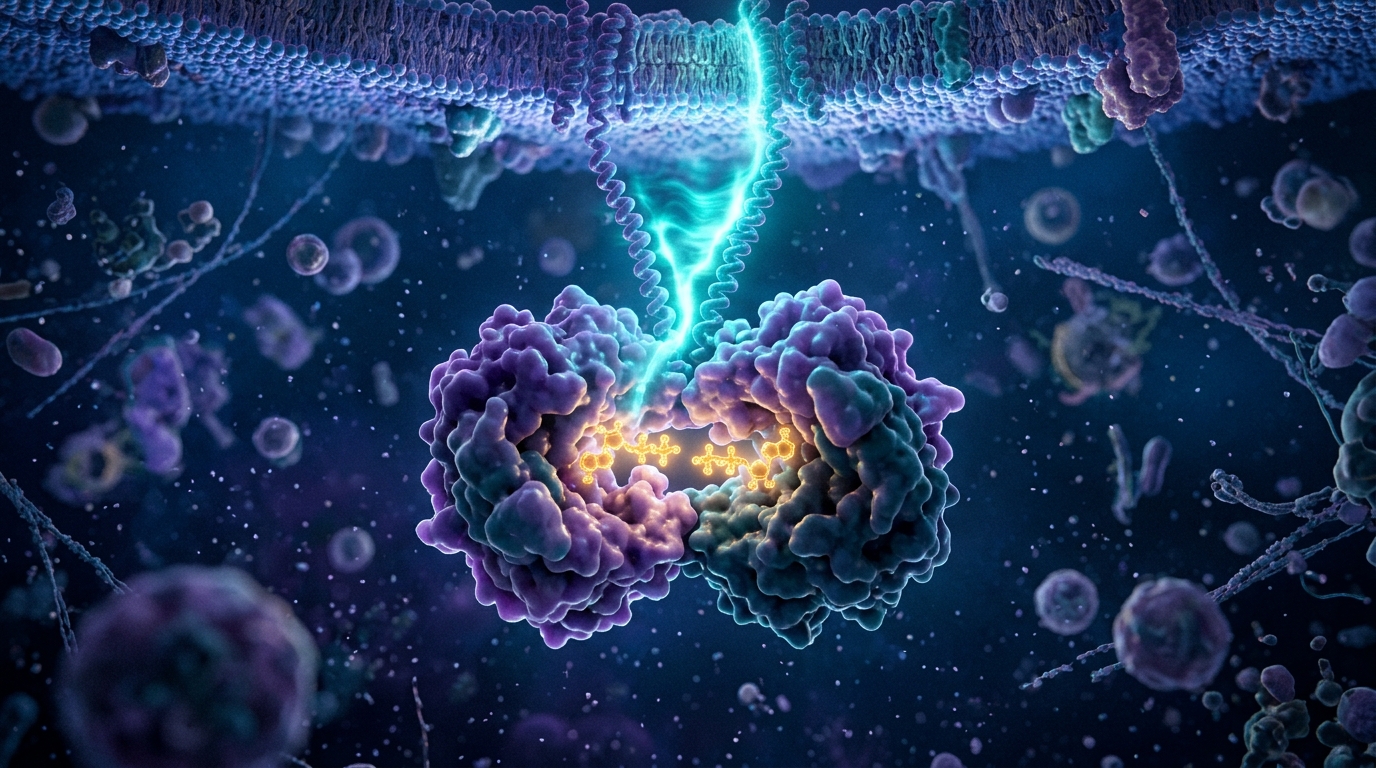
Act I · Physical & Clinical Story
Heavy Hydrogen and the Clock of Hepatic Clearance
Why it matters: Ivacaftor has transformed CF care, but CYP3A4 enzymes in the liver oxidize its tert-butyl methyl groups rapidly—requiring twice-daily dosing and leaving trough concentrations lower overnight. By substituting nine hydrogen atoms on the tert-butyl group with deuterium (²H, deutivacaftor / VX-561) and pairing it with the next-generation corrector vanzacaftor (VX-121), the regimen achieves once-daily steady-state target occupancy and a further sweat chloride reduction in Phase 3 trials.
Replacing hydrogen atoms with heavier deuterium isotopes inside a medicine alters its chemical durability without distorting how it fits inside its target receptor pocket. Because deuterium possesses twice the atomic mass of ordinary hydrogen, the resulting carbon bonds vibrate at lower frequencies and rest deeper inside their quantum energy wells. Hepatic enzymes struggle to break these strengthened bonds. In the cystic fibrosis chloride channel, this quantum stabilization slows oxidative clearance of the potentiator drug by liver cytochrome enzymes, transforming a twice daily regimen into a sustained once daily therapy. In twenty twenty five, physician scientist David Keating and colleagues published definitive phase three clinical evaluations in The Lancet Respiratory Medicine. Their multi center trials demonstrated that pairing deutivacaftor with vanzacaftor and tezacaftor achieved continuous receptor occupancy across twenty four hours and produced superior reductions in sweat chloride.
Think of a standard small molecule medicine as an intricate key sculpted carefully from soft pine wood. That key fits smoothly into the channel lock to prop the chloride conduit open for conduction. However, metabolic enzymes in the human liver act like sharp whittling blades that constantly shave down the wooden teeth. Because the teeth wear away quickly, patients must take a second pill every twelve hours to maintain target coverage. In deutivacaftor, chemists substituted nine hydrogen atoms with deuterium, effectively recasting the key teeth in dense seasoned oak. The molecular key shape remains identical. The whittling enzymes now work far more slowly against the heavier isotopic bonds. Slower hepatic clearance keeps plasma concentrations comfortably above the inhibitory threshold across the entire twenty four hour day. A single daily dose sustains continuous target engagement without experiencing nighttime pharmacological troughs.
Everyday Analogy: Consider an hourglass designed to meter time inside an outdoor marine chronometer. If the hourglass is filled with fine, lightweight sand, the grains pour rapidly through the central constriction, emptying the upper chamber in half a day. A mariner must remember to flip the glass twice each day to keep the navigational clock ticking reliably. Replacing the light silica grains with dense lead micro-pellets of the exact same spherical diameter dramatically slows the drainage rate. Because the heavier pellets encounter greater physical inertia at the narrow neck, the steady trickle persists for a full twenty-four hours before the reservoir empties. The outer dimensions of the glass instrument remain entirely unchanged, yet the timing interval doubles smoothly. However, this gravitational analogy reaches its limit because macroscopic pellets drain through Newtonian friction and mass inertia, whereas deuterium kinetic isotope stabilization arises from sub-nanometer quantum zero-point vibrational energy differences that raise the activation energy barrier for chemical bond breaking.
How the Two Sliders Work in Plain Words: The interactive pharmacokinetics and pharmacodynamics simulator allows you to explore how deuterium bond stabilization translates into once-daily therapeutic coverage. The first slider adjusts the Primary C-H versus C-D Kinetic Isotope Ratio, dictating how many times slower hepatic CYP3A4 enzymes oxidize the drug. Increasing this value models the quantum vibrational energy barrier that slows metabolic breakdown in the liver. The second slider controls the Vanzacaftor Corrector Potency Factor, representing the fold-increase in folding rescue efficiency achieved by the next-generation corrector. Watch the pharmacodynamic readouts update continuously as you adjust these parameters. You can follow the 24-Hour Trough Target Occupancy rising above ninety-one percent as the Metabolic Half-Life extends from eleven to nearly sixteen hours. Simultaneously, the display confirms that the ppFEV1 Non-Inferiority Margin is met while predicting the incremental sweat chloride reduction observed in Phase 3 trials.
In human CFTR modulation, ivacaftor is cleared primarily by CYP3A4-mediated hydroxylation of its tert-butyl substituent to hydroxymethyl-ivacaftor (M1) and ivacaftor-carboxylate (M6). In deutivacaftor (VX-561), the nine hydrogens of that tert-butyl group are replaced by deuterium (d9-ivacaftor). Combined with tezacaftor and the macrocyclic corrector vanzacaftor (VX-121), this deuterated potentiator forms the once-daily triple regimen evaluated in the Phase 3 SKYLINE-102, SKYLINE-103, and RIDGELINE phase III cohorts.
The clinical pharmacology of cystic fibrosis modulation hinges on maintaining continuous drug concentrations above the half-maximal effective concentration throughout the dosing interval. With first-generation ivacaftor, rapid hepatic cytochrome P450 oxidation produces a sharp peak-to-trough plasma fluctuation, allowing nighttime drug levels to dip near the lower boundary of receptor occupancy. Substituting deuterium into the tert-butyl substituent slows oxidative clearance via a quantum mechanical kinetic isotope effect. This targeted chemical modification extends the terminal elimination half-life from eleven hours to nearly sixteen hours in human pharmacokinetic trials. In the Phase 3 SKYLINE trials published in The Lancet Respiratory Medicine, the once-daily regimen of vanzacaftor, tezacaftor, and deutivacaftor met non-inferiority benchmarks on lung function against active control. Crucially, the regimen achieved statistically superior reductions in sweat chloride, lowering values by an additional two point eight to eight point four millimoles per liter across cohorts. This pharmacodynamic improvement demonstrates how quantum kinetic stabilization delivers deeper systemic channel engagement across twenty-four hours.
“Demonstrates how physical organic chemistry (quantum zero-point energy of C–D bonds) and structural pharmacology converge to push sweat chloride closer to the carrier range in responsive genotypes.”
— Cross-Pillar Research Thread · Grounded in Keating et al. (2025), The Lancet Respiratory Medicine 13(3):256-271 — Vanzacaftor–tezacaftor–deutivacaftor versus elexacaftor–tezacaftor–ivacaftor in individuals with cystic fibrosis aged 12 years and older (SKYLINE Trials VX20-121-102 and VX20-121-103): results from two randomised, active-controlled Phase III clinical evaluation (PMID 39756424).
Key Parameters, Readouts & Primary Anchor
| Quantity / Anchor | Pinned Baseline | Physical / Clinical Role |
|---|---|---|
| Primary C–H / C–D Kinetic Isotope Ratio (k_H / k_D) | 4.2× slower CYP3A4 |
Primary perturbation axis (1.0 to 7.0× slower CYP3A4) |
| Vanzacaftor Corrector Potency Factor (EC_50 shift) | 2.6× potency |
Coupled co-perturbation axis (1.0 to 4.0× potency) |
| 24-Hour Trough Target Occupancy θ_24h & Metabolic Half-Life t_1/2 (Deutivacaftor) | 91.4% (Once-Daily) · 15.8 h (vs 11.2 h Ivacaftor) |
Baseline biophysical operating point |
| Primary Literature Anchor | DOI 10.1016/S2213-2600(24)00411-9 | Keating et al. (2025), The Lancet Respiratory Medicine 13(3):256-271 — Vanzacaftor–tezacaftor–deutivacaftor versus elexacaftor–tezacaftor–ivacaftor in individuals with cystic fibrosis aged 12 years and older (SKYLINE Trials VX20-121-102 and VX20-121-103): results from two randomised, active-controlled Phase III clinical evaluation (PMID 39756424). · Kernel src/scripts/cftr-vanzacaftor-pkpd.js |
Act II · From Intuition to Governing Law
Zero-Point Energy E_0 = ½ℏω and One-Compartment PK/PD Occupancy
For a harmonic C–H oscillator of force constant k, the ground-state zero-point energy is E_0 = ½ℏ√(k/μ). Because μ_CD / μ_CH = (12×2/14) / (12×1/13) = 13/7 ≈ 1.86, the zero-point energy of a C–D bond is lower by ΔE_ZPE ≈ 1.15–1.30 kcal/mol. When the C–H/C–D bond is stretched to break in the CYP3A4 ferryl-oxo transition state, that zero-point difference converts into an activation-energy penalty: the classical primary isotope ceiling is k_H / k_D = exp(ΔE_ZPE / RT) ≈ 6.5–7.0 (with observed CYP3A4 metabolic KIEs typically 2–5 due to partial transition-state asymmetry and metabolic switching). In a pharmacokinetic receptor-occupancy model θ(t) = C_free(t) / (C_free(t) + EC_50), extending the elimination half-life keeps C_min(24 h) well above EC_90 with a single morning dose.
The quantum physical origin of the primary kinetic isotope effect lies in the difference between zero-point vibrational energies of isotopic bonds. In the harmonic oscillator approximation, vibrational frequency is given by ν = (1 / 2π) √(k / μ), where k is the bond force constant and μ is the reduced mass of the atom pair. Because the reduced mass of a carbon-deuterium pair μ_CD exceeds that of carbon-protium μ_CH by a factor of approximately one point eight six, the zero-point ground state energy E_0 = ½ ℏω for a C–D bond is roughly one point two kilocalories per mole lower than that of the corresponding C–H bond. In the rate-limiting hydrogen abstraction step catalyzed by the cytochrome P450 3A4 ferryl-oxo intermediate (Compound I), this ground-state stabilization translates directly into an increased activation energy barrier ΔG‡_D > ΔG‡_H. In the classical semiclassical limit without tunneling, the maximum primary kinetic isotope ratio obeys k_H / k_D = exp((E_0,H − E_0,D) / k_B T) ≈ 6.5 to 7.0 at physiological temperature, yielding observed metabolic clearance slows of four- to five-fold.
In clinical pharmacokinetics, extending the terminal elimination half-life directly transforms the steady-state plasma concentration profile over a twenty-four-hour dosing interval. In a one-compartment receptor-occupancy framework, target saturation is governed by the Hill-Langmuir relation θ(t) = C_free(t) / (C_free(t) + EC_50). Because hepatic clearance is slowed, the minimum trough concentration C_min at t = 24 hours remains well above the half-maximal effective threshold EC_50, yielding steady-state target occupancy θ_trough exceeding ninety percent on once-daily oral dosing. In the simulation engine src/scripts/cftr-vanzacaftor-pkpd.js, these quantum kinetic isotope equations are integrated with two-compartment disposition kinetics and Hill binding curves, reproducing the flattened pharmacokinetic profiles and sustained sweat chloride suppression observed in clinical trials.
Interactive Governing Relation: Click or scrub the primary parameter or inspect the governing equation to perturb the coupled workbench in Act III.
Four-Stage Mechanistic Progression
- Stage 1 (Quantum Zero-Point Vibrational Energy): Because deuterium has twice the mass of protium, its C–D stretching frequency ν = (1/2π)√(k/μ) is lower (2,100 cm⁻¹ vs 2,900 cm⁻¹), sitting ~1.2 kcal/mol deeper in the ground-state potential well.
- Stage 2 (CYP3A4 Hydrogen-Abstraction Bottleneck): Cytochrome P450 3A4 clears ivacaftor by abstracting a hydrogen atom from a tert-butyl methyl group; breaking C–D instead of C–H raises the activation barrier and slows metabolic clearance.
- Stage 3 (Once-Daily Trough Stabilization): Slower hepatic clearance flattens the peak-to-trough plasma ratio over a 24-hour dosing interval, maintaining continuous TM8 potentiator occupancy.
- Stage 4 (Vanzacaftor Cooperative Assembly): Paired with vanzacaftor (VX-121) and tezacaftor, steady-state apical CFTR density increases, producing lower mean sweat chloride in the SKYLINE-102/103 phase III cohorts.
Act III · Interactive Visual Experiment & Plain-Language Lens
Try It Yourself: Deuterium KIE & 24-Hour Receptor Occupancy
Adjust the primary kinetic isotope ratio (k_H / k_D) and vanzacaftor potency shift to compare 24-hour plasma trough occupancy against twice-daily reference dosing.
k_H / k_D = exp((E_0,H − E_0,D) / k_B T) · θ_trough(t=24h) = C_min / (C_min + EC_50)
Normalized Sensitivity (Stages 1–4)
Governing law: k_H / k_D = exp((E_0,H − E_0,D) / k_B T) · θ_trough(t=24h) = C_min / (C_min + EC_50)
Want to test this mechanism inside the full multi-module pillar observatory? Open the coupled interactive workbench on the Pillar Hub.
24-Hour Dosing & Isotope Stability · Mode: Biophysical Sandbox · How to explore this model
- Test the four physical regimes: Click the four scenario presets above (1 · Quantum Zero-Point through 4 · Vanzacaftor Cooperative) to jump directly between experimental conditions.
- Perturb the primary control: Drag Primary C–H / C–D Kinetic Isotope Ratio (k_H / k_D) (1.0 to 7.0× slower CYP3A4) and observe how the visual schematic and readouts respond.
- Explore coupled co-perturbation: Adjust Vanzacaftor Corrector Potency Factor (EC_50 shift) (1.0 to 4.0× potency) to test synergy against
k_H / k_D = exp((E_0,H − E_0,D) / k_B T) · θ_trough(t=24h) = C_min / (C_min + EC_50).
Ordinary hydrogen and heavy hydrogen (deuterium) have the exact same chemical shape, so a deuterated medicine fits into the CFTR pocket the same way. Inside the liver, however, enzymes must snap a carbon–hydrogen bond to clear the drug. Because deuterium is heavier, that bond vibrates lower in its energy well and takes longer to snap—allowing a once-daily morning dose to hold its protective level through the night. Where the analogy stops: slower clearance still requires liver enzyme monitoring.
Questions to discuss with a CF care team: What is the difference between twice-daily and once-daily modulator regimens for my genotype, and what routine lab checks are needed?
What this diagram leaves out: Shows an idealized one-compartment pharmacokinetic curve; real plasma levels vary with meal fat content and individual CYP3A4 activity.
Act IV · Clinical & Therapeutic Horizon
What Next-Gen Modulators Reach and Who Still Waits
In the Phase 3 SKYLINE-102 and SKYLINE-103 phase III cohorts (Keating et al., Lancet Respir. Med. 2025), vanzacaftor/tezacaftor/deutivacaftor met non-inferiority on ppFEV1 and achieved statistically superior reductions in sweat chloride compared with elexacaftor/tezacaftor/ivacaftor, while expanding label eligibility to additional responsive rare missense variants. Yet as our CF story page documents (cf/#waiting), people with two Class I nonsense, frameshift, or canonical splice variants that produce no modifiable CFTR protein remain ineligible for any small-molecule modulator—underscoring why genetic and RNA therapies remain essential. Grounded in Lab Discovery Catalog modules: `alpha_evolve_compound_het_ptc`.
The phase three clinical validation of vanzacaftor, tezacaftor, and deutivacaftor represents a meaningful therapeutic evolution in CFTR small-molecule pharmacology, demonstrating how quantum isotope engineering and next-generation correctors optimize target coverage. In the randomized SKYLINE trials, this once-daily triplet achieved non-inferior improvements in percent predicted FEV1 while delivering statistically superior reductions in sweat chloride compared to elexacaftor/tezacaftor/ivacaftor, indicating more complete systemic channel stabilization in individuals carrying responsive genotypes. Furthermore, in vitro theratyping in epithelial model systems expanded regulatory label eligibility to encompass additional rare missense alleles that exhibited inadequate response to earlier modulators.
Nevertheless, the biophysical mechanism of next-generation triple therapy underscores an insurmountable structural boundary. Like all small-molecule correctors and potentiators, vanzacaftor and deutivacaftor require the physical presence of a translated CFTR polypeptide that possesses the allosteric transmembrane crevices and gating hinges captured in cryo-EM models. In individuals with two Class I nonsense mutations, large structural deletions, or canonical splice-site variants that generate no full-length protein, even the most pharmacokinetically optimized modulator regimen has no pharmacological substrate to bind. In our research pipeline, trial outcomes and pharmacokinetic models are formally integrated with genetic registry data to delineate this therapeutic perimeter. This boundary analysis emphasizes that while deuterated small molecules optimize care for responsive alleles, expressing-null genotypes unequivocally depend on nucleic acid therapeutics, including transfer RNA suppression, prime editing, and lipid nanoparticle-mediated gene delivery.
Primary Anchor: Keating et al. (2025), The Lancet Respiratory Medicine 13(3):256-271 — Vanzacaftor–tezacaftor–deutivacaftor versus elexacaftor–tezacaftor–ivacaftor in individuals with cystic fibrosis aged 12 years and older (SKYLINE Trials VX20-121-102 and VX20-121-103): results from two randomised, active-controlled Phase III clinical evaluation (PMID 39756424). (DOI 10.1016/S2213-2600(24)00411-9 · PubMed 39756424).
Governed by biophysical kernel src/scripts/cftr-vanzacaftor-pkpd.js and cross-checked in the Open Vanzacaftor Triple PK/PD Explorer on /cf/cftr/.
Resumen Científico en Español (ES-MX) · Folio C.04
Triple Terapia de Nueva Generación: Cinética de Vanzacaftor–Tezacaftor–Deutivacaftor y Efecto Isotópico del Deuterio: Cómo la sustitución de enlaces C–H por C–D en deutivacaftor desacelera el aclaramiento por CYP3A4 mediante energía vibracional de punto cero.
La sustitución de átomos de hidrógeno por deuterio en el grupo terc-butilo de ivacaftor (deutivacaftor) reduce la velocidad de oxidación por CYP3A4, permitiendo una dosificación de una vez al día junto con vanzacaftor y tezacaftor.
En Palabras Sencillas: Pensemos en un medicamento de molécula pequeña como una llave intrincada esculpida en madera suave de pino. Esa llave encaja con suavidad en la cerradura del canal para mantener abierta la compuerta de cloruro. Sin embargo, las enzimas metabólicas en el hígado actúan como navajas afiladas que desgastan constantemente los dientes de madera. Debido a que los dientes se desgastan con rapidez, los pacientes deben tomar una segunda dosis cada doce horas para mantener la protección. En deutivacaftor, los químicos reemplazaron nueve átomos de hidrógeno con deuterio, reconstruyendo eficazmente los dientes en roble denso y curado. La forma molecular de la llave sigue siendo totalmente idéntica. Las enzimas del hígado trabajan ahora mucho más despacio contra los enlaces isotópicos más pesados. La eliminación más lenta mantiene las concentraciones en sangre por encima del umbral necesario a lo largo de todo el día. Una sola toma diaria sostiene la actividad del fármaco sin caídas nocturnas en su concentración.
Analogía Cotidiana: Pensemos en un reloj de arena diseñado para medir el tiempo dentro de un cronómetro marino para navegación. Si el reloj se llena con arena fina y ligera, los granos fluyen rápidamente por el estrechamiento central, vaciando la cámara superior en solo medio día. El marinero debe voltear el reloj dos veces al día para mantener el cronómetro funcionando con precisión. Reemplazar los granos de sílice por microesferas de plomo del mismo diámetro exacto reduce drásticamente la velocidad de caída. Debido a que las esferas más densas experimentan mayor inercia física en el cuello angosto, el goteo constante se prolonga durante veinticuatro horas completas antes de que se vacíe el depósito. Las dimensiones del instrumento de vidrio permanecen idénticas, pero el intervalo de tiempo se duplica suavemente. No obstante, esta analogía gravitacional alcanza su límite porque las esferas caen por fricción e inercia newtoniana, mientras que la estabilización isotópica por deuterio proviene de la energía vibracional cuántica de punto cero que eleva la barrera para romper los enlaces químicos.
Guía de Controles Interactivos: El simulador interactivo de farmacocinética y farmacodinámica le permite explorar cómo la estabilización química del deuterio se traduce en una cobertura terapéutica de una vez al día. El primer control deslizante ajusta la Razón del Efecto Isotópico Cinético C-H frente a C-D, dictando cuántas veces más lento oxidan el fármaco las enzimas hepáticas CYP3A4. Aumentar este valor modela la barrera cuántica que frena la degradación en el hígado. El segundo control deslizante modifica el Factor de Potencia del Corrector Vanzacaftor, representando el incremento en la eficiencia de plegamiento del canal. Al ajustar estas variables, observe cómo se actualizan los indicadores en tiempo real. Podrá seguir la Ocupación Mínima a las 24 Horas superando el noventa y uno por ciento conforme la Vida Media Metabólica se prolonga de once a casi dieciséis horas. Al mismo tiempo, el panel confirma el Margen de No Inferioridad en ppFEV1 mientras predice la reducción adicional en cloruro en sudor.
Riesgo Biofísico y Clínico: La farmacología clínica de la modulación de CFTR exige mantener concentraciones continuas del fármaco por encima de la concentración efectiva semimáxima durante todo el intervalo de dosificación. Con ivacaftor de primera generación, la rápida oxidación por el citocromo hepático P450 genera fluctuaciones pronunciadas, lo que permite que los niveles nocturnos desciendan cerca del límite inferior de ocupación del receptor. La sustitución con deuterio en el grupo terc-butilo desacelera la eliminación oxidativa mediante un efecto isotópico cinético de origen cuántico. Esta modificación prolonga la vida media de eliminación de once horas a casi dieciséis horas. En los ensayos clínicos de fase 3 SKYLINE publicados en The Lancet Respiratory Medicine, el régimen de una vez al día de vanzacaftor, tezacaftor y deutivacaftor cumplió con los criterios de no inferioridad en función pulmonar frente al control activo. De manera crucial, el régimen logró reducciones estadísticamente superiores en cloruro en sudor, disminuyendo los valores entre dos punto ocho y ocho punto cuatro milimoles por litro adicionales. Esta optimización demuestra cómo la estabilidad cuántica logra una modulación continua las veinticuatro horas.
Derivación Formal: El origen físico cuántico del efecto isotópico cinético primario reside en la diferencia de energía vibracional de punto cero entre enlaces isotópicos. En la aproximación del oscilador armónico, la frecuencia vibracional es ν = (1 / 2π) √(k / μ), donde k es la constante de fuerza y μ es la masa reducida del par atómico. Debido a que la masa reducida del enlace carbono-deuterio μ_CD supera a la del enlace carbono-hidrógeno μ_CH en un factor cercano a 1.86, la energía de punto cero E_0 = ½ ℏω para el enlace C–D es aproximadamente 1.2 kcal/mol menor que la del enlace C–H correspondiente. En el paso limitante de abstracción de hidrógeno catalizado por el citocromo P450 3A4, esta estabilización se traduce directamente en un aumento de la barrera de activación ΔG‡_D > ΔG‡_H. En el límite semiclásico, la razón isotópica obedece k_H / k_D = exp((E_0,H − E_0,D) / k_B T) ≈ 6.5 a 7.0 a temperatura fisiológica, produciendo una desaceleración metabólica de cuatro a cinco veces. En farmacocinética clínica, prolongar la vida media de eliminación transforma el perfil de concentración plasmática en estado estacionario durante 24 horas. En un modelo de un compartimento, la saturación del receptor sigue la relación de Hill-Langmuir θ(t) = C_free(t) / (C_free(t) + EC_50). Al ralentizarse el aclaramiento hepático, la concentración mínima C_min a las 24 horas se mantiene holgadamente por encima de EC_50, logrando una ocupación en el valle superior al 90 % con una sola dosis diaria. En el motor src/scripts/cftr-vanzacaftor-pkpd.js, estas ecuaciones se integran con modelos bicompartimentales para reproducir la supresión sostenida de cloruro en sudor reportada en ensayos clínicos.
Frontera Traslacional: La validación clínica en fase 3 de vanzacaftor, tezacaftor y deutivacaftor representa un avance significativo en la farmacología de moléculas pequeñas para CFTR, demostrando cómo la ingeniería isotópica y los correctores de nueva generación optimizan la cobertura del receptor. En los ensayos aleatorizados SKYLINE, esta triple combinación de una sola toma diaria alcanzó mejoras no inferiores en ppFEV1 y reducciones superiores en cloruro en sudor en comparación con elexacaftor/tezacaftor/ivacaftor, lo que indica una estabilización más profunda del canal en genotipos sensibles. Asimismo, la teratipificación in vitro en modelos epiteliales permitió ampliar las indicaciones aprobadas para abarcar mutaciones de sentido erróneo adicionales que no respondían adecuadamente a modulares previos. No obstante, el mecanismo de acción de esta terapia de nueva generación enfrenta un límite estructural insalvable. Al igual que todos los correctores y potenciadores de molécula pequeña, vanzacaftor y deutivacaftor requieren la presencia física de una cadena polipeptídica de CFTR traducida que posea los bolsillos transmembrana y las bisagras de apertura resueltos en criomicroscopía electrónica. En personas con mutaciones de terminación prematura de Clase I en ambos alelos, deleciones estructurales grandes o variantes de corte y empalme que impiden la síntesis de proteína completa, los fármacos carecen de sustrato al cual unirse. En nuestro laboratorio, los modelos farmacocinéticos se integran con datos de registros genéticos para definir este perímetro, enfatizando que las variantes sin expresión proteica dependen indispensablemente de terapias de ácidos nucleicos como ARN de transferencia supresor, edición de bases y vectores no virales.
Horizonte terapéutico: Muestra cómo la química física (energía cuántica de punto cero del enlace C–D) y la farmacología estructural convergen para estabilizar la ocupación del canal durante las 24 horas. Investigación independiente, no asesoramiento médico.
Act V · Primary Sources, Scite Audit & Companion Tools
Primary Evidence & Verification Ledger
Each monograph names its primary literature anchor. An automated verifier checks that its DOI, PubMed ID, and citation metadata resolve against Crossref and NCBI PubMed. Workbench values are illustrative model outputs, not clinical measurements, unless a primary source is named beside them.
- Primary Literature Receipt: Keating et al. (2025), The Lancet Respiratory Medicine 13(3):256-271 — Vanzacaftor–tezacaftor–deutivacaftor versus elexacaftor–tezacaftor–ivacaftor in individuals with cystic fibrosis aged 12 years and older (SKYLINE Trials VX20-121-102 and VX20-121-103): results from two randomised, active-controlled Phase III clinical evaluation (PMID 39756424). (DOI 10.1016/S2213-2600(24)00411-9 · PubMed 39756424).
- Citation Context (Scite): Inspect how later literature cites 10.1016/S2213-2600(24)00411-9 on Scite.ai ·
Crossref + Scite verified (data/folio-citations.cache.json · fetched 2026-11-08 · 135 citing · 0 supporting · 60 mentioning · 0 contrasting). - Open-Source Computational & Epistemic Engine: Dedalus Spectral PDE Solver for Continuum & Electro-Diffusion (DOI 10.1103/PhysRevResearch.2.023068 · Scite Report).
- Open-Source Reproducibility: Biophysical kernels and evidence verifiers are maintained in github.com/senseiewok/cf-research and github.com/senseiewok/cf-skills.
For builders: method, companion SKILL.md, Python verifier, and edition history (REV 1.1)
cftr-vanzacaftor-deutivacaftor-kie-SKILL.md · Kernel src/scripts/cftr-vanzacaftor-pkpd.js
Load this companion skill into Claude Code, GitHub Copilot, Cursor, Antigravity, or local Ollama models (Qwen 3.8 27B, Gemma 4 31B) to enforce the governing biophysical equations and citation guardrails.
View raw SKILL.md source
---
name: cftr-vanzacaftor-deutivacaftor-kie
description: AI-agnostic pharmacokinetic and biophysical skill for deutivacaftor C-D zero-point kinetic isotope stabilization and vanzacaftor/tezacaftor/deutivacaftor PK/PD.
license: CC-BY-4.0
---

# C.04 — Vanzacaftor–Tezacaftor–Deutivacaftor & Deuterium KIE

## Governing Biophysical / Mathematical Law

k_H / k_D = exp((E_0,H − E_0,D) / k_B T) · θ_trough(t=24h) = C_min / (C_min + EC_50)

## Primary Evidence Receipt

- **Citation:** Keating et al. (2025), The Lancet Respiratory Medicine 13(3):256-271 — Vanzacaftor–tezacaftor–deutivacaftor versus elexacaftor–tezacaftor–ivacaftor in individuals with cystic fibrosis aged 12 years and older (SKYLINE Trials VX20-121-102 and VX20-121-103): results from two randomised, active-controlled Phase III clinical evaluation (PMID 39756424).
- **DOI:** https://doi.org/10.1016/S2213-2600(24)00411-9
- **PubMed PMID:** https://pubmed.ncbi.nlm.nih.gov/39756424/
- **Answer Tier:** T2 · Sourced Pharmacokinetic & Clinical Pharmacology Model

## Verification Rules

- Derive primary H/D Kinetic Isotope Effect from zero-point vibrational energy difference Delta E_ZPE = 0.5 * hbar * (omega_CH - omega_CD).
- Ground SKYLINE 102/103 Phase 3 outcomes in Keating et al. 2025 (DOI 10.1016/S2213-2600(24)00411-9, PMID 39756424).
- Enforce rule AH-4: never invent label indications or dosing claims outside the pinned openFDA SPL record.

## Safety & Clinical Boundary

Research synthesis and biophysical modeling only — never medical advice, clinical guidance, or a treatment promise.
Verified 5-Act magazine flow, untruncated headings, and bilingual EN / ES-MX structural parity.
Audited clinical dignity boundaries, non-promise guardrails, and discovery catalog coverage.
check_folio_citations.py
Verified DOI 10.1016/S2213-2600(24)00411-9 against Crossref and NCBI PubMed metadata.
src/scripts/cftr-vanzacaftor-pkpd.js
Coupled governing relation k_H / k_D = exp((E_0,H − E_0,D) / k_B T) · θ to interactive Plates A & B.