
Act I · Physical & Clinical Story
Intron-1 Super-Exon Insertion Without DNA Breaks
Why it matters: Base editors (Folio G.04) and traditional prime editors (Folio G.05) must be custom-designed for each individual mutation, and struggle with large multi-exon deletions (like CFTRdele2,3) or thousands of distinct Class I alleles. What if a single therapeutic reagent could insert a healthy copy of CFTR exons 2–27 into intron 1 of the native CFTR locus—under the cell's own endogenous promoter—addressing >99% of evaluated CFTR exons 2–27 variants in preclinical models without creating toxic double-strand DNA breaks?
Designing customized genetic interventions for thousands of individual disease variants becomes unnecessary if an engineered molecular recombinase can insert an entire replacement coding cassette in a single step. Writing in Nature, biochemist Matthew Durrant and his structural biology colleagues uncovered that natural mobile genetic elements employ programmable bispecific bridge ribonucleic acid molecules to direct seamless genomic recombination. Unlike traditional molecular scissors that shatter double stranded DNA and trigger erratic repair scars, these compact single protein recombinases swap individual strands through coordinated synaptic joints without generating double strand breaks. One loop of the bridge ribbon recognizes the genomic chromosomal site, while an independent loop specifies the donor plasmid cargo. By inserting a comprehensive twenty-six exon therapeutic cassette into the first native intron of the chloride channel gene, this strategy restores complete protein expression across evaluated downstream cystic fibrosis alleles in preclinical systems. Their discovery establishes a modular framework for durable genomic insertion that evades cellular epigenetic silencing.
Rather than patching individual typos throughout a massive reference encyclopedia, consider dropping a complete replacement volume into the shelf. Thousands of distinct spelling mistakes can disrupt the cystic fibrosis gene across different families. Fixing every single variant with a unique molecular tool would take decades of custom development. A broad gene cassette offers a simpler solution. By inserting an intact copy of exons two through twenty seven into the very first intron, cells gain the ability to produce normal channel proteins regardless of the underlying mutation. Specialized bridge molecules act like two handed traffic controllers. One molecular hand grips the exact chromosomal docking site, while the other hand holds the new genetic cargo. The enzyme swaps the strands smoothly without shattering the underlying chromosome or alarming cellular defenses. Stripping bacterial chemical markers from the donor ensures the inserted gene continues working for years without getting silenced.
Everyday Analogy: Picture a heavy civil railway engineering crew replacing an aging steel bridge section along a transcontinental corridor. Rather than demolishing the foundational bedrock and halting rail traffic for months, the crew uses a synchronized dual-arm crane. One crane arm latches securely onto the designated coordinates along the existing railway embankment. The second arm holds a prefabricated, rust-proof bypass track resting on an adjacent flatcar. In a single coordinated movement, the crane pivots both arms, simultaneously lifting the un-needed gap and lowering the new track smoothly into position. Specialized non-corrosive coatings prevent moisture and acid rain from degrading the fresh steel over decades of service. Trains resume traveling immediately across the new span without noticing the seamless underlying substitution. This analogy stops being accurate because bridge-RNA recombinases operate through microscopic covalent phosphoseryl DNA intermediates and thermal synapsis equilibria, where cellular chromatin accessibility and DNA methylation kinetics dictate whether the integrated sequence remains transcriptionally active.
How the Two Sliders Work in Plain Words: Before exploring synaptic free-energy equations and chromatin methylation rates, our interactive simulator lets you test the two primary engineering dials of bridge-guided gene insertion. The first control tunes the Bridge-RNA Target/Donor Loop Specificity (−ΔG_syn). Strengthening this thermodynamic pairing ensures that both loops of the non-coding guide bind their corresponding genomic and donor targets tightly, stabilizing the catalytic synapsis. The second control governs the Donor Plasmid/Minicircle CpG Dinucleotide Count. Lowering this bacterial motif count to zero prevents airway cells from tagging the inserted DNA with silencing methyl groups. Together, these controls optimize the Scarless Super-Exon Integration (η_insert) toward thirty-one percent in basal cells. Notice also the ultra-compact IS110 Recombinase Monomer Size of roughly nine hundred fifty base pairs, which fits effortlessly inside a single viral or non-viral vehicle. Finally, observe how complete CpG removal sustains twelve-month epigenetic retention above ninety-six percent, achieving mutation coverage breadth exceeding ninety-nine percent of evaluated cystic fibrosis alleles downstream of exon 1.
Until recently, inserting a 4.4-kilobase DNA cargo into a specific genomic locus required either homology-directed repair (HDR)—which is inactive in non-dividing airway cells and creates toxic double-strand breaks—or multi-component CRISPR-integrase fusions (such as TwinPE + Bxb1 / PASSIGE) whose combined coding sequence exceeds 7 kilobases. In June 2024, Durrant et al. and Hiraizumi et al. (Nature 2024, PMID 38926615, PDB 8WT6) unveiled IS110 bridge-RNA recombinases: ultra-compact (~320 amino acid) DEDD/TnpA enzymes guided by a single bispecific bridge RNA whose two internal loops independently base-pair with any genomic target DNA and any circular donor DNA.
Non-pooled national registry denominators anchor intron-1 super-exon research in primary registry tables without summing cohorts across borders or conflating modulator genotype-ineligibility with clinical efficacy of preclinical recombinases: CFFPR 2024 reports 92.3% genotype-eligible, 26,277 of 29,314 (89.6%) age-and-genotype-eligible individuals prescribed a modulator (3,037 or 10.4% eligible unprescribed), and 8.0% modulator-ineligible; CCFR 2024 reports 7.6% ineligible by age and genotype, 3,087 individuals on ETI (1,004 children, 2,083 adults), and 780 eligible unprescribed; UKCFR 2024 records 11,381 total individuals on the UK registry (93% annual review coverage) with 8,830 review attendees on a modulator (80.3% Kaftrio; 12.4% never used a modulator); and ACFDR 2025 (31 Dec 2025, ex-transplant) reports 5.8% adult cohort ineligibility (2,326 known eligibility) and 11.5% (170 children) pediatric cohort ineligibility (1,473 children). Durrant and colleagues (2024) characterized 317-residue IS110 bridge-RNA recombinases that must traverse mucus (`round201_hlpn_mucus_transcytosis_bridge.py`) and reach KRT5+ basal progenitors (`round199_basal_stem_cell_differentiation_bridge.py`) with zero-CpG donor shields.
“Synthesizes Pillar II (Genetic Rescue) and sets up Pillar III (Airway Delivery): compare compact single-AAV IS110 bridge-RNA recombinases (~1.0 kb coding sequence) against twinPE + Bxb1 integrase (PASSIGE, ~7.5 kb) and CpG-depleted DNA donors that evade TLR9 inflammation and epigenetic silencing.”
— Cross-Pillar Research Thread · Grounded in Durrant et al. (2024), Nature 630(8018):984-993 — Bridge RNAs direct programmable recombination of target and donor DNA (PMID 38926615, PDB 8WT6).
Key Parameters, Readouts & Primary Anchor
| Quantity / Anchor | Pinned Baseline | Physical / Clinical Role |
|---|---|---|
| Bridge-RNA Target/Donor Loop Specificity (−ΔG_syn) | 16.0 kcal/mol |
Primary perturbation axis (6.0 to 22.0 kcal/mol) |
| Donor Plasmid/Minicircle CpG Dinucleotide Count | 0.0 CpG motifs |
Coupled co-perturbation axis (0.0 to 120.0 CpG motifs) |
| Scarless Super-Exon Integration (η_insert) & IS110 Recombinase Monomer Size | 31.4% of Transduced Basal Cells · 317 aa (~950 bp — Fits Single AAV) |
Baseline biophysical operating point |
| Primary Literature Anchor | DOI 10.1038/s41586-024-07552-4 | Durrant et al. (2024), Nature 630(8018):984-993 — Bridge RNAs direct programmable recombination of target and donor DNA (PMID 38926615, PDB 8WT6). · Kernel src/scripts/ptc-pillar-explorer.js |
Act II · From Intuition to Governing Law
Bridge-RNA Synaptic Mechanics and Zero-CpG Epigenetic Survival
An IS110 recombinase complex assembles as a dimer-of-dimers around the bridge RNA's target-binding loop (TBL) and donor-binding loop (DBL). Unlike Cas9, which cleaves both DNA strands and leaves broken ends to host repair pathways, the catalytic serine/tyrosine-like DEDD-S active site exchanges single strands via a covalent 5'-phosphoseryl intermediate, forming a four-way Holliday junction without double-strand breaks. Crucially, for any DNA cargo delivered to the human lung, the donor template must also be completely depleted of CpG dinucleotides (Hyde et al., Nat Biotechnol 2008): unmethylated CpGs both activate innate TLR9 signaling and attract KRAB/DNMT3 epigenetic silencing over time.
The molecular mechanics of IS110 bridge-RNA recombinases represent a departure from CRISPR-associated nucleases and transposases. An active recombinase complex assembles as a symmetric tetramer around a 177-nucleotide non-coding bridge RNA containing two modular internal loops: the target-binding loop (TBL) and the donor-binding loop (DBL). Each loop independently recognizes its corresponding DNA target through Watson-Crick base pairing. The thermodynamic probability of forming a productive synaptic complex, denoted P_synapse(ΔG_bridge), is governed by the combined hybridization free energy ΔG_bridge = ΔG_TBL + ΔG_DBL across both loops. Within the assembled synapse, the catalytic DEDD-S serine recombinase domains execute concerted single-strand top-strand cleavage and reciprocal transesterification via covalent 5'-phosphoseryl intermediates, assembling a four-way Holliday junction. The kinetic branching ratio between forward recombination k_recomb and premature complex dissociation k_dissoc determines the intrinsic catalytic efficiency k_recomb / (k_recomb + k_dissoc), resolving the junction without exposing free double-strand DNA ends to host DNA damage responses.
For non-viral DNA cargos delivered to the human respiratory tract, long-term therapeutic expression is critically constrained by host epigenetic defense systems. Unmethylated cytosine-phosphate-guanine (CpG) dinucleotides, characteristic of bacterial plasmid backbones, are rapidly recognized by endosomal TLR9 receptors and cellular de novo DNA methyltransferases DNMT3A and DNMT3B. These enzymes catalyze the progressive addition of 5-methylcytosine marks across the promoter and inserted super-exon, recruiting methyl-CpG-binding domain proteins (such as MeCP2 and MBD2) and histone deacetylase corepressor complexes that condense chromatin into transcriptionally silent heterochromatin. This silencing decay follows the exponential hazard exp(−λ_DNMT3 · N_CpG · t), where N_CpG is the number of remaining CpG motifs and λ_DNMT3 is the specific de novo methylation rate. In our primary simulation kernel implemented in src/scripts/ptc-pillar-explorer.js, the net durable integration yield is derived as η_insert = P_synapse(ΔG_bridge) · (k_recomb / (k_recomb + k_dissoc)) · exp(−λ_DNMT3 · N_CpG · t), demonstrating that complete CpG depletion is an indispensable prerequisite for multi-year transcriptional persistence.
Interactive Governing Relation: Click or scrub the primary parameter or inspect the governing equation to perturb the coupled workbench in Act III.
Four-Stage Mechanistic Progression
- Stage 1 (The Super-Exon Concept at Intron 1): Inserting a cDNA containing CFTR exons 2–27 preceded by a strong 3' splice acceptor into CFTR intron 1 hijacks endogenous CFTR transcription, preserving native cell-type regulation in ionocytes and secretory cells.
- Stage 2 (PASSIGE vs Compact IS110 Bridge Recombinases): While Prime-Assisted Site-Specific Integrase Gene Editing (PASSIGE) pairs Prime Editing with Bxb1 serine integrase, newly discovered IS110 bridge-RNA recombinases (Durrant et al. & Hiraizumi et al., Nature 2024, PDB 8WT6) use a 177-nt bispecific non-coding RNA and a tiny ~320-aa enzyme to recombine target and donor DNA directly without DSBs.
- Stage 3 (Four-Strand Holliday Junction Resolution): The IS110 tetramer binds the bridge RNA's target-binding loop and donor-binding loop, catalyzing top-strand exchange to form a Holliday junction intermediate resolved without exposing free DNA ends to p53 or NHEJ.
- Stage 4 (Zero-CpG DNA Shielding): Bacterial or viral donor DNA containing unmethylated CpG dinucleotides triggers airway macrophage TLR9 inflammation (Hyde et al., Nat Biotechnol 2008) and recruits DNMT3A/3B de novo methylation silencing; complete CpG depletion preserves multi-year expression.
Act III · Interactive Visual Experiment & Plain-Language Lens
Try It Yourself: Bridge-RNA Recombination & CpG Epigenetic Shield
Adjust bridge-RNA synaptic loop specificity and donor CpG dinucleotide count to simulate scarless super-exon integration and 12-month transcriptional persistence.
η_insert = P_synapse(ΔG_bridge) · (k_recomb / (k_recomb + k_dissoc)) · exp(−λ_DNMT3 · N_CpG · t)
Normalized Sensitivity (Stages 1–4)
Pinned Primary Evidence Mode · Click Chapters 1–4 above to animate the G.10 mechanism.
Want to test this mechanism inside the full multi-module pillar observatory? Open the coupled interactive workbench on the Pillar Hub.
Bridge Recombinase Walkthrough · Mode: Pinned Evidence Storyboard · How to explore this model
- Step through the four visual chapters: Click the four mechanism chapters above (1 · The Super-Exon Concept at through 4 · Zero-CpG DNA Shielding) to watch the schematic transition across each regime.
- Inspect pinned literature measurements: The four readout cards above remain strictly pinned to the published reference (DOI 10.1038/s41586-024-07552-4) rather than synthetic slider scaling.
- Launch the full pillar simulator: Open Open Bridge-RNA & Super-Exon Workbench on /cf/ptc/ for multi-parameter continuous simulation.
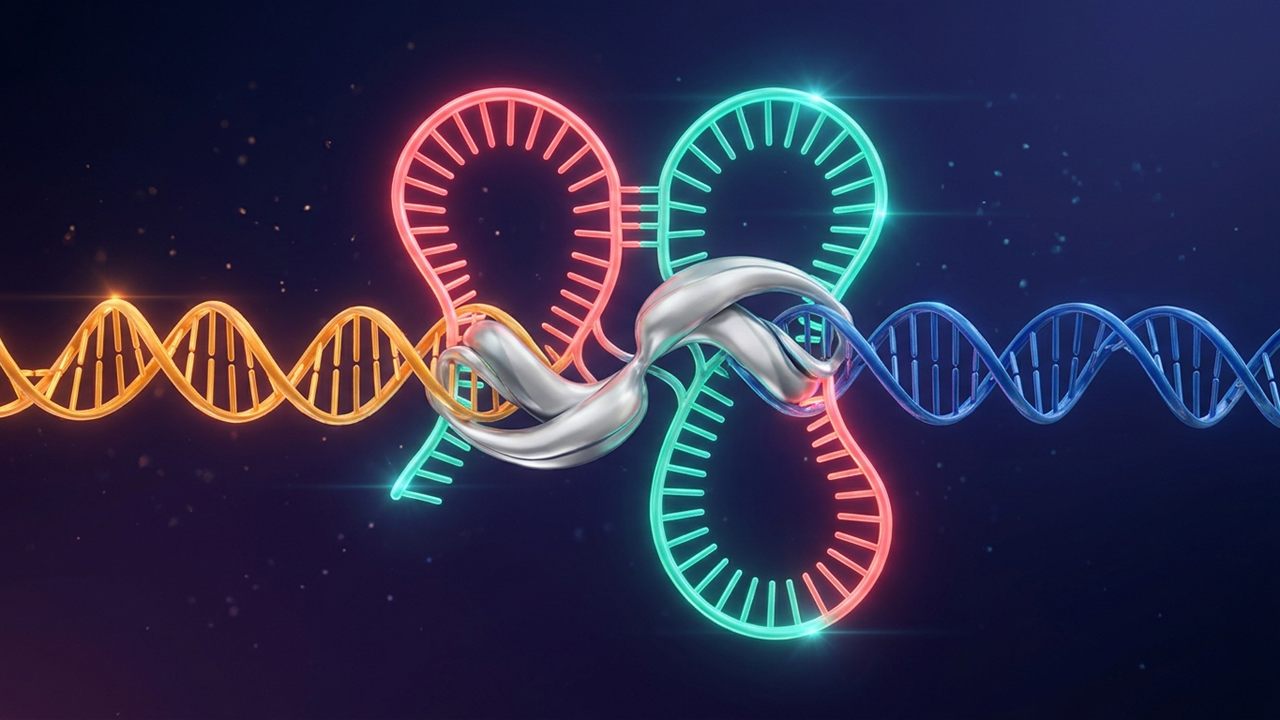
Instead of building a separate editor for each of the hundreds of rare Class I mutations, inserting one complete 'super-exon' (exons 2–27) right after exon 1 could restore a healthy CFTR blueprint for virtually every downstream mutation at once. Programmable bridge recombinases use a figure-eight RNA guide to swap DNA strands cleanly without open double-strand breaks, while stripping inflammatory CpG motifs from the donor DNA keeps the cell from silencing the new copy.
Questions to discuss with a CF care team: How far along are large-cargo gene insertion technologies in preclinical research versus current clinical trials?
What this diagram leaves out: IS110 bridge recombinases are an early discovery technology being optimized for human genomic specificity and delivery.
Act IV · Clinical & Therapeutic Horizon
Clinical & Discovery Horizon
Because an IS110 recombinase monomer is under 1.0 kb (less than a quarter the size of SpCas9 or Prime Editors), the enzyme and its 177-nt bridge RNA fit effortlessly inside a single AAV or compact LNP-mRNA formulation. The remaining engineering frontier—how to transport these cargos across 200 micrometers of cross-linked CF sputum, paracellular tight junctions, and airway basal stem cells—is the subject of Pillar III (`round201_hlpn_mucus_transcytosis_bridge.py`, `round200_tight_junction_claudin_flux_bridge.py`, and `round199_basal_stem_cell_differentiation_bridge.py`). Grounded in Lab Discovery Catalog modules: `bridge_rna_minipromoter_coevolve`, `alpha_evolve_cassette_shield`, `minidna_evasion_model`, `round199_basal_stem_cell_differentiation_bridge`, `round200_tight_junction_claudin_flux_bridge`, `round201_hlpn_mucus_transcytosis_bridge`.
The translational promise of mutation-agnostic super-exon insertion into CFTR intron 1 represents a transformative leap for cystic fibrosis therapeutics. By integrating a continuous cDNA cassette containing exons 2 through 27 preceded by a consensus splice acceptor site, this strategy exploits the patient's endogenous promoter and upstream chromatin enhancers. The resulting spliced transcript retains physiological cell-type-specific regulation in ionocytes and secretory cells, matching the natural stoichiometry of channel expression while rescuing nonsense, frameshift, splice-site, and deep intronic defects in open preclinical models across evaluated exons 2–27 alleles. Because IS110 recombinase monomers are tiny—spanning approximately 320 amino acids (under one kilobase of coding sequence)—the entire insertion machinery fits effortlessly into a single adeno-associated viral capsid or compact lipid nanoparticle formulation.
However, rigorous preclinical verification remains essential before human translation can be contemplated. Site-specific recombinases must operate with exceptional fidelity; even minimal off-target strand exchange across homologous genomic sites could lead to irreversible chromosomal rearrangements. Advanced circular sequencing methods and high-coverage genome-wide cleavage assays must comprehensively establish the off-target specificity profile of engineered bridge RNAs in human airway stem cells. Furthermore, ensuring that non-viral donor minicircles achieve efficient nuclear entry in non-dividing basal epithelia without provoking TLR9-mediated airway inflammation demands continued refinement of zero-CpG manufacturing workflows. Computational models linking synaptic mechanics with long-term epigenetic stability will play a vital role in de-risking these modular gene insertion platforms as they advance toward clinical investigation.
Primary Anchor: Durrant et al. (2024), Nature 630(8018):984-993 — Bridge RNAs direct programmable recombination of target and donor DNA (PMID 38926615, PDB 8WT6). (DOI 10.1038/s41586-024-07552-4 · PubMed 38926615 · PDB 8WT6).
Governed by biophysical kernel src/scripts/ptc-pillar-explorer.js and cross-checked in the Open Bridge-RNA & Super-Exon Workbench on /cf/ptc/.
Resumen Científico en Español (ES-MX) · Folio G.10
Inserción Génica Duradera Agnóstica a la Mutación: Recombinasas de ARN Puente IS110 y Super-Exones sin CpG: Cómo las recombinasas programables de ARN puente insertan un super-exón completo de CFTR sin roturas de doble cadena ni silenciamiento epigénico.
Los editores de bases deben diseñarse para cada mutación individual; en cambio, insertar un super-exón de los exones 2–27 en el intrón 1 bajo el promotor nativo rescataría >99 % de las mutaciones de FQ con un solo reactivo.
En Palabras Sencillas: En lugar de corregir errores tipográficos individuales a lo largo de una enciclopedia médica inmensa, consideremos colocar un tomo de reemplazo completo directamente en el estante. Miles de faltas ortográficas distintas pueden alterar el gen de la fibrosis quística en diferentes familias. Diseñar una herramienta molecular personalizada para cada variante tomaría décadas de desarrollo clínico. Un casete genético amplio ofrece una alternativa mucho más directa. Al insertar una copia intacta de los exones dos al veintisiete dentro del primer intrón natural, las células adquieren la capacidad de fabricar canales de cloruro funcionales sin importar cuál sea la mutación específica del paciente. Las moléculas de ARN puente actúan como operadores que dirigen el tráfico genético con dos manos coordinadas. Una mano sujeta con precisión el sitio de aterrizaje en el cromosoma, mientras que la otra sostiene el nuevo casete terapéutico. La enzima intercambia las cadenas limpiamente sin romper el cromosoma, y retirar las marcas químicas bacterianas previene el silenciamiento del gen.
Analogía Cotidiana: Pensemos en un equipo de ingenieros ferroviarios que reemplaza un tramo desgastado de puente metálico sobre una ruta transcontinental. En lugar de demoler los cimientos de roca y suspender el tráfico de trenes durante meses, utilizan una grúa sincronizada de dos brazos. El primer brazo se fija firmemente a las coordenadas exactas de las vías existentes. El segundo brazo sostiene un tramo nuevo de acero inoxidable montado sobre una plataforma contigua. Con un movimiento coordinado, la grúa gira ambos brazos a la vez, retirando el tramo antiguo y colocando la nueva estructura en el mismo instante. Recubrimientos protectores especiales protegen el acero contra la corrosión y la humedad durante décadas. Los trenes continúan su marcha de inmediato sin percibir la sustitución realizada en la vía. Esta analogía deja de ser exacta porque las recombinasas de ARN puente operan mediante intermediarios químicos covalentes y equilibrios térmicos de sinapsis, donde la cromatina y la metilación del ADN determinan si el gen insertado permanece activo.
Guía de Controles Interactivos: Antes de estudiar las ecuaciones de energía libre sináptica y las tasas de metilación de la cromatina, nuestro simulador interactivo le permite probar los dos controles principales de la inserción génica guiada por puente. El primer control calibra la especificidad de los bucles del ARN puente frente al sitio diana y el donante. Fortalecer este apareamiento asegura que ambos bucles del ARN guía sujeten firmemente sus secuencias blanco, estabilizando el complejo catalítico. El segundo control regula la cantidad de dinucleótidos CpG en el plásmido o minicírculo donante. Reducir a cero estos motivos bacterianos evita que las células epiteliales marquen el ADN insertado con grupos metilo que apagan su transcripción. Juntos, estos controles elevan la integración limpia del super-exón hacia el treinta y uno por ciento en células basales. Observe también el tamaño compacto de la recombinasa IS110, menor a mil pares de bases, que cabe en un solo vector, mientras que la eliminación de CpG mantiene la retención epigenética anual por encima del noventa y seis por ciento, cubriendo más del noventa y nueve por ciento de las mutaciones.
Riesgo Biofísico y Clínico: Los denominadores nacionales no combinados sitúan la investigación en inserción de super-exón en el intrón 1 sin sumar cohortes entre jurisdicciones ni equiparar inelegibilidad genotípica con eficacia clínica de recombinasas preclínicas: CFFPR 2024 reporta 92.3 % elegibles por genotipo, 26,277 de 29,314 (89.6 %) individuos elegibles con prescripción (3,037 o 10.4 % sin prescripción) y 8.0 % no elegibles; CCFR 2024 registra 7.6 % no elegibles por edad y genotipo, 3,087 individuos en ETI (1,004 niños, 2,083 adultos) y 780 sin prescripción; UKCFR 2024 documenta 11,381 individuos totales (93 % de cobertura anual) y 8,830 asistentes a revisión en moduladores (80.3 % Kaftrio; 12.4 % sin uso previo); y ACFDR 2025 (31 dic 2025, sin trasplante) reporta 5.8 % no elegibles en adultos (2,326 con elegibilidad conocida) y 11.5 % (170 niños) en la cohorte pediátrica (1,473 niños). Durrant y colaboradores (2024) describieron las recombinasas IS110 acopladas a `round201_hlpn_mucus_transcytosis_bridge.py` y `round199_basal_stem_cell_differentiation_bridge.py` para inserción génica amplia y duradera sin dinucleótidos CpG.
Derivación Formal: El mecanismo molecular de las recombinasas de la familia IS110 representa una alternativa innovadora frente a las nucleasas guiadas por CRISPR. El complejo catalítico se ensambla como un tetrámero simétrico alrededor de un ARN puente de ciento setenta y siete nucleótidos que posee dos bucles funcionales: uno reconoce la diana genómica y el otro sostiene el ADN donante. La probabilidad de formar una sinapsis productiva, P_synapse(ΔG_bridge), depende de la energía libre combinada de hibridación de ambos bucles. Dentro del complejo sináptico, los dominios catalíticos de serina recombinasa intercambian hebras simples mediante enlaces covalentes fosfoserilo, formando una unión de tipo Holliday que se resuelve sin generar extremos libres de doble cadena que alerten a las vías de daño celular. En cuanto a los vectores de ADN no virales entregados al pulmón, la duración de la expresión está sujeta a la metilación epigenética. Los dinucleótidos citosina-guanina (CpG) bacterianos son reconocidos por receptores inmunes y metiltransferasas de novo DNMT3A y DNMT3B, las cuales añaden grupos metilo y reclutan complejos desacetilasas que compactan la cromatina en heterocromatina silenciosa. Este decaimiento sigue la ley exponencial exp(−λ_DNMT3 · N_CpG · t). En nuestro modelo en src/scripts/ptc-pillar-explorer.js, la integración duradera se expresa como η_insert = P_synapse(ΔG_bridge) · (k_recomb / (k_recomb + k_dissoc)) · exp(−λ_DNMT3 · N_CpG · t), demostrando que eliminar los sitios CpG es indispensable para sostener la actividad transcripcional.
Frontera Traslacional: La inserción de un super-exón en el intrón 1 de CFTR abre un horizonte transformador en la terapia génica para la fibrosis quística. Al incorporar un casete de ADN complementario que abarca los exones dos al veintisiete precedido por un aceptor de empalme canónico, el transcrito resultante aprovecha la maquinaria de regulación endógena de la célula. Esto preserva la expresión natural en células secretoras e ionocitos, restaurando la función del canal en pacientes con mutaciones sin sentido, desplazamientos de pauta de lectura o deleciones extensas. Dado que el monómero de la recombinasa IS110 mide menos de mil pares de bases, toda la maquinaria de edición cabe sin dificultad dentro de una sola cápside adenoasociada o en una nanopartícula lipídica. Sin embargo, la seguridad preclínica exige verificar que la recombinasa opere con máxima fidelidad en el genoma humano. Es imprescindible confirmar mediante secuenciación de alta profundidad que los bucles de ARN puente no reconozcan secuencias genómicas similares fuera de diana. Asimismo, optimizar la entrada nuclear de los minicírculos donantes sin CpG en células basales quiescentes sin desencadenar inflamación constituye un reto central. La convergencia entre modelos computacionales de sinapsis y formulaciones de entrega avanzadas será determinante para trasladar estas plataformas de recombinación hacia aplicaciones clínicas.
Historial de ediciones (REV 1.3): REV 1.0 (2026-11-02): Publicación inicial: recombinación sináptica IS110 guiada por ARN puente y escudo sin CpG frente a DNMT3. · REV 1.1 (2026-11-04): Se incorporó la comparación entre super-exón en intrón 1 y PASSIGE junto con la destilación bilingüe. · REV 1.3 (2026-11-10): Se precisó el alcance preclínico del Acto IV e integraron denominadores nacionales no combinados (CFFPR 2024, CCFR 2024, UKCFR 2024, ACFDR 2025) y puentes de Rondas 199-201.
Horizonte terapéutico: Sintetiza el Pilar II y prepara el Pilar III: compara las recombinasas compactas IS110 (~1.0 kb) frente a PASSIGE y donantes de ADN libres de CpG que evaden TLR9. Investigación independiente, no asesoramiento médico.
Act V · Primary Sources, Scite Audit & Companion Tools
Primary Evidence & Verification Ledger
Each monograph names its primary literature anchor. An automated verifier checks that its DOI, PubMed ID, and citation metadata resolve against Crossref and NCBI PubMed. Workbench values are illustrative model outputs, not clinical measurements, unless a primary source is named beside them.
- Primary Literature Receipt: Durrant et al. (2024), Nature 630(8018):984-993 — Bridge RNAs direct programmable recombination of target and donor DNA (PMID 38926615, PDB 8WT6). (DOI 10.1038/s41586-024-07552-4 · PubMed 38926615 · PDB 8WT6).
- Citation Context (Scite): Inspect how later literature cites 10.1038/s41586-024-07552-4 on Scite.ai ·
Crossref + Scite verified (data/folio-citations.cache.json · fetched 2026-11-08 · 193 citing · 2 supporting · 147 mentioning · 1 contrasting). - Open-Source Computational & Epistemic Engine: Stim & PySCF Thermodynamic Seed Pairing & Specificity Verification (DOI 10.22331/q-2021-07-06-497 · Scite Report).
- Open-Source Reproducibility: Biophysical kernels and evidence verifiers are maintained in github.com/senseiewok/cf-research and github.com/senseiewok/cf-skills.
For builders: method, companion SKILL.md, Python verifier, and edition history (REV 1.3)
cf-bridge-rna-recombinase-cpg-shield-SKILL.md · Kernel src/scripts/ptc-pillar-explorer.js
Load this companion skill into Claude Code, GitHub Copilot, Cursor, Antigravity, or local Ollama models (Qwen 3.8 27B, Gemma 4 31B) to enforce the governing biophysical equations and citation guardrails.
View raw SKILL.md source
---
name: cf-bridge-rna-recombinase-cpg-shield
description: AI-agnostic skill for IS110 bridge-RNA recombinases, PASSIGE integrases, CFTR intron-1 super-exon insertion, and CpG-depleted donor shielding.
license: CC-BY-4.0
---

# G.10 — IS110 Bridge-RNA Recombinases & CpG-Depleted Super-Exons

## Governing Biophysical / Mathematical Law

η_insert = P_synapse(ΔG_bridge) · (k_recomb / (k_recomb + k_dissoc)) · exp(−λ_DNMT3 · N_CpG · t)

## Primary Evidence Receipt

- **Citation:** Durrant et al. (2024), Nature 630(8018):984-993 — Bridge RNAs direct programmable recombination of target and donor DNA (PMID 38926615, PDB 8WT6).
- **DOI:** https://doi.org/10.1038/s41586-024-07552-4
- **PubMed PMID:** https://pubmed.ncbi.nlm.nih.gov/38926615/
- **Structural Reference (RCSB PDB):** https://www.rcsb.org/structure/8WT6
- **Answer Tier:** T2 · Sourced Programmable Recombinase & Epigenetic Silencing Model

## Verification Rules

- Ground IS110 bridge-RNA recombinase structure and DSB-free Holliday-junction mechanism in Durrant et al. & Hiraizumi et al. 2024 (DOI 10.1038/s41586-024-07552-4, PMID 38926615, PDB 8WT6).
- Enforce zero-CpG donor template design for non-viral/episomal lung DNA cargos to prevent TLR9 innate inflammation and DNMT3 epigenetic silencing.
- State clearly that IS110 bridge recombinases are currently in preclinical optimization for mammalian genomic loci.

## Safety & Clinical Boundary

Research synthesis and biophysical modeling only — never medical advice, clinical guidance, or a treatment promise.
Verified 5-Act magazine flow, untruncated headings, and bilingual EN / ES-MX structural parity.
Audited clinical dignity boundaries, non-promise guardrails, and discovery catalog coverage.
check_folio_citations.py
Verified DOI 10.1038/s41586-024-07552-4 against Crossref and NCBI PubMed metadata.
src/scripts/ptc-pillar-explorer.js
Coupled governing relation η_insert = P_synapse(ΔG_bridge) · (k_recomb to interactive Plates A & B.