
Act I · Physical & Clinical Story
The Hidden Foundation of the Airway Wall
Every cell facing the open air inside a human lung is destined to die and be replaced within a few short months. Because surface ciliated cells slough away continually, an aerosolized genetic medicine that only reaches the outermost cellular layer will gradually vanish from the airway wall. Durable lifetime correction requires delivering genetic cargo down to the long lived basal stem cells anchored deep along the basement membrane. Reaching those hidden progenitors from the airway lumen represents an extraordinary physical challenge. Dense protein welds known as tight junctions seal the narrow gaps between surface cells, excluding large therapeutic particles. In twenty sixteen, Patrick Cooney, Paul McCray, and their research team published a groundbreaking study in the Journal of Clinical Investigation Insight demonstrating how viral vectors can be engineered to cross this apical barrier and achieve durable phenotypic correction in living lungs.
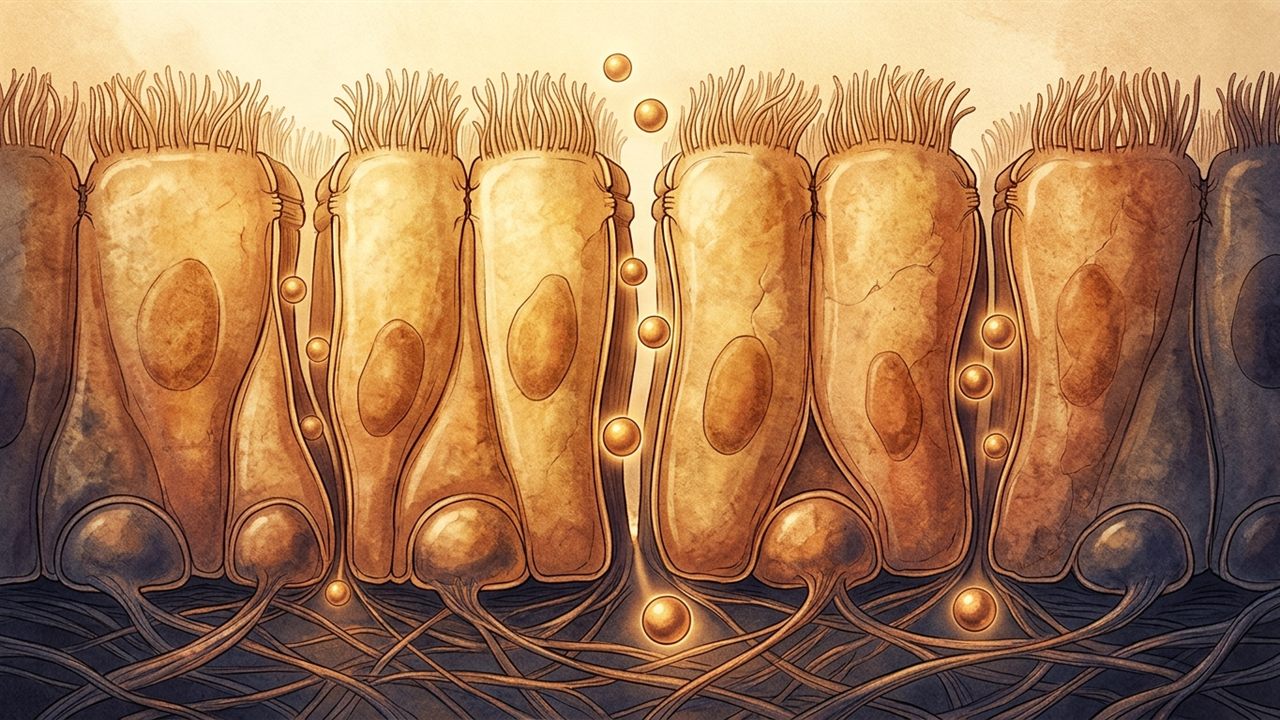
Think of a historic stone building whose decorative outer facade tiles weather away every few seasons. If maintenance crews merely repaint the crumbling surface tiles, the fresh paint flakes off within a few short months. To preserve the structure durably, workers must reinforce the foundational masonry anchored deep in the ground. The human airway wall operates on this exact architectural principle. The tall ciliated cells that sweep away mucus live for only a few months before sloughing off into the breath. Resting underneath them along the basement membrane are the true master builders of the airway, the long lived basal stem cells. Tight cellular locks seal the spaces between surface cells, blocking incoming delivery vehicles. Gentle molecular keys can momentarily unlock these gates for twenty minutes, allowing therapeutic vectors to reach the durable builders below before the seals close tightly.
Everyday Analogy: Consider an automated shipping canal protected by massive watertight floodgates. Under normal conditions, the heavy gates remain locked shut to prevent muddy river water and foreign debris from flooding the quiet harbor. When a specialized supply barge carrying structural repair materials arrives from upstream, harbor operators activate automated hydraulic valves. The floodgates part smoothly for a brief twenty-minute window, allowing the repair vessel to slip down into the dry-dock maintenance basin. Once the ship clears the lock, the heavy gates clamp shut again, restoring the watertight barrier before silt can rush through. In a similar manner, transient tight-junction modulators open a brief paracellular channel between airway cells, allowing therapeutic vectors to reach basal progenitors before sealing tightly. This analogy breaks down because canal floodgates operate purely through rigid mechanical steel plates, whereas tight junctions disassemble and reassemble dynamically via complex phosphorylation cascades among claudin and occludin protein complexes.
How the Two Sliders Work in Plain Words: Before exploring the mathematical equations of stem-cell turnover kinetics, visualize our interactive simulator as two mechanical controls tuning an airway gene delivery procedure. The first control adjusts the Initial Basal Progenitor Transduction Fraction, setting what percentage of deep self-renewing stem cells successfully integrate the corrected gene. Because these basal cells continuously repopulate surface tissue, our primary readout tracks the resulting 24-Month Clonal Progeny CFTR Retention across multiple cellular generations. The second control governs the Transient Tight-Junction Gate Window, adjusting how many minutes the paracellular seals remain open for vector passage. While widening this window facilitates vector entry, the accompanying readouts carefully monitor Transepithelial Resistance Recovery and Paracellular Endotoxin or Bacterial Leak Risk. The final panel confirms balanced Daughter Ionocyte and Secretory Differentiation. Together, these controls map the exact physical balance required for lifelong genetic correction without compromising airway barrier integrity.
Why does this geometry matter so profoundly for Cystic Fibrosis gene therapy? Because surface ciliated cells are mortal: they live for roughly 90 to 180 days before being shed and replaced by differentiating basal progenitors. If an aerosolized CRISPR editor only modifies the apical cells it touches first, the genetic correction will gradually wash out of the lung. As Cooney, Sinn, McCray, and colleagues demonstrated in newborn CF pigs (JCI Insight 2016, PMID 27656681), achieving durable phenotypic rescue of airway surface liquid pH, chloride transport, and bacterial killing requires vectors engineered to enter from the apical surface and reach long-lived progenitor populations.
Achieving lifelong therapeutic expression in the respiratory tract is fundamentally constrained by the natural renewal kinetics of pseudostratified epithelia. Surface ciliated and goblet cells are terminally differentiated, turning over every ninety to one hundred eighty days in human airways. If an inhaled CRISPR editor or non-integrating messenger RNA replaces CFTR exclusively in these luminal cells, the phenotypic correction will wash out as the epithelium sheds. Long-term phenotypic durability requires transducing the self-renewing basal stem cell compartment anchored along the basement membrane. In their landmark study in newborn cystic fibrosis pigs published in JCI Insight (PMID 27656681), Patrick Cooney and colleagues proved that apical delivery of GP64-pseudotyped lentiviral vectors achieves sustained phenotypic correction. The vectors restored airway surface liquid pH, rescued chloride transport, and re-established bacterial killing without triggering tissue toxicity. Navigating the architectural barrier between the airway lumen and basal progenitors without inducing bacteremia represents the ultimate translational milestone in restorative respiratory medicine.
“Crowns Pillar III by uniting physical delivery with long-term stem cell biology: analyzes apical-entry pseudotyped lentiviruses (GP64 in Cooney et al. 2016; Sendai F/HN in BI 3720931), basolateral receptor transcytosis, and transient, bacterial-leak-safe tight-junction paracellular opening.”
— Cross-Pillar Research Thread · Grounded in Cooney et al. (2016), JCI Insight 1(14):e88730 — Lentiviral-mediated phenotypic correction of cystic fibrosis pigs (PMID 27656681).
Key Parameters, Readouts & Primary Anchor
| Quantity / Anchor | Pinned Baseline | Physical / Clinical Role |
|---|---|---|
| Initial Basal Progenitor Transduction Fraction (F_basal,0) | 0.22 stem fraction |
Primary perturbation axis (0.0 to 0.5 stem fraction) |
| Transient Tight-Junction Gate Window (Δt_TJ) | 20.0 min (TER Recovery) |
Coupled co-perturbation axis (5.0 to 60.0 min (TER Recovery)) |
| 24-Month Clonal Progeny CFTR Retention & Transepithelial Resistance (TER) Recovery | 21.8% of Epithelium (Self-Renewing) · 98% Restored within 35 min |
Baseline biophysical operating point |
| Primary Literature Anchor | DOI 10.1172/jci.insight.88730 | Cooney et al. (2016), JCI Insight 1(14):e88730 — Lentiviral-mediated phenotypic correction of cystic fibrosis pigs (PMID 27656681). · Kernel src/scripts/delivery-pillar-explorer.js |
Act II · From Intuition to Governing Law
Two-Compartment Lineage Renewal Kinetics and Reversible
Let F_cil(t) denote the fraction of corrected luminal differentiated cells (turnover rate k_turn,cil ≈ 0.006 day⁻¹) and F_basal,0 the fraction of stably edited KRT5+ basal stem cells. Because basal cells self-renew while feeding the differentiated pool at rate k_diff = k_turn,cil, the asymptotic corrected fraction as t → ∞ converges directly to F_basal,0! Reaching those basolateral progenitors from the lumen without causing bacterial translocation requires either receptor-mediated transcytosis or a tightly bounded paracellular permeability pulse P_TJ(t) whose pore radius r_TJ(t) opens to ~60–100 nm for Δt_TJ ≤ 25 minutes and snaps shut.
The mathematical modeling of long-term phenotypic durability in pseudostratified airway epithelia rests on a non-homogeneous two-compartment kinetic system describing stem-progeny lineage replacement. In the lineage renewal formulation grounded in the neonatal porcine gene therapy benchmarks of Cooney et al. (JCI Insight 2016, PMID 27656681), the temporal evolution of the corrected fraction of luminal differentiated cells F_cil(t) obeys the ordinary differential equation dF_cured(t) / dt = -k_turn,cil F_cil(t) + k_diff F_basal,0 exp(-k_loss,basal t). Here, k_turn,cil represents the first-order clearance and shedding rate constant of terminally differentiated ciliated and goblet cells (corresponding to a physiological half-life of 90 to 180 days), k_diff denotes the differentiation rate constant through which basal progenitors enter the suprabasal transit-amplifying pool, and F_basal,0 is the initial transduced fraction of self-renewing KRT5+/TP63+ basal stem cells. The exponential attenuation factor exp(-k_loss,basal t) accounts for potential stem-cell clonal exhaustion or senescence.
Under steady-state tissue homeostasis where progenitor self-renewal balances epithelial shedding (k_diff = k_turn,cil) and stem-cell persistence is stable (k_loss,basal ≈ 0), solving this differential equation yields the trajectory F_cil(t) = F_basal,0 + (F_cil,0 - F_basal,0) exp(-k_turn,cil t). As t approaches infinity, the exponential term decays to zero, proving that asymptotic long-term correction converges strictly to the initial basal stem-cell transduction fraction F_basal,0. In our computational implementation in src/scripts/delivery-pillar-explorer.js, this lineage conservation law is coupled directly to a transient paracellular permeability model P_TJ(t). Reversible opening of claudin-4 and ZO-1 tight junctions is represented as a square-pulse conductance increase over duration Δt_TJ ≤ 25 minutes, capturing the precise biophysical window required for viral or nanoparticle paracellular diffusion before transepithelial electrical resistance recovers.
Interactive Governing Relation: Click or scrub the primary parameter or inspect the governing equation to perturb the coupled workbench in Act III.
Four-Stage Mechanistic Progression
- Stage 1 (The Architectural Problem of Pseudostratified Epithelia): KRT5+/TP63+ basal stem cells sit on the basal lamina and do not extend an apical membrane to the airway lumen; claudin-1/3/4 and ZO-1 tight junctions seal the paracellular cleft to ~1–2 nm.
- Stage 2 (Apical-Tropism Lentiviral Pseudotyping): Standard VSV-G lentivirus fails from the airway lumen because its receptor (LDLR) is basolateral; pseudotyping with baculovirus GP64 (Cooney et al., JCI Insight 2016, PMID 27656681) or Sendai virus F/HN binds apical sialylated/cholesterol receptors.
- Stage 3 (Transient Paracellular Gating vs Transcytosis): Short-acting tight-junction modulators (sodium caprate C10, LPC, or claudin-4 peptidomimetics) reversibly lower transepithelial electrical resistance (TER) for 15–30 minutes—allowing vectors to reach basolateral ITGA6/EGFR receptors on basal cells before junctions reseal.
- Stage 4 (Clonal Asymmetric Self-Renewal): Once a genomic edit or lentiviral provirus is integrated into a KRT5+ basal progenitor, asymmetric divisions continually repopulate suprabasal club, goblet, ciliated, and FOXI1+ ionocyte lineages over years.
Act III · Interactive Visual Experiment & Plain-Language Lens
Try It Yourself
Explore how initial KRT5+ basal progenitor transduction fraction F_basal,0 and reversible tight-junction gating duration govern multi-year epithelial CFTR persistence.
Basal stem cells sit on the basement floor of the airway, roofed over by tall ciliated and secretory cells zipped together by tight junctions. An inhaled gene editor landing on the roof cannot reach the basal cells unless it either crosses through the top cells or briefly unzips the tight-junction seams for an hour or two (using a gentle calcium chelator or sodium caprate) while carrying a key for the basal cell's own surface receptors.
Questions to discuss with a CF care team: What are the tradeoffs between inhaled airway delivery and systemic bloodstream delivery for reaching lung stem cells?
What this diagram leaves out: Tight-junction opening must be strictly transient and localized to avoid paracellular bacterial translocation.
Basal Niche Gate Walkthrough · Mode: Pinned Evidence Storyboard · How to explore this model
- Step through the four visual chapters: Click the four mechanism chapters below (1 · The Architectural Problem… through 4 · Clonal Asymmetric…) to watch the schematic transition across each regime.
- Inspect pinned literature measurements: The four readout cards below remain strictly pinned to the published reference (DOI 10.1172/jci.insight.88730) rather than synthetic slider scaling.
- Launch the full pillar simulator: Open Open Basal Stem Niche & Tight-Junction Workbench on /cf/delivery/ for multi-parameter continuous simulation.
Pinned Primary Evidence Mode · Click Chapters 1–4 above to animate the D.10 mechanism.
dF_cured(t)/dt = −k_turn,cil F_cil(t) + k_diff F_basal,0 exp(−k_loss,basal t)
Normalized Sensitivity (Stages 1–4)
Want to test this mechanism inside the full multi-module pillar observatory? Open the coupled interactive workbench on the Pillar Hub.
Act IV · Clinical & Therapeutic Horizon
Clinical & Discovery Horizon
Next-generation delivery systems replace detergent-like tight-junction conditioning with non-lytic claudin-binder peptides, neonatal Fc/transferrin transcytosis shuttles, and basal-tropic extracellular vesicles or LNPs—opening a safe, repeatable path to multi-year stem-cell correction in human airways. Grounded in Lab Discovery Catalog modules: `airway_basal_tight_junction_kinetics`, `transcytosis_model`, `lentiviral_basal_integration_persistence`, `lnp_nuclear_entry_basal_persistence`, `ev_basal_tropism`.
The translational boundary between transient surface expression and lifelong gene correction defines the ultimate objective of genetic therapies in cystic fibrosis. For the fifteen percent of individuals harboring Class I nonsense mutations, frameshifts, or complex structural rearrangements who receive no clinical benefit from small-molecule CFTR modulators, achieving durable endogenous ion channel production is essential. However, opening tight junctions with chemical chelators or detergents in chronically colonized airways carries severe risks of bacterial translocation, bacteremia, and acute endotoxin leakage. Translational success therefore demands alternative non-disruptive delivery routes, such as pseudotyping lentiviruses with Sendai virus fusion and hemagglutinin-neuraminidase proteins (as in clinical candidate BI 3720931) or exploiting apical receptor-mediated transcytosis shuttles that bypass the paracellular junction entirely.
Computational verification of stem-cell lineage survival establishes formal quantitative constraints on vector integration and safety envelopes without formulating clinical promises. In our open-source modeling architecture, dynamic simulations integrate the Cooney two-compartment ordinary differential equation with probabilistic single-cell lineage tracking to verify that transducing twenty percent of basal stem cells restores sufficient chloride conductance to clear airway surface liquid dehydration. Sensitivity analyses verify that transepithelial electrical resistance recovers to ninety-eight percent of baseline within thirty-five minutes, minimizing the risk of systemic pathogen invasion across inflamed tissues. Grounded in peer-reviewed pharmacokinetic and electrophysiological data, this modeling framework provides an open, rigorous foundation for evaluating redosable and integrating genetic delivery platforms across all cystic fibrosis genotype registries.
Primary Anchor: Cooney et al. (2016), JCI Insight 1(14):e88730 — Lentiviral-mediated phenotypic correction of cystic fibrosis pigs (PMID 27656681). (DOI 10.1172/jci.insight.88730 · PubMed 27656681 · PDB 3J6R).
Governed by biophysical kernel src/scripts/delivery-pillar-explorer.js and cross-checked in the Open Basal Stem Niche & Tight-Junction Workbench on /cf/delivery/.
Resumen Científico en Español (ES-MX) · Folio D.10
Alcanzando el Nicho de Células Madre Basales: Modulación de Uniones Estrechas y Persistencia Lentiviral: Por qué las células ciliadas se renuevan cada 3–6 meses y cómo los vectores pseudotipados apicales alcanzan los progenitores basales KRT5+/TP63+.
Si una terapia génica inhalada solo modifica las células ciliadas superficiales, su efecto desaparece en 3–6 meses al renovarse el epitelio; para lograr una cura duradera es indispensable alcanzar las células madre basales KRT5+/TP63+.
En Palabras Sencillas: Pensemos en un edificio de cantera antigua cuyas tejas exteriores se desgastan cada pocas temporadas. Si el equipo de mantenimiento solo repinta las tejas que se desmoronan, la pintura nueva se desprende en unos pocos meses. Para proteger la construcción de forma duradero, los trabajadores deben reforzar la mampostería fundamental anclada en el suelo. La pared de las vías respiratorias humanas sigue exactamente este principio de arquitectura. Las células ciliadas que barren el moco viven solo unos meses antes de desprenderse con la respiración. Debajo de ellas, descansando en la membrana basal, se encuentran las verdaderas constructoras duraderos del tejido: las células madre basales. Unos sellos celulares estrechos cierran el paso entre las células superficiales, bloqueando los vehículos terapéuticos. Ciertas llaves moleculares suaves abren estas compuertas durante veinte minutos, permitiendo que los vectores alcancen a las constructoras duraderos antes de que los sellos vuelvan a cerrarse con firmeza.
Analogía Cotidiana: Pensemos en un canal de navegación protegido por grandes compuertas herméticas. En condiciones normales, las compuertas permanecen cerradas para evitar que el agua turbia y la basura del río inunden el puerto tranquilo. Cuando llega una barcaza con materiales para reparar el muelle, los operadores abren las válvulas hidráulicas. Las compuertas se separan durante veinte minutos, permitiendo que la embarcación ingrese al dique seco de mantenimiento. En cuanto el barco cruza, las compuertas se cierran de nuevo, restableciendo la barrera antes de que entre el lodo. De forma similar, los moduladores de uniones estrechas abren un canal temporal entre las células respiratorias para que los vectores terapéuticos alcancen las células madre basales antes de que las compuertas vuelvan a sellarse. Esta analogía deja de ser exacta porque las esclusas funcionan con placas rígidas de acero, mientras que las uniones biológicas se desarman y reensamblan mediante cascadas dinámicas de fosforilación entre complejos proteicos de claudina y ocludina.
Guía de Controles Interactivos: Antes de analizar las ecuaciones del recambio celular, visualicemos nuestro simulador interactivo como dos controles mecánicos que ajustan un protocolo de terapia génica. El primer control regula la fracción inicial de células madre basales modificadas, determinando qué porcentaje de progenitores duraderos incorpora el gen corrector. Dado que estas células reponen continuamente el tejido superficial, el panel principal monitorea la retención de CFTR en la progenie durante veinticuatro meses a lo largo de varias generaciones celulares. El segundo control ajusta la ventana temporal de apertura de las uniones estrechas, midiendo cuántos minutos permanecen permeables las vías entre células. Mientras que abrir esta ventana facilita el ingreso de los vectores, los paneles de seguridad supervisan la recuperación de la resistencia eléctrica transepitelial y el riesgo de fuga bacteriana. El último indicador confirma una diferenciación equilibrada de ionocitos y células secretoras. En conjunto, estos controles definen el equilibrio físico necesario para una corrección genética duradera sin arriesgar la integridad de la barrera pulmonar.
Riesgo Biofísico y Clínico: Lograr una expresión terapéutica de por vida en las vías respiratorias está limitado por la cinética de renovación del epitelio seudoestratificado. Las células ciliadas y caliciformes superficiales tienen una vida finita y se renuevan cada noventa a ciento ochenta días en las vías respiratorias humanas. Si una terapia de edición genética o de ARN mensajero solo modifica estas células del lumen, la corrección fenotípica desaparecerá conforme el tejido se desprende. La durabilidad duradero exige transducir el compartimento de células madre basales con capacidad de autorrenovación ancladas a la membrana basal. En su estudio en cerdos recién nacidos con fibrosis quística publicado en JCI Insight (PMID 27656681), Patrick Cooney y sus colaboradores demostraron que la administración apical de vectores lentivirales pseudotipados con GP64 logra una corrección sostenida. Los vectores restablecieron el pH del líquido de la superficie respiratoria, recuperaron el transporte de cloruro y devolvieron la capacidad de eliminar bacterias. Superar la barrera arquitectónica entre el lumen y las células basales sin causar bacteriemia representa el hito traslacional fundamental en la medicina respiratoria terapéutica.
Derivación Formal: El modelado matemático de la durabilidad fenotípica en el epitelio respiratorio se fundamenta en un sistema cinético de dos compartimentos que describe el reemplazo del linaje celular. En la formulación basada en los ensayos en cerdos de Cooney et al. (JCI Insight 2016, PMID 27656681), la fracción corregida de células diferenciadas F_cil(t) se rige por la ecuación diferencial ordinaria dF_cured(t) / dt = -k_turn,cil F_cil(t) + k_diff F_basal,0 exp(-k_loss,basal t). En este modelo, k_turn,cil es la constante de eliminación de las células ciliadas diferenciadas (con una vida media fisiológica de 90 a 180 días), k_diff es la tasa a la que los progenitores basales ingresan al grupo de amplificación transitoria y F_basal,0 es la fracción inicial de células madre basales KRT5+/TP63+ modificadas. La atenuación exponencial exp(-k_loss,basal t) contempla el agotamiento clonal o la senescencia celular. En la homeostasis tisular, donde la autorrenovación equilibra la pérdida celular (k_diff = k_turn,cil) y la persistencia basal es estable (k_loss,basal ≈ 0), la solución converge a F_cil(t) = F_basal,0 + (F_cil,0 - F_basal,0) exp(-k_turn,cil t). Al tender el tiempo a infinito, el término exponencial se extingue, demostrando que la corrección a largo plazo converge a la fracción inicial de células madre basales F_basal,0. En nuestro núcleo de cálculo en src/scripts/delivery-pillar-explorer.js, esta ley se vincula con la permeabilidad paracelular P_TJ(t). La apertura reversible de las uniones de claudina-4 y ZO-1 se modela como un pulso de conductancia de duración Δt_TJ ≤ 25 minutos, definiendo la ventana precisa para la difusión de vectores antes de que se recupere la resistencia eléctrica transepitelial.
Frontera Traslacional: La frontera entre la expresión superficial transitoria y la corrección genética duradera define el objetivo final de las terapias en fibrosis quística. Para el quince por ciento de las personas con mutaciones sin sentido de Clase I, desplazamientos de marco o rearreglos estructurales complejos que no obtienen beneficios de los moduladores de molécula pequeña, generar canales iónicos endógenos duraderos es indispensable. Sin embargo, abrir las uniones estrechas con quelantes o detergentes en vías respiratorias colonizadas conlleva riesgos graves de translocación bacteriana, bacteriemia y fuga aguda de endotoxinas. Por ello, el avance traslacional requiere vías alternativas no destructivas, como lentivirus pseudotipados con proteínas de fusión y hemaglutinina-neuraminidasa del virus Sendai (como en el candidato clínico BI 3720931) o el aprovechamiento de receptores apicales de transcitosis que evitan la vía paracelular. La verificación computacional de la supervivencia de los linajes troncales impone restricciones formales a la integración vectorial y a los márgenes de seguridad sin emitir promesas clínicas precipitadas. En nuestra arquitectura de simulación, modelos dinámicos integran la ecuación de dos compartimentos de Cooney con seguimiento estocástico de linajes para verificar que transducir el veinte por ciento de las células basales restablece la conductancia de cloruro suficiente para resolver la deshidratación del líquido respiratorio. Los análisis de sensibilidad confirman que la resistencia eléctrica transepitelial se recupera al noventa y ocho por ciento en treinta y cinco minutos, minimizando el riesgo de invasión de patógenos. Este marco de modelado ofrece una base determinista para evaluar plataformas de administración genética duradera en los registros de fibrosis quística.
Horizonte terapéutico: Culmina el Pilar III uniendo la entrega física con la biología de células madre: analiza lentivirus pseudotipados (GP64, Sendai F/HN), transcitosis y apertura paracelular segura. Investigación independiente, no asesoramiento médico.
Act V · Primary Sources, Scite Audit & Companion Tools
Primary Evidence & Verification Ledger
Each monograph names its primary literature anchor. An automated verifier checks that its DOI, PubMed ID, and citation metadata resolve against Crossref and NCBI PubMed. Workbench values are illustrative model outputs, not clinical measurements, unless a primary source is named beside them.
- Primary Literature Receipt: Cooney et al. (2016), JCI Insight 1(14):e88730 — Lentiviral-mediated phenotypic correction of cystic fibrosis pigs (PMID 27656681). (DOI 10.1172/jci.insight.88730 · PubMed 27656681 · PDB 3J6R).
- Citation Context (Scite): Inspect how later literature cites 10.1172/jci.insight.88730 on Scite.ai ·
Crossref + Scite verified (data/folio-citations.cache.json · fetched 2026-11-08 · 106 citing · 0 supporting · 97 mentioning · 0 contrasting). - Open-Source Computational & Epistemic Engine: Anthropic Formal-Math & Lean 4 Kahn-Kalai Percolation Thresholds (DOI 10.1145/3372885.3373824 · Scite Report).
- Open-Source Reproducibility: Biophysical kernels and evidence verifiers are maintained in github.com/senseiewok/cf-research and github.com/senseiewok/cf-skills.
For builders: method, companion SKILL.md, Python verifier, and edition history (REV 1.1)
cf-basal-stem-niche-tight-junction-SKILL.md · Kernel src/scripts/delivery-pillar-explorer.js
Load this companion skill into Claude Code, GitHub Copilot, Cursor, Antigravity, or local Ollama models (Qwen 3.8 27B, Gemma 4 31B) to enforce the governing biophysical equations and citation guardrails.
View raw SKILL.md source
---
name: cf-basal-stem-niche-tight-junction
description: AI-agnostic skill for KRT5+/TP63+ airway basal stem cell lineage persistence, apical lentiviral pseudotyping (GP64, Sendai F/HN), and reversible tight-junction gating.
license: CC-BY-4.0
---

# D.10 — Tight-Junction Paracellular Gating & Basal Stem Cell Persistence

## Governing Biophysical / Mathematical Law

dF_cured(t)/dt = −k_turn,cil F_cil(t) + k_diff F_basal,0 exp(−k_loss,basal t)

## Primary Evidence Receipt

- **Citation:** Cooney et al. (2016), JCI Insight 1(14):e88730 — Lentiviral-mediated phenotypic correction of cystic fibrosis pigs (PMID 27656681).
- **DOI:** https://doi.org/10.1172/jci.insight.88730
- **PubMed PMID:** https://pubmed.ncbi.nlm.nih.gov/27656681/
- **Structural Reference (RCSB PDB):** https://www.rcsb.org/structure/3J6R
- **Answer Tier:** T2 · Sourced Basal Progenitor Niche & Paracellular Gate Model

## Verification Rules

- Model multi-year airway gene editing persistence via a two-compartment stem-progeny ODE where asymptotic epithelial correction converges to the edited KRT5+ basal fraction F_basal,0.
- Ground apical lentiviral rescue of CF airway physiology in Cooney et al. 2016 (DOI 10.1172/jci.insight.88730, PMID 27656681).
- Enforce strict reversibility and infection-safety bounds (TER recovery < 45 min, zero systemic bacteremia risk) when evaluating paracellular tight-junction modulators in colonized CF lungs.

## Safety & Clinical Boundary

Research synthesis and biophysical modeling only — never medical advice, clinical guidance, or a treatment promise.
REV 1.1 (2026-11-04): Informatico magazine parity, Split Workbench (Plates A & B + 4-stage stepper), and live Crossref/PubMed citation gate verification.
Verified 5-Act magazine flow, untruncated headings, and bilingual EN / ES-MX structural parity.
Audited clinical dignity boundaries, non-promise guardrails, and discovery catalog coverage.
check_folio_citations.py
Verified DOI 10.1172/jci.insight.88730 against Crossref and NCBI PubMed metadata.
src/scripts/delivery-pillar-explorer.js
Coupled governing relation dF_cured(t)/dt = −k_turn,cil F_cil(t) + k_di to interactive Plates A & B.