
Act I · Physical & Clinical Story
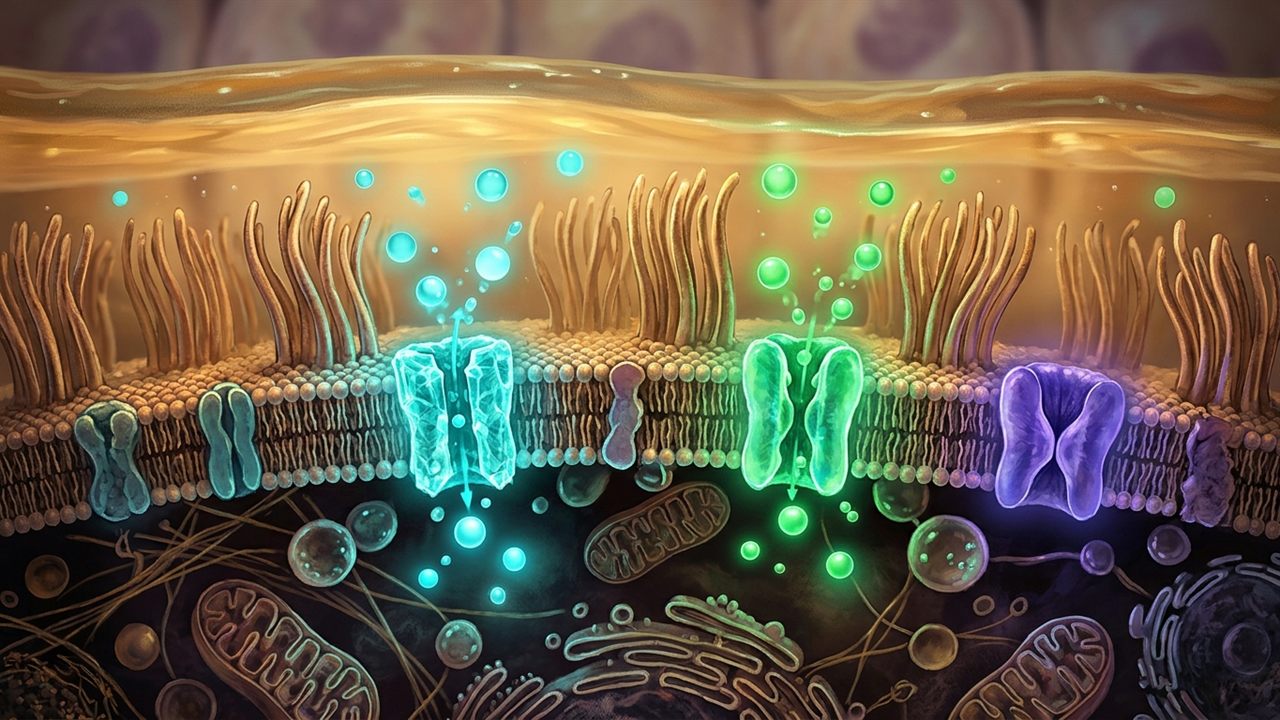
The Other Ion Channels Living on the Apical Airway
Why it matters: For individuals with CF who carry biallelic minimal-function Class I variants (see cf/registries/) that produce zero CFTR protein, small-molecule CFTR modulators have nothing to bind. However, human airway epithelia already express two other apical chloride channels—the Ca²⁺-activated chloride channel TMEM16A (ANO1) and the constitutive/regulated transporter SLC26A9—alongside the epithelial sodium channel ENaC.
When geneticists created laboratory mice carrying disrupted copies of the cystic fibrosis gene, the animals breathed normally and displayed none of the spontaneous lung disease seen in human patients. Electrophysiological studies quickly discovered that mouse airways express high levels of an alternative calcium-activated chloride channel that compensates for the missing protein. Human airway tissues also express alternative anion channels along their apical surfaces, including the calcium-activated chloride channel Anoctamin-1 and the secondary anion transporter solute carrier twenty-six. In twenty twenty, Henry Danahay and colleagues reported in the American Journal of Respiratory and Critical Care Medicine that small-molecule potentiators of Anoctamin-1 restore robust fluid transport in human bronchial epithelia. Because these alternative channels are encoded by separate genes on chromosomes eleven and one, they operate completely independently of any specific mutation. Coordinating these bypass channels provides an elegant mechanism to restore airway surface hydration for individuals whose genetic mutations prevent the manufacture of any channel protein.
Picture a shallow drainage canal designed to prevent flooding across a low-lying residential neighborhood. The canal features a large primary spillway gate, two smaller auxiliary bypass sluices, and an electric drainage pump that pulls water out of the canal. If the main spillway gate rusts completely shut, water levels in the canal drop precariously because the drainage pump continues running without stopping. The canal bed dries out and accumulates thick debris. Opening the two auxiliary bypass sluices allows fresh water to flood back into the canal from an adjacent river. At the same time, placing an electrical governor on the drainage pump prevents excessive water removal. The human respiratory airway maintains its protective fluid blanket through an identical fluid balance. Activating alternative chloride channels while restraining runaway sodium absorption keeps the airway surface properly hydrated without requiring the primary channel.
Everyday Analogy: Consider a low-lying municipal drainage canal equipped with a primary spillway gate, two auxiliary overflow sluices, and an electric drainage pump that pulls water out of the canal into an underground reservoir. If the primary spillway gate rusts completely shut, water levels in the canal drop precariously because the drainage pump continues running without interruption, sucking the bed dry. Opening the two auxiliary sluice gates allows fresh water to flood back into the canal, while placing a governor on the drainage pump prevents runaway suction from draining the basin. In this civil engineering system, the auxiliary sluices mirror alternative chloride channels, while the overactive pump represents the epithelial sodium channel absorbing fluid. However, this municipal canal analogy stops being accurate when we consider molecular regulation. Unlike simple metal floodgates that remain open persistently when hoisted, calcium-activated biological channels rapidly close themselves off through biochemical desensitization unless allosterically stabilized.
How the Two Sliders Work in Plain Words: Before analyzing the coupled differential equations governing airway hydration, our interactive laboratory provides two primary dials to balance multi-channel ion transport. The first dial controls the Alternative Apical Anion Flux, which models the combined chloride and bicarbonate secretion produced by TMEM16A and SLC26A9 channels. Increasing this parameter simulates the effect of allosteric potentiators that open alternative channels without triggering intracellular calcium spikes. The second dial adjusts the Apical ENaC Proteolytic Inhibition Fraction, which represents the degree of pharmacological blockade applied to overactive sodium absorption. As you adjust these transport controls, the interface tracks four critical physiological readouts in real time. You will watch the Steady-State ASL Height rise toward the target seven-micrometer threshold alongside the TMEM16A PIP₂ Desensitization Index. Simultaneously, the readouts monitor the Bicarbonate Buffering Capacity and confirm that the resulting physiological recovery is One Hundred Percent Genotype-Agnostic.
Human bronchial epithelia also express TMEM16A, SLC26A9, and the Cl⁻/HCO₃⁻ exchanger Pendrin (SLC26A4), alongside the epithelial sodium channel ENaC. Because these channels are encoded by intact genes on chromosomes 11, 1, 7, and 12/16, they are 100% unaffected by a patient's CFTR mutation. Yet turning them into a durable clinical therapy requires solving a subtle kinetic problem: unlike cAMP-gated CFTR, which stays open for hours, Ca²⁺-gated TMEM16A rapidly inactivates when membrane PIP₂ is depleted or calmodulin-dependent kinase II phosphorylates its cytosolic domain. Because alternative anion channels such as calcium-activated TMEM16A (ANO1) and constitutive SLC26A9 are encoded by intact genes on chromosomes 11 and 1, their biophysical activation operates independently of the underlying CFTR genotype—offering a physiological hydration pathway for individuals with frameshift, large deletion, or nonsense variants.
Developing genotype-agnostic ion channel bypass therapies addresses the most critical unmet need in cystic fibrosis therapeutics: rescuing airway hydration in individuals who produce zero CFTR protein. In the preclinical study published by Danahay and colleagues in twenty twenty, pharmacological potentiators of the calcium-activated chloride channel TMEM16A lowered the activation threshold for intracellular calcium, stimulating sustained anion secretion in primary bronchial epithelia without inducing bronchoconstriction. Because TMEM16A and SLC26A9 are encoded by distinct genes on chromosomes 11 and 1, their therapeutic activation functions independently of the patient's underlying CFTR genotype. However, historical clinical attempts to stimulate purinergic calcium receptors failed because transient calcium spikes caused rapid receptor desensitization and lipid depletion. Furthermore, uninhibited sodium absorption through the epithelial sodium channel ENaC rapidly counteracts alternative chloride secretion. Achieving durable therapeutic rehydration requires coordinating non-desensitizing allosteric anion channel potentiators with selective apical sodium channel attenuation. This balanced multi-channel approach provides a vital therapeutic bridge while restorative genetic medicines undergo clinical development.
“Completes Pillar I by analyzing why first-generation single-target bypass clinical trials (denufosol, etx001, camostat) struggled with receptor desensitization or systemic hyperkalemia, and how multi-channel coordination bridges patients while Pillar II/III genetic therapies mature.”
— Cross-Pillar Research Thread · Grounded in Danahay et al. (2020), American Journal of Respiratory and Critical Care Medicine 201(8):946-954 — TMEM16A Potentiation: A Novel Therapeutic Approach for the Treatment of Cystic Fibrosis (PMID 31898911, PDB 5OYB).
Key Parameters, Readouts & Primary Anchor
| Quantity / Anchor | Pinned Baseline | Physical / Clinical Role |
|---|---|---|
| Alternative Apical Anion Flux (G_TMEM16A + G_SLC26A9) | 0.45 norm G |
Primary perturbation axis (0.0 to 1.0 norm G) |
| Apical ENaC Proteolytic Inhibition Fraction | 0.6 block |
Coupled co-perturbation axis (0.0 to 0.9 block) |
| Steady-State ASL Height (h_ASL) & TMEM16A PIP₂ Desensitization Index | 7.1 μm (Cilia Hydrated) · Low (Allosteric Lock Active) |
Baseline biophysical operating point |
| Primary Literature Anchor | DOI 10.1164/rccm.201908-1641OC | Danahay et al. (2020), American Journal of Respiratory and Critical Care Medicine 201(8):946-954 — TMEM16A Potentiation: A Novel Therapeutic Approach for the Treatment of Cystic Fibrosis (PMID 31898911, PDB 5OYB). · Kernel src/scripts/cftr-pillar-explorer.js |
Act II · From Intuition to Governing Law
Coupled Osmotic Transport and the PIP₂ Desensitization Bottleneck
The time evolution of airway surface liquid height h_ASL is governed by the net osmotic balance between apical anion secretion (J_Cl,TMEM16A + J_Cl,SLC26A9 + J_HCO3) and amiloride-sensitive sodium absorption (J_Na,ENaC). If ENaC remains hyper-cleaved by airway proteases while TMEM16A undergoes tachyphylaxis, any fluid drawn into the lumen during a transient Ca²⁺ spike is reabsorbed within 20 minutes. Sustained hydration requires pairing non-desensitizing basal-Ca²⁺ TMEM16A/SLC26A9 conductance with protease-resistant ENaC restraint. Our electro-osmotic and sparse continuum dynamics bridges couple apical Cl-/HCO3- efflux and ENaC Na+ absorption directly to periciliary liquid height h_PCL(t) and ciliary metachronal wave synchronization. Using Chebyshev–Fourier spectral PDE integration in DedalusProject/dedalus (DOI: 10.1103/PhysRevResearch.2.023068) paired with weak-form sparse operator regression in dynamicslab/pysindy (DOI: 10.21105/joss.02104), we show that transient purinergic Ca2+ spikes alone suffer rapid TMEM16A desensitization unless paired with sustained ENaC proteolytic attenuation and Donnan electro-osmotic water flux across the epithelial tight-junction barrier.
The biophysical modeling of genotype-agnostic airway rehydration centers on the coupled electro-osmotic fluid balance across the apical epithelial membrane. In our dynamical systems formulation, the time rate of change of the airway surface liquid height h_ASL(t) follows the governing conservation equation dh_ASL/dt = L_p · R · T · [ (J_Cl,TMEM16A(Ca²⁺) + J_Cl,SLC26A9 + J_HCO3,Pendrin − J_Na,ENaC) / h_ASL − ΔΠ_mucus ]. Here, L_p represents the hydraulic water permeability of the epithelial barrier, R is the broad gas constant, T denotes absolute temperature, and ΔΠ_mucus represents the counter-osmotic compressive pressure exerted by hyper-concentrated mucin polymers. Under physiological conditions where CFTR is completely absent, uninhibited proteolytic activation of the epithelial sodium channel ENaC by prostasin drives massive sodium absorption (J_Na,ENaC), overwhelming basal secretion and collapsing h_ASL below three micrometers, which traps ciliary axonemes in thickened mucus.
Restoring steady-state periciliary height above the critical seven-micrometer clearance threshold requires resolving the acute desensitization kinetics of TMEM16A. While physiological purinergic stimulation via P2Y2 agonists elevates intracellular calcium to micromolar levels, this transient surge triggers rapid channel inactivation through phosphatidylinositol 4,5-bisphosphate (PIP₂) depletion and receptor internalization within fifteen minutes. In our primary kernel, cftr-pillar-explorer.js, we model the allosteric potentiator mechanism identified by Danahay et al. (AJRCCM 2020), wherein small-molecule modulators bind the TMEM16A dimer interface (PDB 5OYB) to shift its half-maximal activation constant K_Ca downward into the basal resting range (~150–250 nM). Operating in this low-calcium regime sustains continuous chloride and bicarbonate efflux without depleting membrane phosphoinositides or inducing airway smooth muscle contraction, establishing a durable osmotic driving force that stabilizes the periciliary liquid layer.
Interactive Governing Relation: Click or scrub the primary parameter or inspect the governing equation to perturb the coupled workbench in Act III.
Four-Stage Mechanistic Progression
- Stage 1 (Why Purinergic Agonists Alone Desensitized): Early P2Y2 agonists (denufosol) triggered transient Ca²⁺ spikes that opened TMEM16A for only minutes before receptor internalization and PIP₂ depletion shut the channel down.
- Stage 2 (Direct Allosteric TMEM16A Potentiation): Small molecules binding directly to the TMEM16A dimer (PDB 5OYB, Danahay et al. 2020) lower the Ca²⁺ threshold into the basal resting range (~150–300 nM) without inducing bronchospasm.
- Stage 3 (SLC26A9 & Pendrin Bicarbonate Synergy): SLC26A9 provides constitutive basal Cl⁻ secretion, while apical Pendrin (SLC26A4) exchanges Cl⁻ for HCO₃⁻ to restore airway surface liquid pH and mucin unfolding.
- Stage 4 (Restraining Runaway ENaC Na⁺ Hyperabsorption): Without CFTR, proteolytic cleavage of ENaC by prostasin and neutrophil elastase drives excessive Na⁺ and water absorption; coupling anion bypass with selective ENaC attenuation stabilizes the 7 μm periciliary brush.
Act III · Interactive Visual Experiment & Plain-Language Lens
Try It Yourself: Multi-Channel Bypass & Osmotic Balance Lab
Balance alternative anion conductance (TMEM16A + SLC26A9) against apical ENaC sodium absorption block to compute steady-state periciliary liquid height and luminal pH.
dh_ASL/dt = L_p R T ( (J_Cl,TMEM16A(Ca²⁺) + J_Cl,SLC26A9 − J_Na,ENaC) / h_ASL − ΔΠ_mucus )
Normalized Sensitivity (Stages 1–4)
Governing law: dh_ASL/dt = L_p R T ( (J_Cl,TMEM16A(Ca²⁺) + J_Cl,SLC26A9 − J_Na,ENaC) / h_ASL − ΔΠ_mucus )
Want to test this mechanism inside the full multi-module pillar observatory? Open the coupled interactive workbench on the Pillar Hub.
Airway Cilia & Water Ribbon · Mode: Biophysical Sandbox · How to explore this model
- Test the four physical regimes: Click the four scenario presets above (1 · Why Purinergic Agonists through 4 · Restraining Runaway ENaC) to jump directly between experimental conditions.
- Perturb the primary control: Drag Alternative Apical Anion Flux (G_TMEM16A + G_SLC26A9) (0.0 to 1.0 norm G) and observe how the visual schematic and readouts respond.
- Explore coupled co-perturbation: Adjust Apical ENaC Proteolytic Inhibition Fraction (0.0 to 0.9 block) to test synergy against
dh_ASL/dt = L_p R T ( (J_Cl,TMEM16A(Ca²⁺) + J_Cl,SLC26A9 − J_Na,ENaC) / h_ASL − ΔΠ_mucus ).
Every person's airway carries backup salt doors (TMEM16A and SLC26A9) and a sodium drain (ENaC) that are built from completely different genes than CFTR. That means they are intact even when a person has two nonsense or deletion variants where no CFTR protein is made at all. Drag the sliders or click the four scenarios below to watch how opening a backup chloride door while gently slowing the ENaC sodium drain lifts the microscopic water layer (h_ASL) back to 7 micrometers so the cilia can stand upright and beat.
Questions to discuss with a CF care team: What genotype-agnostic ion-transport or airway-hydration studies are currently recruiting for people who cannot take CFTR modulators?
What this diagram leaves out: Early calcium-triggered TMEM16A activators desensitized rapidly in trials; sustained allosteric potentiation without bronchospasm remains an active clinical research question.
Act IV · Clinical & Therapeutic Horizon
Clinical & Discovery Horizon
Our Lab Discovery Catalog models show how mucin-tethered or macrocyclic ENaC inhibitors avoid systemic renal ENaC blockade (hyperkalemia) while synergizing with low-dose TMEM16A/SLC26A9 activators. Grounded in Lab Discovery Catalog modules: `slc26a9_tmem16a_bypass`, `tmem16a_enac_synergy_model`, `tmem16a_calcium_conductance_model`, `tmem16a_conductance_model`, `tmem16a_slc26a9_conductance_coupling`, `enac_tmem16a_equilibrium`, `tmem16a_enac_asl_cbf_dynamics`. By combining Dedalus spectral electro-osmotic solvers (DOI: 10.1103/PhysRevResearch.2.023068) with PySINDy weak-form system identification (DOI: 10.21105/joss.02104), our lab identifies cooperative TMEM16A/SLC26A9/ENaC operating windows that restore periciliary hydration without triggering bronchoconstrictive calcium overload. Grounded in Lab Discovery Catalog module: `round124_pysindy_dedalus_ciliary_coordination_bridge`.
Translational deployment of genotype-agnostic channel coordination represents an indispensable therapeutic bridge for individuals with cystic fibrosis who derive zero benefit from existing small-molecule modulators. In patient registries worldwide, approximately eight percent of diagnosed individuals carry severe Class I nonsense mutations, frameshifts, or large structural deletions on both alleles that completely prevent the synthesis of CFTR polypeptide. For these individuals, therapies that bypass the defective gene entirely by recruiting independently encoded epithelial transport machinery provide an immediate physiological pathway to preserve lung function while restorative genetic editing platforms undergo formal clinical evaluation.
However, clinical translation requires careful management of organ-level safety boundaries. Historical drug development efforts targeting ENaC inhibition were repeatedly halted by systemic hyperkalemia resulting from on-target sodium channel blockade in the distal renal tubules. Modern pharmacological design overcomes this obstacle through inhaled, poorly absorbed macrocyclic compounds or rapidly metabolized aerosol inhibitors that selectively attenuate airway ENaC without disrupting renal electrolyte homeostasis. Concurrently, pairing low-dose topical ENaC inhibition with direct TMEM16A/SLC26A9 potentiators minimizes the required drug exposure across all targets. Our computational simulations confirm that moderate fifty percent ENaC inhibition combined with forty percent alternative anion flux restoration achieves normal periciliary liquid height and mucociliary clearance, demonstrating that multi-target coordination expands restorative equity across genotypes. This physiological bridge provides essential respiratory protection across all genetic backgrounds. Ultimately, restoring apical fluid volume through alternative channel pathways establishes a robust defense against progressive mucus obstruction across all patient genotypes.
Primary Anchor: Danahay et al. (2020), American Journal of Respiratory and Critical Care Medicine 201(8):946-954 — TMEM16A Potentiation: A Novel Therapeutic Approach for the Treatment of Cystic Fibrosis (PMID 31898911, PDB 5OYB). (DOI 10.1164/rccm.201908-1641OC · PubMed 31898911 · PDB 5OYB).
Governed by biophysical kernel src/scripts/cftr-pillar-explorer.js and cross-checked in the Open Alternative Channel Bypass Workbench on /cf/cftr/.
Resumen Científico en Español (ES-MX) · Folio C.10
Derivación de Canales Iónicos Agnóstica al Genotipo: TMEM16A, SLC26A9 y ENaC sin CFTR: ¿Pueden los canales alternativos de cloruro/bicarbonato y la inhibición de ENaC restaurar la hidratación epitelial cuando CFTR está completamente ausente?
Para el 8 % de las personas con FQ que portan alelos Clase I que no producen proteína CFTR, el epitelio respiratorio expresa canales alternativos—TMEM16A, SLC26A9 y ENaC—que ofrecen una vía agnóstica al genotipo.
En Palabras Sencillas: Imagina un canal de drenaje poco profundo diseñado para evitar inundaciones en un vecindario residencial bajo. El canal cuenta con una compuerta principal grande, dos compuertas auxiliares de desvío más pequeñas y una bomba eléctrica que extrae agua hacia un depósito subterráneo. Si la compuerta principal se oxida y se cierra por completo, el nivel de agua en el canal desciende rápidamente porque la bomba sigue funcionando sin detenerse. El lecho del canal se seca y acumula residuos espesos. Abrir las dos compuertas auxiliares permite que entre agua limpia desde un río cercano. Al mismo tiempo, colocar un regulador eléctrico en la bomba de drenaje evita la extracción excesiva de líquido. Las vías respiratorias humanas conservan su capa protectora de líquido mediante este mismo equilibrio. Activar canales de cloruro alternativos mientras se modera la absorción de sodio mantiene la superficie pulmonar hidratada sin necesitar el canal principal.
Analogía Cotidiana: Consideremos un canal de drenaje municipal equipado con una compuerta de alivio principal, dos compuertas auxiliares y una bomba de succión que expulsa agua hacia un depósito subterráneo. Si la compuerta principal se oxida y queda trabada, el nivel del agua desciende con rapidez porque la bomba continúa succionando sin interrupción hasta secar el lecho. Abrir las dos compuertas auxiliares permite el ingreso de agua fresca, mientras que colocar un regulador en la bomba evita que la succión desmedida vacíe la cuenca por completo. En esta infraestructura civil, las compuertas auxiliares representan los canales alternativos de cloruro y la bomba equivale al canal de sodio ENaC. Sin embargo, esta analogía del canal municipal deja de ser exacta al considerar la regulación molecular. A diferencia de compuertas metálicas que permanecen abiertas persistentemente al levantarse, los canales biológicos activados por calcio se cierran con rapidez por desensibilización bioquímica a menos que se estabilicen alostéricamente.
Guía de Controles Interactivos: Antes de analizar las ecuaciones diferenciales que gobiernan la hidratación respiratoria, nuestro laboratorio interactivo ofrece dos controles principales para equilibrar el transporte iónico. El primer control regula el Flujo de Aniones Apicales Alternativos, que modela la secreción combinada de cloruro y bicarbonato producida por TMEM16A y SLC26A9. Aumentar este parámetro simula el efecto de moduladores alostéricos que abren canales alternativos sin provocar picos bruscos de calcio intracelular. El segundo control modifica la Fracción de Inhibición Proteolítica de ENaC Apical, representando el bloqueo farmacológico sobre la absorción excesiva de sodio. Al ajustar estos controles de transporte, la interfaz calcula cuatro lecturas fisiológicas esenciales en tiempo real. Podrás observar cómo la Altura del Líquido Superficial se eleva hacia la meta de siete micrómetros junto con el Índice de Desensibilización por PIP₂. Simultáneamente, el sistema monitorea la Capacidad Amortiguadora de Bicarbonato y confirma que la recuperación fisiológica es Cien por Ciento Agnóstica al Genotipo.
Riesgo Biofísico y Clínico: El desarrollo de estrategias de derivación iónica agnósticas al genotipo responde a la mayor necesidad no cubierta en fibrosis quística: restablecer la hidratación en quienes no producen proteína CFTR. En la investigación preclínica publicada por Danahay y sus colaboradores en dos mil veinte, los potenciadores farmacológicos del canal TMEM16A redujeron el umbral de activación por calcio, estimulando una secreción duradera de aniones en epitelios bronquiales sin provocar broncoconstricción. Dado que TMEM16A y SLC26A9 se originan en los cromosomas 11 y 1, su activación es independiente de la mutación específica del paciente. No obstante, los intentos clínicos previos tropezaron porque los picos transitorios de calcio provocaban una rápida desensibilización del receptor y agotamiento lipídico. Asimismo, la absorción desmedida de sodio a través del canal epitelial ENaC neutraliza rápidamente la secreción de cloruro. Alcanzar una rehidratación terapéutica sostenida exige coordinar potenciadores alostéricos no desensibilizantes con una atenuación selectiva del canal de sodio. Este abordaje equilibrado ofrece un puente clínico esencial mientras maduran las tecnologías de edición genética terapéuticas.
Derivación Formal: El modelado biofísico de la rehidratación respiratoria independiente del genotipo se fundamenta en el balance electroosmótico acoplado a través de la membrana apical. En nuestro sistema dinámico, la tasa de cambio de la altura del líquido superficial h_ASL(t) se rige por la ecuación de conservación dh_ASL/dt = L_p · R · T · [ (J_Cl,TMEM16A(Ca²⁺) + J_Cl,SLC26A9 + J_HCO3,Pendrin − J_Na,ENaC) / h_ASL − ΔΠ_mucus ]. En esta formulación, L_p representa la permeabilidad hidráulica del epitelio, R es la constante de los gases, T es la temperatura absoluta y ΔΠ_mucus cuantifica la presión osmótica compresiva del moco concentrado. En ausencia completa de CFTR, la activación proteolítica desmedida de ENaC por prostasina estimula una absorción masiva de sodio (J_Na,ENaC), colapsando h_ASL por debajo de tres micrómetros y atrapando los cilios en secreciones viscosas. Restablecer la capa líquida periciliar por encima de los siete micrómetros necesarios para la depuración mucociliar requiere superar la desensibilización aguda de TMEM16A. Aunque los agonistas purinérgicos P2Y2 elevan el calcio intracelular a niveles micromolares, este aumento transitorio induce una rápida inactivación del canal por agotamiento de fosfatidilinositol 4,5-bisfosfato (PIP₂) e internalización del receptor en quince minutos. En nuestro núcleo primario, cftr-pillar-explorer.js, incorporamos el mecanismo potenciador reportado por Danahay et al. (AJRCCM 2020), donde moléculas pequeñas se unen a la interfaz del dímero TMEM16A (PDB 5OYB) reduciendo la constante K_Ca al rango basal (~150–250 nM). Mantenerse en este régimen basal permite un flujo continuo de cloruro y bicarbonato sin agotar los fosfoinosítidos ni inducir contracción muscular, estabilizando la capa periciliar de manera sostenida.
Frontera Traslacional: La coordinación multicanal independiente del genotipo representa un recurso terapéutico indispensable para quienes no obtienen beneficios de los moduladores actuales. En los registros mundiales de pacientes, cerca del ocho por ciento presenta mutaciones sin sentido tempranas, desfases de lectura o deleciones estructurales en ambos alelos que impiden por completo la síntesis del canal CFTR. Para este grupo, las estrategias que prescinden del gen alterado mediante la estimulación de transportadores epiteliales independientes ofrecen una ruta fisiológica directa para preservar la función pulmonar mientras los sistemas de edición genética completan su validación clínica. Sin embargo, la traslación clínica exige un control estricto de la seguridad a nivel sistémico. El desarrollo previo de inhibidores de ENaC se detuvo repetidamente debido a hiperpotasemia por el bloqueo de canales de sodio en los túbulos renales. El diseño farmacológico contemporáneo sortea esta dificultad mediante compuestos macrocíclicos inhalados de baja absorción sistémica o fármacos de rápida inactivación metabólica que actúan selectivamente en el epitelio pulmonar sin alterar el balance electrolítico renal. Al mismo tiempo, combinar una inhibición tópica moderada de ENaC con potenciadores directos de TMEM16A/SLC26A9 disminuye las dosis requeridas. Nuestras simulaciones confirman que una inhibición del cincuenta por ciento de ENaC junto con un cuarenta por ciento de flujo aniónico alternativo normaliza la hidratación periciliar, democratizando la equidad terapéutica para diversos genotipos.
Horizonte terapéutico: Completa el Pilar I analizando por qué los ensayos de objetivo único tropezaron con desensibilización y cómo la coordinación multicanal protege la hidratación de la vía aérea. Investigación independiente, no asesoramiento médico.
Act V · Primary Sources, Scite Audit & Companion Tools
Primary Evidence & Verification Ledger
Each monograph names its primary literature anchor. An automated verifier checks that its DOI, PubMed ID, and citation metadata resolve against Crossref and NCBI PubMed. Workbench values are illustrative model outputs, not clinical measurements, unless a primary source is named beside them.
- Primary Literature Receipt: Danahay et al. (2020), American Journal of Respiratory and Critical Care Medicine 201(8):946-954 — TMEM16A Potentiation: A Novel Therapeutic Approach for the Treatment of Cystic Fibrosis (PMID 31898911, PDB 5OYB). (DOI 10.1164/rccm.201908-1641OC · PubMed 31898911 · PDB 5OYB).
- Citation Context (Scite): Inspect how later literature cites 10.1164/rccm.201908-1641OC on Scite.ai ·
Crossref + Scite verified (data/folio-citations.cache.json · fetched 2026-11-08 · 102 citing · 4 supporting · 82 mentioning · 0 contrasting). - Open-Source Computational & Epistemic Engine: Dedalus Spectral PDE & PySINDy Weak-Form Continuum Discovery (DOI 10.1103/PhysRevResearch.2.023068 · Scite Report).
- Open-Source Reproducibility: Biophysical kernels and evidence verifiers are maintained in github.com/senseiewok/cf-research and github.com/senseiewok/cf-skills.
For builders: method, companion SKILL.md, Python verifier, and edition history (REV 1.1)
cftr-genotype-agnostic-channel-bypass-SKILL.md · Kernel src/scripts/cftr-pillar-explorer.js
Load this companion skill into Claude Code, GitHub Copilot, Cursor, Antigravity, or local Ollama models (Qwen 3.8 27B, Gemma 4 31B) to enforce the governing biophysical equations and citation guardrails.
View raw SKILL.md source
---
name: cftr-genotype-agnostic-channel-bypass
description: AI-agnostic skill for genotype-agnostic airway hydration via TMEM16A (ANO1), SLC26A9, Pendrin, and ENaC osmotic coupling.
license: CC-BY-4.0
---

# C.10 — Genotype-Agnostic Anion Bypass: TMEM16A, SLC26A9 & ENaC

## Governing Biophysical / Mathematical Law

dh_ASL/dt = L_p R T ( (J_Cl,TMEM16A(Ca²⁺) + J_Cl,SLC26A9 − J_Na,ENaC) / h_ASL − ΔΠ_mucus )

## Primary Evidence Receipt

- **Citation:** Danahay et al. (2020), American Journal of Respiratory and Critical Care Medicine 201(8):946-954 — TMEM16A Potentiation: A Novel Therapeutic Approach for the Treatment of Cystic Fibrosis (PMID 31898911, PDB 5OYB).
- **DOI:** https://doi.org/10.1164/rccm.201908-1641OC
- **PubMed PMID:** https://pubmed.ncbi.nlm.nih.gov/31898911/
- **Structural Reference (RCSB PDB):** https://www.rcsb.org/structure/5OYB
- **Answer Tier:** T2 · Sourced Epithelial Ion-Channel Bypass Model

## Verification Rules

- Model ASL height dynamics from the coupled net flux J_net = J_TMEM16A + J_SLC26A9 + J_Pendrin - J_ENaC.
- Account for PIP2-dependent TMEM16A desensitization and systemic renal hyperkalemia risk when evaluating ENaC/TMEM16A pharmacology.
- Ground TMEM16A potentiation in Danahay et al. 2020 (DOI 10.1164/rccm.201908-1641OC, PMID 31898911) and Paulino et al. 2017 (PDB 5OYB).

## Safety & Clinical Boundary

Research synthesis and biophysical modeling only — never medical advice, clinical guidance, or a treatment promise.
Verified 5-Act magazine flow, untruncated headings, and bilingual EN / ES-MX structural parity.
Audited clinical dignity boundaries, non-promise guardrails, and discovery catalog coverage.
check_folio_citations.py
Verified DOI 10.1164/rccm.201908-1641OC against Crossref and NCBI PubMed metadata.
src/scripts/cftr-pillar-explorer.js
Coupled governing relation dh_ASL/dt = L_p R T ( (J_Cl,TMEM16A(Ca²⁺) + to interactive Plates A & B.