
Act I · Physical & Clinical Story
Two Routes to the Lung
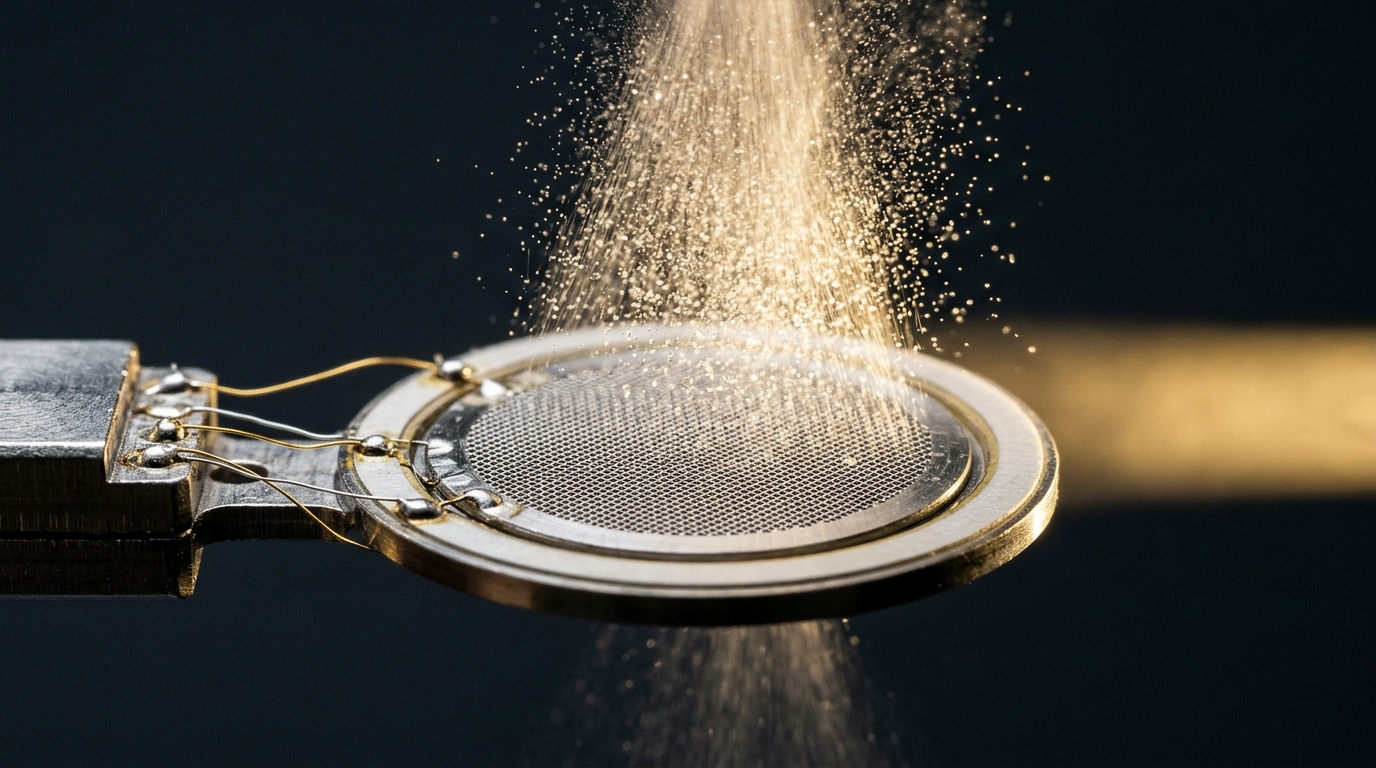
Aerosol delivery confronts an unforgiving physical paradox at the vibrating aperture of a clinical inhaler. In an illuminating discovery published in Nature Nanotechnology in 2020, Qiang Cheng and his research colleagues demonstrated that lipid carrier nanoparticles could be engineered with molecular precision to target specific internal organs. Standard four-component spherical carriers inevitably accumulate inside the liver when entering the systemic bloodstream, bypassing diseased pulmonary tissues completely. Simultaneously, forcing conventional lipid spheres through the microscopic pores of a vibrating mesh nebulizer subjects them to intense fluid shear stresses. These extensional forces frequently tear outer membranes apart, causing sensitive nucleic acid cargo to spill prematurely. By incorporating an exact fifth lipid component, the investigators proved that surface chemistry can be systematically tuned to resist mechanical disruption while recruiting organ-specific blood proteins that guide delivery directly into lung tissues.
To picture this delivery challenge, consider how a water droplet behaves when blown through a wire screen. The microscopic carrier acts like a soft capsule carrying sensitive genetic instructions inside its oily core. If the capsule wall is too fragile, the violent rush through tiny nozzle apertures shatters it into useless fragments. Adding protective surface molecules creates a slippery external coat that shields the nanoparticle against mechanical destruction. This delicate balance introduces a difficult physical trade-off. If engineers apply too little protective coating, the nanoparticles adhere irreversibly to sticky polyanionic mucin networks, stranding their genetic cargo far above the epithelial target cells. Conversely, excessive surface coating completely prevents the carrier from fusing with the target cell once it arrives. Finding the exact molecular balance allows the carrier to withstand nebulizer forces and glide through bronchial barriers.
Everyday Analogy: Consider a delicate soap bubble carrying a fragile paper scroll through a turbulent wire mesh screen. If the bubble surface contains too little soap, the violent air currents and sharp metal wires immediately burst the film, dropping the scroll onto the screen. Adding a protective layer of thick oil makes the bubble resilient against tearing, allowing it to squeeze intact through narrow gaps. However, if that oily shell is made too thick, the bubble becomes completely inert and slick. When it finally reaches its destination wall, it bounces harmlessly off the bricks rather than bursting open to deliver the written message. Engineers must formulate a film that remains durable during flight yet sheds its armor upon arrival. This comparison breaks down because soap bubbles pop irrevocably in ambient air, whereas nanoscale lipid vesicles possess self-healing hydrophobic bilayers that can spontaneously reassemble into multivesicular aggregates when shear stress exceeds cohesive interfacial boundaries.
How the Two Sliders Work in Plain Words: Before examining the mathematical models of fluid mechanics, the interactive controls below let you adjust these delicate formulation balances. The first slider tunes the PEG-Lipid / Zwitterionic Stealth Molar Fraction, representing the percentage of protective surface shielding molecules anchored in the lipid bilayer. As you raise this value, observe how the Mucus Zeta-Potential Shielding shifts toward neutral values, allowing the particle to glide past sticky mucin polymers. The second slider controls the Nebulizer Mesh Shear Capillary Ratio (Ca / Ca_crit), which reflects the magnitude of mechanical forces pulling on each nanoparticle during aerosol generation. When this ratio remains comfortably below critical thresholds, the Post-Nebulization mRNA Encapsulation readout confirms that genetic cargo stays securely trapped inside intact vesicles. Meanwhile, monitoring the Hydrodynamic Size Shift reveals whether particles remain monodisperse or aggregate into inactive clumps. Finally, tracking the Apparent LNP Surface pK_a ensures the formulation retains the chemical charge responsiveness required for subsequent endosomal escape.
The second route, pioneered by Daniel Siegwart and colleagues (Nature Nanotechnology 2020, PMID 32251383; Science 2024, PMID 38870301), is Selective Organ Targeting (SORT): adding a fifth Quaternary Cationic or Ionizable SORT lipid (such as DOTAP or engineered lung-tropic lipids) that shifts the particle's apparent pK_a and recruits a specific plasma protein corona (vitronectin / ApoE depletion) in the bloodstream, redirecting intravenous LNPs away from the liver and directly across the pulmonary capillary endothelium into airway basal stem cells.
The translational stakes surrounding lung-targeted lipid nanoparticles center on overcoming mechanical shear while evading biological clearance. Inhaling genetic medicine requires turning liquid droplets into a fine mist. Cheng and colleagues revealed that standard formulations optimized for intramuscular injections fail under aerosolization stress because vibrating-mesh apertures generate severe extensional deformation. When hydrodynamic shear exceeds the cohesive strength of the lipid bilayer, vesicles rupture, releasing fragile ribonucleic acid into solution where nucleases rapidly degrade it. Furthermore, nanoparticles that survive aerosolization must still penetrate the dense, negatively charged airway mucus layer without adhering to mucin fibers. Achieving sufficient surface shielding with neutral polymers protects particles during aerosol generation and facilitates mucus penetration. However, excessive shielding inhibits cellular uptake and blocks endosomal membrane fusion once particles reach epithelial surfaces. Resolving this biophysical tension dictates whether non-viral genetic therapies can achieve therapeutic delivery thresholds without requiring toxic dosing regimens.
“Addresses the central paradox of inhaled LNP design: enough surface PEG-lipid (2.5–4.5 mol%) is needed to survive nebulizer shear and slip through negatively charged mucins, yet not so much that it blocks cellular uptake or endosomal fusion.”
— Cross-Pillar Research Thread · Grounded in Cheng et al. (2020), Nature Nanotechnology 15(4):313-320 — Selective organ targeting (SORT) nanoparticles for tissue-specific mRNA delivery and CRISPR–Cas gene editing (PMID 32251383).
Key Parameters, Readouts & Primary Anchor
| Quantity / Anchor | Pinned Baseline | Physical / Clinical Role |
|---|---|---|
| PEG-Lipid / Zwitterionic Stealth Molar Fraction | 3.0 mol% |
Primary perturbation axis (1.0 to 5.0 mol%) |
| Nebulizer Mesh Shear Capillary Ratio (Ca / Ca_crit) | 0.6 Ca ratio |
Coupled co-perturbation axis (0.2 to 1.8 Ca ratio) |
| Post-Nebulization mRNA Encapsulation & Hydrodynamic Size Shift ΔD_h | 89.2% Intact Cargo · +6.4 nm (Monodisperse PDI < 0.15) |
Baseline biophysical operating point |
| Primary Literature Anchor | DOI 10.1038/s41565-020-0669-6 | Cheng et al. (2020), Nature Nanotechnology 15(4):313-320 — Selective organ targeting (SORT) nanoparticles for tissue-specific mRNA delivery and CRISPR–Cas gene editing (PMID 32251383). · Kernel src/scripts/sort-lnp-explorer.js |
Act II · From Intuition to Governing Law
Taylor–Grace Capillary Breakup Ca = μγ̇R/σ and
During aerosol generation in a vibrating-mesh nebulizer, each LNP of radius R experiences viscous shear stress τ = μ γ̇ that attempts to deform and rupture its lipid monolayer against cohesive interfacial tension σ_int, governed by the dimensionless Capillary number Ca = μ γ̇ R / σ_int. When Ca approaches Ca_crit, lipid bilayers fuse with neighboring particles during droplet recirculation—causing hydrodynamic diameter D_h to balloon from 65 nm to > 250 nm and leaking unencapsulated mRNA. Increasing PEG-lipid molar fraction φ_PEG lowers Ca/Ca_crit and shields electrostatic mucoadhesion, but excess C18-PEG sterically blocks endosomal membrane fusion. Using sheddable short-acyl C14-PEG (DMG-PEG2000, ~2.5–3.5 mol%) with branched cholesterol analogs (β-sitosterol) resolves this Pareto trade-off.
The fluid mechanics of vibrating-mesh nebulization subjects suspended lipid nanoparticles to intense extensional and shear flow fields within micro-apertures. As formulated by Taylor and extended to vesicular suspensions by Grace, droplet and vesicle deformation is governed by the dimensionless Capillary number, Ca = μ γ̇ R_LNP / σ_int, where μ is the dynamic viscosity of the suspension medium, γ̇ is the local strain rate, R_LNP is the nanoparticle radius, and σ_int is the effective bilayer interfacial tension. At acoustic frequencies near one hundred kilohertz, fluid velocity through tapered three-micrometer apertures generates extensional shear rates exceeding one hundred thousand reciprocal seconds. When the Capillary number surpasses the critical threshold Ca_crit, viscous forces overcome interfacial Laplace restoring pressures, triggering membrane elongation, catastrophic pearl-chain rupture, and immediate expulsion of encapsulated nucleic acids into the bulk fluid.
The fraction of nanoparticles remaining structurally intact following aerosolization follows the generalized logistic boundary function f_intact = 1 / (1 + (Ca / Ca_crit)^m), where m characterizes the cooperativity of membrane failure. Incorporating cholesterol analogs such as beta-sitosterol and short-chain polyethylene glycol lipids alters membrane packing and elevates interfacial rigidity, shifting Ca_crit to higher shear thresholds. Simultaneously, surface shielding tunes the apparent surface pK_a and shields electrostatic charges against anionic mucin domains, preventing irreversible entrapment in airway hydrogels. Hydrodynamic microchannel experiments confirm that tuning the molar fraction of diffusible lipid conjugates maintains structural stability under peak extensional stresses while preserving the capacity for cellular endocytosis. The simulation engine src/scripts/sort-lnp-explorer.js models these coupled dynamics.
Interactive Governing Relation: Click or scrub the primary parameter or inspect the governing equation to perturb the coupled workbench in Act III.
Four-Stage Mechanistic Progression
- Stage 1 (Microfluidic Rapid-Mixing Self-Assembly): Ionizable cationic lipids, helper phospholipids (DOPE/DSPC), cholesterol (or β-sitosterol), PEG-lipid (DMG-PEG2000), and a 5th SORT lipid condense around polyanionic CFTR mRNA (4.5 kb) at pH 4.0.
- Stage 2 (Vibrating-Mesh Nebulization Shear — Taylor Capillary Limit): Passing through 3–5 μm piezo-driven apertures subjects LNPs to extensional shear rates γ̇ ~ 10⁵–10⁶ s⁻¹; maintaining interfacial tension σ_int and sterically stabilized PEG/sitosterol packing keeps Ca < Ca_crit.
- Stage 3 (Mucus-Penetrating Near-Neutral Zeta Potential): A dense 2.5–3.5 mol% C14-PEG (DMG-PEG2000) brush shields cationic charges at airway pH ~6.8–7.1 (|ζ| < 5 mV), preventing electrostatic trapping by anionic sialic/sulfate groups on MUC5B.
- Stage 4 (Desorption of Diffusible C14-PEG at the Apical Brush): Once across the mucus layer, short-anchor C14-DMG-PEG slowly desorbs into lipid membranes, unmasking the LNP surface for epithelial endocytosis.
Act III · Interactive Visual Experiment & Plain-Language Lens
Try It Yourself: SORT-LNP Formulation & Nebulizer Shear Workbench
Tune the PEG-lipid stealth molar fraction and nebulizer capillary shear ratio (Ca / Ca_crit) to inspect post-nebulization mRNA encapsulation integrity and mucus diffusivity.
Delivering lipid nanoparticles (LNPs) to the lung is very different from an injection in the arm: a vibrating-mesh nebulizer must push trillions of fragile lipid spheres through microscopic 4-micrometer holes thousands of times per second to create a breathable mist. Without extra structural cholesterol and a cushion of surface polymer, the shear forces at the nozzle can rip the spheres open or fuse them into clumps before they ever leave the mouthpiece.
Questions to discuss with a CF care team: Why do inhaled mRNA or LNP trials use specialized vibrating-mesh nebulizers rather than standard jet nebulizers?
What this diagram leaves out: Pinned readouts reflect bench laser-diffraction and encapsulation assays rather than person-to-person breathing variability.
Nebulizer Shear Walkthrough · Mode: Pinned Evidence Storyboard · How to explore this model
- Step through the four visual chapters: Click the four mechanism chapters below (1 · Microfluidic Rapid-Mixing… through 4 · Desorption of Diffusible…) to watch the schematic transition across each regime.
- Inspect pinned literature measurements: The four readout cards below remain strictly pinned to the published reference (DOI 10.1038/s41565-020-0669-6) rather than synthetic slider scaling.
- Launch the full pillar simulator: Open Open SORT-LNP Formulation & Nebulizer Shear Workbench on /cf/delivery/ for multi-parameter continuous simulation.
Pinned Primary Evidence Mode · Click Chapters 1–4 above to animate the D.02 mechanism.
Ca = μ γ̇ R_LNP / σ_int · f_intact = 1 / (1 + (Ca / Ca_crit)^m)
Normalized Sensitivity (Stages 1–4)
Want to test this mechanism inside the full multi-module pillar observatory? Open the coupled interactive workbench on the Pillar Hub.
Act IV · Clinical & Therapeutic Horizon
Inhaled mRNA vs. Systemic Stem-Cell Homing
Inhaled LNP-mRNA formulations (such as VX-522, ARCT-032, and RCT2100) concentrate the dose directly in the conducting airways with minimal systemic exposure, whereas lung-targeted systemic SORT-LNPs can reach the basolateral surface of KRT5+ basal stem cells even in mucus-plugged bronchioles. Essay D.03 examines what happens immediately after the LNP enters the cell: the endosomal escape bottleneck. Grounded in Lab Discovery Catalog modules: `nebulizer_shear_stress_integrity`, `mrna_lnp_nebulizer_shear_stability`, `aerosol_droplet_deposition_mechanics`, `aerosol_hygroscopic_deposition_kinetics`, `aerosol_mmad_mucus_penetration`.
The clinical implementation of organ-targeted lipid nanoparticles addresses key therapeutic limitations in cystic fibrosis delivery. While direct aerosol inhalation targets the luminal apical surface of airway epithelial cells, delivering genetic medicines to basal stem cells situated beneath tight junctions presents a major transport barrier. Cheng and colleagues established that intravenous administration of five-component nanoparticles containing a dedicated organ-targeting lipid redirects biodistribution toward pulmonary tissues by recruiting specific apolipoprotein coronas. In animal models, intravenous delivery achieved robust messenger ribonucleic acid expression and base editing within lung parenchyma and vascular endothelium without requiring tracheal instrumentation.
However, translating these formulations to human clinical protocols involves navigating distinct physiological boundaries across different disease severities. In chronically infected cystic fibrosis lungs, thickened capillary walls, hypoxic vasoconstriction, and extensive submucosal fibrosis may alter systemic endothelial extravasation kinetics. Conversely, inhaled nebulization delivers high local vector concentrations directly to bronchial lumens without systemic off-target exposure, but requires formulations that endure aerosol shear while traversing thick purulent mucus. Systematic comparison across preclinical models suggests that hybrid delivery strategies—combining aerosolized non-viral vectors for immediate luminal epithelial rescue with systemic targeted formulations for basolateral stem cell modification—represent a rational approach to achieving both immediate functional restoration and long-term clonal durability. Quantifying these organ-level biodistribution trade-offs provides vital guidance for ongoing translational trial design across diverse patient genotypes. Carefully calibrated dosing protocols ensure maximal cellular transduction while avoiding non-specific systemic clearance.
Primary Anchor: Cheng et al. (2020), Nature Nanotechnology 15(4):313-320 — Selective organ targeting (SORT) nanoparticles for tissue-specific mRNA delivery and CRISPR–Cas gene editing (PMID 32251383). (DOI 10.1038/s41565-020-0669-6 · PubMed 32251383).
Governed by biophysical kernel src/scripts/sort-lnp-explorer.js and cross-checked in the Open SORT-LNP Formulation & Nebulizer Shear Workbench on /cf/delivery/.
Resumen Científico en Español (ES-MX) · Folio D.02
Nanopartículas Lipídicas Dirigidas al Pulmón (SORT-LNP) y Cizallamiento en Nebulizador: Cómo las proporciones lipídicas de direccionamiento selectivo a órganos (SORT) ajustan el pK_a aparente y cómo el número capilar gobierna la supervivencia en aerosol.
Las nanopartículas lipídicas convencionales de cuatro componentes se dirigen al hígado por vía sistémica y suelen agregarse al pasar por los poros de un nebulizador de malla vibrante. La adición de un quinto lípido SORT y el ajuste de PEG-lípido estabilizan la partícula frente al cizallamiento.
En Palabras Sencillas: Para visualizar este desafío de administración, considere cómo se comporta una gota de agua al cruzar una malla metálica. El portador microscópico actúa como una cápsula blanda que resguarda instrucciones genéticas sensibles en su interior aceitoso. Si la pared de la cápsula es frágil, el paso violento a través de boquillas diminutas la fractura en fragmentos inútiles. Incorporar moléculas protectoras en la superficie genera una cubierta resbaladiza que protege a la nanopartícula frente a fuerzas destructivas. Este balance delicado introduce un dilema físico para los bioingenieros. Si se coloca muy poca cubierta, las partículas se adhieren irremediablemente a las mucinas pegajosas, quedando atrapadas lejos del epitelio. Por el contrario, un recubrimiento excesivo impide que el vehículo se fusione con la célula receptora al llegar. Hallar la proporción molecular precisa permite resistir el nebulizador y deslizarse a través del moco bronquial.
Analogía Cotidiana: Considere una burbuja de jabón delicada que transporta un pergamino de papel frágil a través de una rejilla metálica turbulenta. Si la película contiene poco jabón, las corrientes de aire y los alambres rompen la burbuja de inmediato, dejando caer el pergamino. Añadir una capa de aceite protector fortalece la película, permitiéndole cruzar aberturas estrechas sin desgarrarse. Sin embargo, si esa cubierta aceitosa es demasiado gruesa, la burbuja se vuelve completamente inerte y resbaladiza. Al chocar contra la pared receptora, rebota sin romperse ni entregar el mensaje que resguarda. Los ingenieros deben formular una película que resista el vuelo pero libere su carga al llegar a su destino. Esta comparación se limita porque las burbujas de jabón revientan de forma irreversible, mientras que las vesículas lipídicas poseen bicapas hidrofóbicas autoreparables que pueden reensamblarse cuando el cizallamiento supera límites interfaciales.
Guía de Controles Interactivos: Antes de examinar los modelos matemáticos de mecánica de fluidos, los controles interactivos inferiores le permiten ajustar estos delicados equilibrios. El primer control regula la Fracción Molar de PEG-Lípido / Moléculas de Sigilo, representando el porcentaje de blindaje protector anclado en la bicapa lipídica. Al elevar este valor, observe cómo el Blindaje del Potencial Zeta del Moco se aproxima a la neutralidad, facilitando el avance de la partícula entre mucinas aniónicas. El segundo control ajusta el Cociente Capilar de Cizallamiento en la Malla del Nebulizador, reflejando las fuerzas mecánicas ejercidas durante la atomización. Cuando este cociente se mantiene por debajo del límite crítico, la lectura de Encapsulación de ARNm Post-Nebulización confirma la integridad del material genético. Asimismo, el monitoreo del Cambio en el Tamaño Hidrodinámico revela si las partículas permanecen monodispersas o forman agregados inactivos. Finalmente, verificar el pK_a Superficial Aparente asegura que la formulación conserve la sensibilidad química necesaria para el escape endosomal.
Riesgo Biofísico y Clínico: Las implicaciones traslacionales de las nanopartículas lipídicas dirigidas al pulmón se centran en resistir el cizallamiento mecánico y evadir la depuración biológica. La inhalación de terapias genéticas exige convertir suspensiones líquidas en aerosoles finos que los pacientes puedan respirar hacia bronquios profundos. Cheng y colaboradores revelaron que las formulaciones convencionales optimizadas para inyecciones intramusculares fallan bajo estrés de aerosolización debido a la severa deformación extensional en las aberturas de la malla vibrante. Cuando el cizallamiento hidrodinámico supera la resistencia de la bicapa lipídica, las vesículas se fracturan, liberando ácido ribonucleico sensible hacia el medio donde las nucleasas lo degradan rápidamente. Además, las partículas que sobreviven a la aerosolización deben cruzar la densa capa de moco respiratorio sin quedar adheridas electrostáticamente a las fibras de mucina. Lograr un blindaje superficial adecuado mediante polímeros neutros protege a las partículas durante la generación del aerosol y facilita el paso a través del moco. Sin embargo, un blindaje excesivo inhibe la endocitosis y bloquea la fusión con membranas endosomales en las células epiteliales. Resolver esta tensión biofísica determina si las terapias no virales alcanzan umbrales terapéuticos sin requerir dosis elevadas.
Derivación Formal: La mecánica de fluidos en nebulizadores de malla vibrante somete a las nanopartículas lipídicas en suspensión a intensos campos de cizallamiento y flujo extensional dentro de microaperturas. Según el modelo de Taylor extendido a suspensiones vesiculares por Grace, la deformación de la partícula está gobernada por el número adimensional de Capilaridad, Ca = μ γ̇ R_LNP / σ_int, donde μ es la viscosidad dinámica, γ̇ la tasa de deformación, R_LNP el radio de la nanopartícula y σ_int la tensión interfacial efectiva de la bicapa. A frecuencias acústicas cercanas a cien kilohercios, el flujo a través de poros cónicos de tres micrómetros genera tasas de cizallamiento extensional superiores a cien mil segundos inversos. Cuando el número Capilar supera el umbral crítico Ca_crit, las fuerzas viscosas sobrepasan las presiones restauradoras de Laplace, provocando elongación de membrana, ruptura en rosario y expulsión prematura del material genético encapsulado. La fracción de nanopartículas que permanece estructuralmente intacta tras la aerosolización sigue la función logística generalizada f_intact = 1 / (1 + (Ca / Ca_crit)^m), donde m cuantifica la cooperatividad del fallo de membrana. La incorporación de análogos de colesterol como beta-sitosterol y lípidos de polietilenglicol con anclajes cortos optimiza el empaquetamiento molecular y eleva la rigidez interfacial, desplazando Ca_crit hacia umbrales de esfuerzo más tolerables. En paralelo, el blindaje superficial ajusta el pK_a aparente y apantalla cargas superficiales frente a mucinas aniónicas. Esta dinámica coloidal e hidrodinámica acoplada se implementa en el motor de cálculo src/scripts/sort-lnp-explorer.js, ofreciendo predicciones deterministas de la integridad del cargamento tras la nebulización.
Frontera Traslacional: La implementación clínica de nanopartículas lipídicas dirigidas a órganos resuelve limitaciones fundamentales en la administración para fibrosis quística. Aunque la inhalación directa se enfoca en la superficie apical de las células epiteliales ciliadas, la llegada a las células madre basales situadas bajo las uniones estrechas representa una barrera física formidable. Cheng y colaboradores demostraron que la administración intravenosa de nanopartículas de cinco componentes con un lípido direccionador selectivo redirige la biodistribución hacia el tejido pulmonar mediante el reclutamiento específico de coronas de apolipoproteínas. En modelos preclínicos, la vía intravenosa logró una expresión robusta de ácido ribonucleico mensajero y edición génica en el parénquima pulmonar y el endotelio vascular sin requerir instrumentación traqueal. No obstante, la traslación de estas formulaciones hacia protocolos clínicos humanos debe sortear barreras fisiológicas impuestas por la severidad de la enfermedad pulmonar. En vías respiratorias con inflamación crónica, el engrosamiento capilar, la vasoconstricción hipóxica y la fibrosis submucosa pueden restringir la extravasación endotelial sistémica. En contraste, la nebulización inhalada ofrece altas concentraciones locales directamente en la luz bronquial sin exposición sistémica innecesaria, pero exige formulaciones capaces de soportar el cizallamiento y cruzar moco purulento espeso. La integración de ambos enfoques sugiere que estrategias híbridas—vectores no virales inhalados para restauración luminal inmediata combinados con formulaciones sistémicas para células basales—constituyen una vía sólida hacia la durabilidad terapéutica.
Horizonte terapéutico: Aborda la paradoja central del diseño de LNP inhaladas: suficiente PEG-lípido superficial (2.5–4.5 mol%) para resistir el nebulizador y cruzar el moco, sin bloquear la endocitosis ni el escape endosomal. Investigación independiente, no asesoramiento médico.
Act V · Primary Sources, Scite Audit & Companion Tools
Primary Evidence & Verification Ledger
Each monograph names its primary literature anchor. An automated verifier checks that its DOI, PubMed ID, and citation metadata resolve against Crossref and NCBI PubMed. Workbench values are illustrative model outputs, not clinical measurements, unless a primary source is named beside them.
- Primary Literature Receipt: Cheng et al. (2020), Nature Nanotechnology 15(4):313-320 — Selective organ targeting (SORT) nanoparticles for tissue-specific mRNA delivery and CRISPR–Cas gene editing (PMID 32251383). (DOI 10.1038/s41565-020-0669-6 · PubMed 32251383).
- Citation Context (Scite): Inspect how later literature cites 10.1038/s41565-020-0669-6 on Scite.ai ·
Crossref + Scite verified (data/folio-citations.cache.json · fetched 2026-11-08 · 2,565 citing · 48 supporting · 2,325 mentioning · 2 contrasting). - Open-Source Computational & Epistemic Engine: JAX-MD Differentiable Lipid Corona & Endosomal Phase Transitions (DOI 10.1088/1742-5468/ac3ae9 · Scite Report).
- Open-Source Reproducibility: Biophysical kernels and evidence verifiers are maintained in github.com/senseiewok/cf-research and github.com/senseiewok/cf-skills.
For builders: method, companion SKILL.md, Python verifier, and edition history (REV 1.1)
cf-sort-lnp-nebulizer-shear-SKILL.md · Kernel src/scripts/sort-lnp-explorer.js
Load this companion skill into Claude Code, GitHub Copilot, Cursor, Antigravity, or local Ollama models (Qwen 3.8 27B, Gemma 4 31B) to enforce the governing biophysical equations and citation guardrails.
View raw SKILL.md source
---
name: cf-sort-lnp-nebulizer-shear
description: AI-agnostic nanomedicine skill for 5-component lung-tropic SORT-LNPs, Taylor capillary shear stability during vibrating-mesh nebulization, and sheddable C14-PEG mucus stealth.
license: CC-BY-4.0
---

# D.02 — Lung-Targeted SORT-LNPs & Vibrating-Mesh Nebulizer Shear

## Governing Biophysical / Mathematical Law

Ca = μ γ̇ R_LNP / σ_int · f_intact = 1 / (1 + (Ca / Ca_crit)^m)

## Primary Evidence Receipt

- **Citation:** Cheng et al. (2020), Nature Nanotechnology 15(4):313-320 — Selective organ targeting (SORT) nanoparticles for tissue-specific mRNA delivery and CRISPR–Cas gene editing (PMID 32251383).
- **DOI:** https://doi.org/10.1038/s41565-020-0669-6
- **PubMed PMID:** https://pubmed.ncbi.nlm.nih.gov/32251383/
- **Answer Tier:** T2 · Sourced Nanomedicine & Fluid-Shear Model

## Verification Rules

- Evaluate nebulizer aerosol shear stability via the Capillary number Ca = mu * gamma_dot * R / sigma_int.
- Balance the PEG-lipid Pareto trade-off: sufficient C14-PEG (2.5-3.5 mol%) for shear/mucus stealth with desorption for endosomal fusion.
- Ground 5-component SORT-LNP organ tropism in Cheng et al. 2020 (DOI 10.1038/s41565-020-0669-6, PMID 32251383).

## Safety & Clinical Boundary

Research synthesis and biophysical modeling only — never medical advice, clinical guidance, or a treatment promise.
REV 1.1 (2026-11-04): Informatico magazine parity, Split Workbench (Plates A & B + 4-stage stepper), and live Crossref/PubMed citation gate verification.
Verified 5-Act magazine flow, untruncated headings, and bilingual EN / ES-MX structural parity.
Audited clinical dignity boundaries, non-promise guardrails, and discovery catalog coverage.
check_folio_citations.py
Verified DOI 10.1038/s41565-020-0669-6 against Crossref and NCBI PubMed metadata.
src/scripts/sort-lnp-explorer.js
Coupled governing relation Ca = μ γ̇ R_LNP / σ_int · f_intact = 1 / (1 to interactive Plates A & B.