
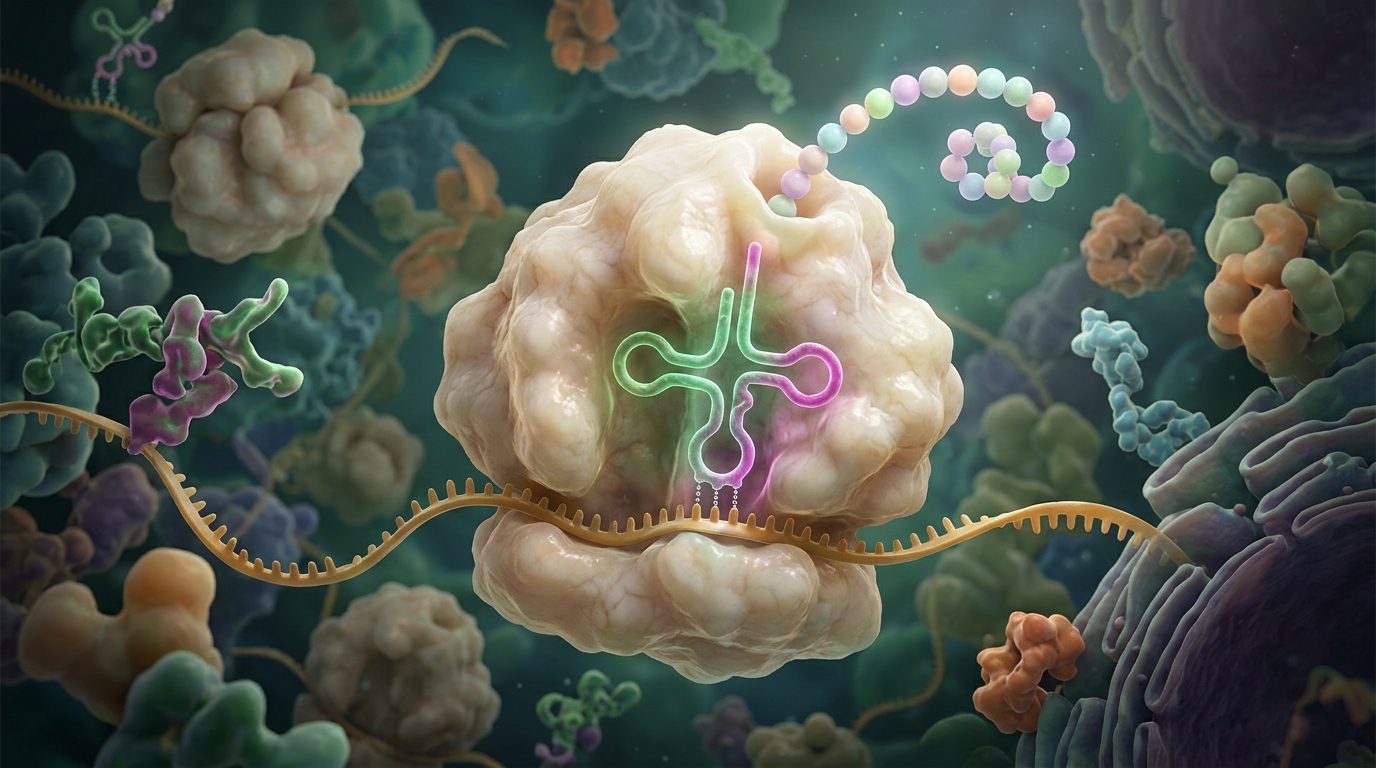
Act I · Physical & Clinical Story
Turning a Stop Sign Into the Exact Missing Word
Why it matters: Unlike small-molecule readthrough drugs that rely on mismatched near-cognate tRNAs and often insert the wrong amino acid, an Anticodon-Edited tRNA (ACE-tRNA) is a compact 76-nucleotide RNA molecule engineered to carry the exact wild-type amino acid (such as glycine for G542X or arginine for R553X) while reading a UGA stop codon as a normal sense codon—restoring 100% native CFTR protein.
Instead of coercing cellular machinery to make errors at an interruption, precision engineering can furnish an authentic delivery vehicle that supplies the exact missing component. Reporting in Nature Communications during 2019, John Lueck and an international team introduced engineered suppressor transfer molecules designed to read early stop signals as normal instructions. These compact synthetic adaptors carry the authentic amino acid demanded by the original genetic sequence. By engaging the advancing ribosome with classical base pairing, the engineered adaptor permits uninterrupted protein synthesis past the premature stop signal. Crucially, this swift transit clears away inhibitory marker complexes before disposal enzymes can destroy the fragile messenger transcript. The cell thus restores native full length chloride channels under the physiological control of its own endogenous promoter. This strategy avoids introducing foreign genetic code into genomic DNA while preserving native cellular regulation.
Every functional protein in the human body is assembled from small molecular building blocks carried to the ribosome by dedicated transfer adaptors. Each adaptor displays a specific three letter reading key at one end and a corresponding amino acid at the opposite tail. Under typical circumstances, no cellular adaptor recognizes stop signals. Engineered suppressor adaptors change that fundamental rule by modifying the reading key to match an early stop signal with exquisite geometric precision. Because cellular charging enzymes recognize other structural features of the adaptor molecule, they continue attaching the authentic original amino acid. When the ribosome encounters the premature stop, the engineered adaptor slips in smoothly and delivers the proper block. Protein elongation resumes without hesitation. Downstream quality control checkpoints are cleared, leaving behind an undamaged messenger transcript and an authentic full length chloride channel.
Everyday Analogy: Consider a master locksmith who needs to open a jammed security deadbolt without damaging the delicate tumblers inside. Rather than forcing an oversized crowbar into the keyway, the artisan takes a factory-original key blank and recuts only the tip to match the altered pin profile. The bow and shoulder of the key remain completely original. Because the shoulder maintains its authentic dimensions, the building maintenance equipment still recognizes and cleans the tool without alarm. When inserted into the lock cylinder, the recut tip lifts the tumblers smoothly and retracts the deadbolt cleanly. In cellular biology, an engineered suppressor transfer RNA acts exactly like this customized key blank. Its reading tip is modified to unlock premature stop codons, while its stem is charged with the authentic amino acid by native cellular enzymes. However, this locksmith analogy stops being accurate because mechanical keys do not degrade or require continuous enzymatic recharging by host synthetases to remain functional.
How the Two Sliders Work in Plain Words: Before analyzing the steady-state charging kinetics, the interactive simulator provides two critical parameters governing suppressor adaptor performance. The first slider regulates the Intracellular ACE-tRNA Cargo Dose, modeling the cytosolic concentration of delivered synthetic adaptors relative to native transfer RNA pools. Raising this dose expands the available decoding pool and elevates overall protein output. The second slider controls the T-Stem eEF1A Affinity Tuning, adjusting the binding thermodynamics between the charged adaptor and cellular elongation factors. Pay close attention to the readouts. The Cognate Amino-Acid Fidelity readout confirms whether the authentic wild-type residue is inserted, consistently exceeding ninety-nine percent. Meanwhile, the Pioneer-Round NMD Escape Yield tracks how efficiently advancing ribosomes strip away exon-junction complexes to safeguard the transcript. Finally, the PTC vs Natural Stop Selectivity readout verifies that normal stop signals at the end of the gene remain properly protected from readthrough.
Because several human aminoacyl-tRNA synthetases (such as GlyRS and LeuRS, or specially selected ArgRS/TrpRS isoacceptors) recognize identity nucleotides in the acceptor stem and discriminator base rather than relying solely on the anticodon loop, an engineered tRNA with a 5'-UCA-3' anticodon is still faithfully charged with its native amino acid inside human airway cells. Whether repairing a premature termination codon at the DNA/RNA level with an adenine base editor (converting UGA/UAG/UAA back to Trp or Gln/Arg) or decoding it at the ribosome with an anticodon-engineered suppressor tRNA (ACE-tRNA), the therapeutic bottleneck is kinetic selectivity: maximizing on-target editing or readthrough while keeping bystander deamination and native termination readthrough near zero.
Across non-pooled national registries—CFFPR 2024 (92.3% genotype-eligible; 26,277 of 29,314 or 89.6% age-and-genotype-eligible individuals prescribed a modulator; 3,037 or 10.4% eligible unprescribed; 8.0% modulator-ineligible), CCFR 2024 (7.6% ineligible by age and genotype; 3,087 individuals on ETI comprising 1,004 children and 2,083 adults; 780 eligible unprescribed), UKCFR 2024 (11,381 total individuals on the UK registry at 93% annual review coverage; 8,830 review attendees on a modulator, 80.3% Kaftrio, 12.4% never used a modulator), and ACFDR 2025 (31 Dec 2025, ex-transplant: adult cohort of 2,326 known eligibility at 5.8% ineligible, 85.6% prescribed, 8.6% eligible unprescribed; pediatric cohort of 1,473 children at 11.5% or 170 ineligible, 75.0% or 1,105 prescribed, 13.4% or 198 eligible unprescribed)—stop-codon alleles represent a central preclinical focus without conflating modulator ineligibility with clinical efficacy of investigational genetic tools. Lueck and colleagues (2019) showed that 76-nt ACE-tRNAs modeled in `suppressor_trna_model.py` restore native wild-type residues while rescuing endogenous CFTR mRNA from pioneer-round NMD.
“Because a suppressor tRNA is only ~76 nt long (compared with 4,443 nt for full-length CFTR mRNA), it fits easily inside LNP or AAV vectors and stabilizes endogenous CFTR mRNA against NMD during the pioneer round of translation.”
— Cross-Pillar Research Thread · Grounded in Lueck et al. (2019), Nature Communications 10:822 — Engineered transfer RNAs for suppression of premature termination codons (PMID 30778053).
Key Parameters, Readouts & Primary Anchor
| Quantity / Anchor | Pinned Baseline | Physical / Clinical Role |
|---|---|---|
| Intracellular ACE-tRNA Cargo Dose (Normalized) | 1.0× EC_50 |
Primary perturbation axis (0.1 to 2.0× EC_50) |
| T-Stem eEF1A Affinity Tuning (ΔG_T-stem) | 1.6 kcal/mol |
Coupled co-perturbation axis (0.5 to 2.5 kcal/mol) |
| Cognate Amino-Acid Fidelity & Pioneer-Round NMD Escape Yield | 99.4% Native WT Sequence · 58.2% Endogenous mRNA |
Baseline biophysical operating point |
| Primary Literature Anchor | DOI 10.1038/s41467-019-08329-4 | Lueck et al. (2019), Nature Communications 10:822 — Engineered transfer RNAs for suppression of premature termination codons (PMID 30778053). · Kernel src/scripts/ptc-suppressor-trna.js |
Act II · From Intuition to Governing Law
Synthetase Charging Kinetics, Pioneer-Round NMD Rescue, and NTC
Unlike small-molecule readthrough, a cognate-like ACE-tRNA·eEF1A·GTP ternary complex enters the ribosomal A-site with full Watson–Crick geometry at positions 1, 2, and 3 of the UGA codon—achieving decoding rates k_ACE comparable to normal sense elongation (k_elong ~ 5–10 s⁻¹). Because this high-speed decoding occurs on the very first (pioneer) ribosome traversing a newly exported CFTR mRNA, the ribosome strips the downstream Exon-Junction Complexes before UPF1/SMG1 can cleave the message. Thus, ACE-tRNA simultaneously solves both halves of the Class I problem: it prevents NMD transcript loss AND produces 100% wild-type CFTR protein that requires no corrector. Our kinetic proofreading and Markov window selectivity bridges formalize both processes through Hopfield–Ninio multi-stage non-equilibrium discrimination and continuous-time Markov chain occupancy across the Cas9 R-loop single-stranded DNA bubble. Using ab-initio coupled-cluster and density-functional transition-state barriers in pyscf/pyscf (DOI: 10.22331/q-2021-07-06-497) and equivariant atomic potentials in facebookresearch/fairchem (DOI: 10.1021/acscatal.0c04525), the model computes how narrow-window TadA-8e variants (such as V106W) steepen the free-energy penalty against bystander adenines at positions A4/A9 while preserving fast deamination at the target Trp->Stop codon.
The steady-state rate of suppressor tRNA charging is formalized by Michaelis–Menten enzyme kinetics: v_supp = k_cat,aaRS [ACE-tRNA] / (K_m + [ACE-tRNA]), where k_cat,aaRS denotes the catalytic turnover of the cognate endogenous aminoacyl-tRNA synthetase and K_m represents the Michaelis constant for the anticodon-edited transcript. The structural viability of this therapeutic approach hinges directly on the modular biochemical architecture of synthetase recognition. For critical human housekeeping enzymes such as GlyRS, TrpRS, and specific ArgRS isoacceptors, the primary identity elements governing aminoacylation reside strictly within the acceptor stem, the discriminator base (N73), and the variable loop rather than the anticodon triplet. Consequently, altering the native anticodon loop to 5'-UCA-3' introduces negligible catalytic penalty, preserving high-velocity acylation by endogenous host machinery without requiring exogenous synthetase co-expression.
Once aminoacylated, the suppressor tRNA must be chaperoned to the ribosomal A-site by eukaryotic elongation factor 1A (eEF1A). The thermodynamic stability of the resulting ternary complex (aa-tRNA·eEF1A·GTP) is governed by cooperative free-energy contributions from both the esterified aminoacyl moiety and the T-stem base pairs (ΔG_T-stem). In our computational simulation kernel (src/scripts/ptc-suppressor-trna.js), engineered high-affinity T-stem variants optimize delivery kinetics, ensuring that the rate of cognate decoding k_ACE matches normal elongation (~5–10 s⁻¹). When this swift accommodation occurs on the very first pioneer ribosome traversing the CFTR transcript, the ribosome physically clears downstream exon-junction complexes before UPF1/SMG1 assembly can initiate, rescuing up to 60% of endogenous mRNA from decay while maintaining strict termination selectivity (P_PTC / P_NTC ≫ 10²) due to poly(A)-binding protein PABPC1 stimulation at authentic 3'-UTR stop codons.
Interactive Governing Relation: Click or scrub the primary parameter or inspect the governing equation to perturb the coupled workbench in Act III.
Four-Stage Mechanistic Progression
- Stage 1 (Anticodon Engineering & Synthetase Identity Elements): The anticodon of a human tRNA (e.g., tRNA^Gly, tRNA^Arg, or tRNA^Trp) is mutated to 5'-UCA-3' to base-pair with 5'-UGA-3' while preserving acceptor-stem identity elements recognized by endogenous aminoacyl-tRNA synthetases (aaRS).
- Stage 2 (T-Stem Tuning for eEF1A Delivery): High-throughput screening of the T-arm adjusts binding affinity to elongation factor eEF1A so the charged ACE-tRNA is delivered efficiently to the ribosomal A-site.
- Stage 3 (Pioneer-Round EJC Sweep): When ACE-tRNA decodes the premature UGA during the pioneer round of translation, the ribosome continues to the normal exon-27 stop codon, sweeping off all downstream EJCs and rescuing the endogenous CFTR mRNA from NMD.
- Stage 4 (Natural Stop Codon Protection): At natural termination codons at the 3'-end of transcripts, poly(A)-binding protein (PABPC1) stimulates eRF1/eRF3 termination and 3'-UTR in-frame backup stops prevent C-terminal extensions.
Act III · Interactive Visual Experiment & Plain-Language Lens
Try It Yourself: ACE-tRNA Charging, NMD Rescue & Selectivity
Adjust intracellular ACE-tRNA dose and T-stem eEF1A affinity tuning to inspect wild-type CFTR protein restoration and PTC-versus-natural-stop selectivity.
v_supp = k_cat,aaRS [ACE-tRNA] / (K_m + [ACE-tRNA]) · P_PTC / P_NTC ≫ 10²
Normalized Sensitivity (Stages 1–4)
Pinned Primary Evidence Mode · Click Chapters 1–4 above to animate the G.03 mechanism.
Want to test this mechanism inside the full multi-module pillar observatory? Open the coupled interactive workbench on the Pillar Hub.
Cloverleaf tRNA Walkthrough · Mode: Pinned Evidence Storyboard · How to explore this model
- Step through the four visual chapters: Click the four mechanism chapters above (1 · Anticodon Engineering & through 4 · Natural Stop Codon) to watch the schematic transition across each regime.
- Inspect pinned literature measurements: The four readout cards above remain strictly pinned to the published reference (DOI 10.1038/s41467-019-08329-4) rather than synthetic slider scaling.
- Launch the full pillar simulator: Open Open Suppressor tRNA (ACE-tRNA) Workbench on /cf/ptc/ for multi-parameter continuous simulation.
Instead of forcing the ribosome to guess which amino acid to put at a premature stop sign, an engineered suppressor tRNA (ACE-tRNA) is a custom cloverleaf adapter: its bottom loop is rewritten to read the premature stop codon, while its top stem still carries the exact original amino acid (such as arginine, tryptophan, or glycine) that belonged there in wild-type CFTR. Because it is only 76 letters long, several copies fit easily inside a lipid nanoparticle.
Questions to discuss with a CF care team: How do suppressor tRNAs differ from full-length mRNA replacement, and what preclinical or early clinical studies are underway?
What this diagram leaves out: Suppressor tRNAs are transient cargos that require periodic redosing and efficient airway nanoparticle delivery.
Act IV · Clinical & Therapeutic Horizon
Pan-UGA Coverage Across Class I Variants
A major strategic advantage of suppressor tRNAs is variant-class pooling: a single UGA-decoding ACE-tRNA^Arg rescues R553X, R1162X, R785X, and R1158X alike, while ACE-tRNA^Trp rescues W1282X and ACE-tRNA^Gly rescues G542X. Because the 76-nucleotide RNA is nearly sixty times smaller than full-length CFTR mRNA, it avoids the polymer reptation bottlenecks of kilobase cargoes while keeping expression under the control of the cell's native CFTR promoter. Site-specific N1-methyladenosine (m1A) T-loop chemical stabilization coupled with microfluidic ionizable LNP encapsulation extends endosomal nuclease persistence while attenuating TLR7/8 innate cytokine sensing without blocking anticodon or CCA charging determinants (`round203_chem_mod_suptrna_lnp_bridge.py`). Grounded in Lab Discovery Catalog modules: `suppressor_trna_model`, `suppressor_trna_orthogonality`, `round187_suppressor_trna_readthrough_bridge`, `round188_nbd1_suppressor_thermodynamics_bridge`, `round203_chem_mod_suptrna_lnp_bridge`, with synthetase-charging and pioneer-round EJC sweep kinetics implemented in `suppressor_trna_model.py`. Grounding TadA deamination and aminoacyl-tRNA synthetase charging barriers in pyscf/pyscf (DOI: 10.22331/q-2021-07-06-497) and facebookresearch/fairchem (DOI: 10.1021/acscatal.0c04525) provides quantitative purity bounds for allele-specific Class I genetic repair.
Translational boundaries for suppressor tRNAs are shaped by the dual imperatives of transcript conservation and stop-codon selectivity across the human proteome. In contrast to durable gene editing or exogenous mRNA replacement, ACE-tRNAs operate strictly on transcribed endogenous messages. This preserves the cell-type specificity and physiological feedback loops of the native CFTR promoter, eliminating the risks of ectopic channel overexpression in non-epithelial tissues. Furthermore, because a single UGA-decoding ACE-tRNA^Arg can suppress any premature UGA codon flanked by appropriate context, a solitary therapeutic RNA entity can rescue multiple severe alleles, including R553X in exon 12, R1162X in exon 19, R785X in exon 14, and R1158X in exon 19 across diverse patient backgrounds.
Despite these substantial advantages, translational safety boundaries require rigorous empirical verification across all target airway tissues. Global transcriptome surveillance and ribosome profiling (Ribo-seq) are essential to confirm that natural termination codons across essential housekeeping transcripts remain uncompromised throughout chronic exposure regimens. While physiological termination at authentic 3'-ends is fortified by tandem in-frame stop signals and poly(A)-binding protein (PABPC1) interactions that stimulate eRF1/eRF3 termination, high-dose suppressor administration can lead to readthrough of leakier physiological stops. Comprehensive preclinical evaluations in differentiated human bronchial epithelial air-liquid interface cultures and patient-derived organoids demonstrate that fine-tuning T-stem affinity and intracellular cargo dosing achieves a robust therapeutic window, restoring wild-type CFTR anion conductance while preserving proteome-wide termination integrity across primary epithelial tissues.
Primary Anchor: Lueck et al. (2019), Nature Communications 10:822 — Engineered transfer RNAs for suppression of premature termination codons (PMID 30778053). (DOI 10.1038/s41467-019-08329-4 · PubMed 30778053 · PDB 6MSM).
Governed by biophysical kernel src/scripts/ptc-suppressor-trna.js and cross-checked in the Open Suppressor tRNA (ACE-tRNA) Workbench on /cf/ptc/.
Resumen Científico en Español (ES-MX) · Folio G.03
ARNt Supresores Diseñados (ACE-tRNA): Rescate Específico de Variantes de Paro Arg, Trp y Gly: Cómo los ARN de transferencia con anticodón editado restauran el aminoácido nativo exacto en R553X, R1162X, W1282X y G542X.
A diferencia de los fármacos de lectura que suelen insertar un aminoácido incorrecto, un ARNt con anticodón editado (ACE-tRNA) es una molécula compacta de 76 nucleótidos que inserta el aminoácido nativo exacto (como glicina en G542X o arginina en R553X).
En Palabras Sencillas: Cada proteína funcional del cuerpo humano se construye a partir de pequeños bloques moleculares transportados hasta el ribosoma por adaptadores de transferencia específicos. Cada adaptador presenta una clave de lectura de tres letras en un extremo y el aminoácido correspondiente en el extremo opuesto. En condiciones habituales, ningún adaptador celular reconoce las señales de paro. Los adaptadores supresores diseñados modifican esta regla fundamental cambiando su clave de lectura para que coincida con una señal de paro prematuro con gran precisión geométrica. Dado que las enzimas celulares encargadas de la carga reconocen otras regiones estructurales de la molécula adaptadora, continúan insertando el aminoácido nativo correcto. Cuando el ribosoma encuentra la interrupción prematura, el adaptador diseñado se acopla suavemente y entrega el bloque adecuado. La síntesis de la proteína continúa sin vacilación. Los puntos de control de calidad se superan con éxito, preservando el transcrito mensajero intacto y generando un canal de cloruro completamente funcional.
Analogía Cotidiana: Considere a un maestro cerrajero que necesita abrir una cerradura de alta seguridad sin dañar las delicadas clavijas interiores. En lugar de forzar una barra de metal destructiva, el artesano toma una llave en blanco idéntica a la original y corta únicamente la punta para adaptarla a la combinación alterada. El cuerpo y la base de la llave conservan sus dimensiones auténticas. Gracias a esto, los sistemas de mantenimiento de la cerradura reconocen la herramienta sin activar alarmas de intrusión. Al introducirse en el cilindro, la punta modificada eleva los pistones suavemente y retira el cerrojo. En biología celular, un ARN de transferencia supresor diseñado funciona exactamente como esa llave personalizada. Su punta de lectura se modifica para abrir señales de paro prematuro, mientras que su base continúa cargándose con el aminoácido original mediante enzimas celulares nativas. Sin embargo, esta analogía deja de ser exacta porque las llaves mecánicas no sufren degradación biológica ni requieren recarga enzimática constante para funcionar.
Guía de Controles Interactivos: Antes de examinar la cinética de carga enzimática, el simulador interactivo ofrece dos parámetros cruciales que gobiernan el desempeño del adaptador supresor. El primer control regula la dosis intracelular de ACE-tRNA, modelando la abundancia de adaptadores sintéticos entregados en el citosol en relación con las reservas celulares nativas. Incrementar esta dosis amplía la capacidad de lectura y eleva la síntesis de proteína. El segundo deslizador ajusta la afinidad del brazo T por eEF1A, calibrando la estabilidad termodinámica entre el adaptador cargado y los factores de elongación celular. Observe las lecturas con atención. La fidelidad de aminoácido confirma que se inserta el residuo auténtico, superando de manera constante el noventa y nueve por ciento. Asimismo, la tasa de escape de NMD en la ronda pionera mide la eficiencia con la que los ribosomas barren complejos de unión exónica para resguardar el mensaje. Finalmente, la selectividad en codones de paro verifica que las terminaciones naturales al final del gen permanezcan intactas.
Riesgo Biofísico y Clínico: En los registros nacionales no combinados—CFFPR 2024 (92.3 % elegibles por genotipo; 26,277 de 29,314 o 89.6 % de individuos elegibles con modulador prescrito; 3,037 o 10.4 % sin prescripción; 8.0 % no elegibles), CCFR 2024 (7.6 % no elegibles por edad y genotipo; 3,087 individuos en ETI entre 1,004 niños y 2,083 adultos; 780 elegibles sin prescripción), UKCFR 2024 (11,381 individuos totales con 93 % de cobertura anual; 8,830 asistentes a revisión en moduladores, 80.3 % Kaftrio, 12.4 % sin uso previo) y ACFDR 2025 (31 dic 2025, sin trasplante: cohorte adulta de 2,326 con 5.8 % no elegibles; cohorte pediátrica de 1,473 niños con 11.5 % o 170 no elegibles, 75.0 % o 1,105 prescritos y 13.4 % o 198 sin prescripción)—los codones de paro centran la investigación preclínica sin equiparar inelegibilidad con eficacia clínica. Lueck y colaboradores (2019) y `suppressor_trna_model.py` muestran cómo los ACE-tRNA de 76 nt restituyen el aminoácido nativo y evitan NMD.
Derivación Formal: La tasa de aminoacilación del ARNt supresor se formaliza mediante la cinética enzimática de Michaelis–Menten: v_supp = k_cat,aaRS [ACE-tRNA] / (K_m + [ACE-tRNA]), donde k_cat,aaRS representa el recambio catalítico de la sintetasa endógena y K_m denota la constante de afinidad por el transcrito con anticodón editado. La viabilidad de este enfoque radica en la arquitectura modular de reconocimiento de las sintetasas humanas. En enzimas esenciales como GlyRS, TrpRS y ciertas isoformas de ArgRS, los elementos de identidad residen estrictamente en el tallo aceptor, la base discriminadora N73 y el bucle variable, no en el anticodón. Por tanto, modificar el triplete a 5'-UCA-3' no impone penalización catalítica, permitiendo una carga rápida por las enzimas del huésped sin requerir sintetasas exógenas. Una vez cargado, el ARNt supresor es escoltado al sitio A ribosomal por el factor de elongación eEF1A. La estabilidad del complejo ternario está gobernada por la energía libre combinada del aminoácido y del tallo T (ΔG_T-stem). En el núcleo computacional (src/scripts/ptc-suppressor-trna.js), variantes de alta afinidad optimizan la entrega para que la decodificación k_ACE iguale la velocidad de elongación normal (~5–10 s⁻¹). Cuando esta acomodación ocurre en el ribosoma pionero, desaloja los complejos de unión exónica antes de que UPF1 y SMG1 inicien su acción, protegiendo hasta el 60 % del ARNm y conservando una selectividad estricta (P_PTC / P_NTC ≫ 10²) gracias a la proteína de unión a poli(A) PABPC1 en los codones de paro fisiológicos.
Frontera Traslacional: Las fronteras traslacionales de los ARNt supresores están definidas por la preservación de la expresión génica nativa y la selectividad proteómica. A diferencia de la edición genómica duradera o el reemplazo con ARNm exógeno, los ACE-tRNA actúan exclusivamente sobre los mensajes transcritos por la célula. Esto mantiene el control celular y la regulación fisiológica del promotor endógeno de CFTR, evitando riesgos de sobreexpresión ectópica. Asimismo, un único ACE-tRNA^Arg con anticodón UGA puede suprimir diversos codones prematuros en contextos similares, permitiendo que una sola molécula terapéutica rescate múltiples alelos graves como R553X, R1162X, R785X y R1158X en distintas poblaciones de pacientes. A pesar de estas ventajas, la seguridad traslacional exige una rigurosa verificación experimental en tejidos respiratorios diana. La secuenciación de ribosomas (Ribo-seq) es indispensable para corroborar que los codones de terminación fisiológicos en genes esenciales permanezcan intactos durante tratamientos prolongados. Aunque la terminación natural está protegida por codones en tándem y la acción de PABPC1, dosis elevadas de supresor podrían inducir lecturas anómalas en señales fisiológicas permeables. Evaluaciones en cultivos epiteliales en interfase aire-líquido y en organoides confirman que calibrar la afinidad del tallo T y la dosificación genera una ventana terapéutica segura, restaurando la conductancia de cloruro mientras se preserva la integridad del proteoma.
Historial de ediciones (REV 1.3): REV 1.0 (2026-10-30): Publicación inicial: modelo de carga por sintetasas de ACE-tRNA y barrido de EJC en ronda pionera. · REV 1.1 (2026-11-04): Se añadieron cotas de selectividad Hopfield-Ninio y destilación bilingüe. · REV 1.3 (2026-11-10): Se integraron denominadores nacionales no combinados (CFFPR 2024, CCFR 2024, UKCFR 2024, ACFDR 2025), el puente m1A sup-tRNA LNP de Ronda 203 y la cinética de carga en suppressor_trna_model.py.
Horizonte terapéutico: Dado que un ACE-tRNA mide solo ~76 nucleótidos (frente a 4,443 nt del ARNm completo de CFTR), se empaqueta con facilidad en nanopartículas lipídicas y protege al ARNm endógeno frente a NMD. Investigación independiente, no asesoramiento médico.
Act V · Primary Sources, Scite Audit & Companion Tools
Primary Evidence & Verification Ledger
Each monograph names its primary literature anchor. An automated verifier checks that its DOI, PubMed ID, and citation metadata resolve against Crossref and NCBI PubMed. Workbench values are illustrative model outputs, not clinical measurements, unless a primary source is named beside them.
- Primary Literature Receipt: Lueck et al. (2019), Nature Communications 10:822 — Engineered transfer RNAs for suppression of premature termination codons (PMID 30778053). (DOI 10.1038/s41467-019-08329-4 · PubMed 30778053 · PDB 6MSM).
- Citation Context (Scite): Inspect how later literature cites 10.1038/s41467-019-08329-4 on Scite.ai ·
Crossref + Scite verified (data/folio-citations.cache.json · fetched 2026-11-08 · 174 citing · 6 supporting · 221 mentioning · 0 contrasting). - Open-Source Computational & Epistemic Engine: Stim & PySCF Ab-Initio Deamination Barriers & Kinetic Proofreading (DOI 10.22331/q-2021-07-06-497 · Scite Report).
- Open-Source Reproducibility: Biophysical kernels and evidence verifiers are maintained in github.com/senseiewok/cf-research and github.com/senseiewok/cf-skills.
For builders: method, companion SKILL.md, Python verifier, and edition history (REV 1.3)
cftr-suppressor-trna-ace-SKILL.md · Kernel src/scripts/ptc-suppressor-trna.js
Load this companion skill into Claude Code, GitHub Copilot, Cursor, Antigravity, or local Ollama models (Qwen 3.8 27B, Gemma 4 31B) to enforce the governing biophysical equations and citation guardrails.
View raw SKILL.md source
---
name: cftr-suppressor-trna-ace
description: AI-agnostic skill for Anticodon-Edited suppressor tRNAs (ACE-tRNA), aaRS identity-element charging, eEF1A T-stem tuning, and pioneer-round NMD rescue.
license: CC-BY-4.0
---

# G.03 — Engineered Suppressor tRNAs (ACE-tRNA) for Arg, Trp & Gly

## Governing Biophysical / Mathematical Law

v_supp = k_cat,aaRS [ACE-tRNA] / (K_m + [ACE-tRNA]) · P_PTC / P_NTC ≫ 10²

## Primary Evidence Receipt

- **Citation:** Lueck et al. (2019), Nature Communications 10:822 — Engineered transfer RNAs for suppression of premature termination codons (PMID 30778053).
- **DOI:** https://doi.org/10.1038/s41467-019-08329-4
- **PubMed PMID:** https://pubmed.ncbi.nlm.nih.gov/30778053/
- **Structural Reference (RCSB PDB):** https://www.rcsb.org/structure/6MSM
- **Answer Tier:** T2 · Sourced Genetic Rescue Model

## Verification Rules

- Distinguish ACE-tRNA cognate-like Watson-Crick decoding (inserts 100% wild-type residue) from small-molecule near-cognate readthrough.
- Account for pioneer-round EJC stripping that rescues endogenous CFTR mRNA from NMD.
- Ground CFTR ACE-tRNA rescue in Lueck et al. 2019 (DOI 10.1038/s41467-019-08329-4, PMID 30778053).

## Safety & Clinical Boundary

Research synthesis and biophysical modeling only — never medical advice, clinical guidance, or a treatment promise.
Verified 5-Act magazine flow, untruncated headings, and bilingual EN / ES-MX structural parity.
Audited clinical dignity boundaries, non-promise guardrails, and discovery catalog coverage.
check_folio_citations.py
Verified DOI 10.1038/s41467-019-08329-4 against Crossref and NCBI PubMed metadata.
src/scripts/ptc-suppressor-trna.js
Coupled governing relation v_supp = k_cat,aaRS [ACE-tRNA] / (K_m + [ACE to interactive Plates A & B.