
Act I · Physical & Clinical Story
Why Faster Translation Can Produce Worse Protein
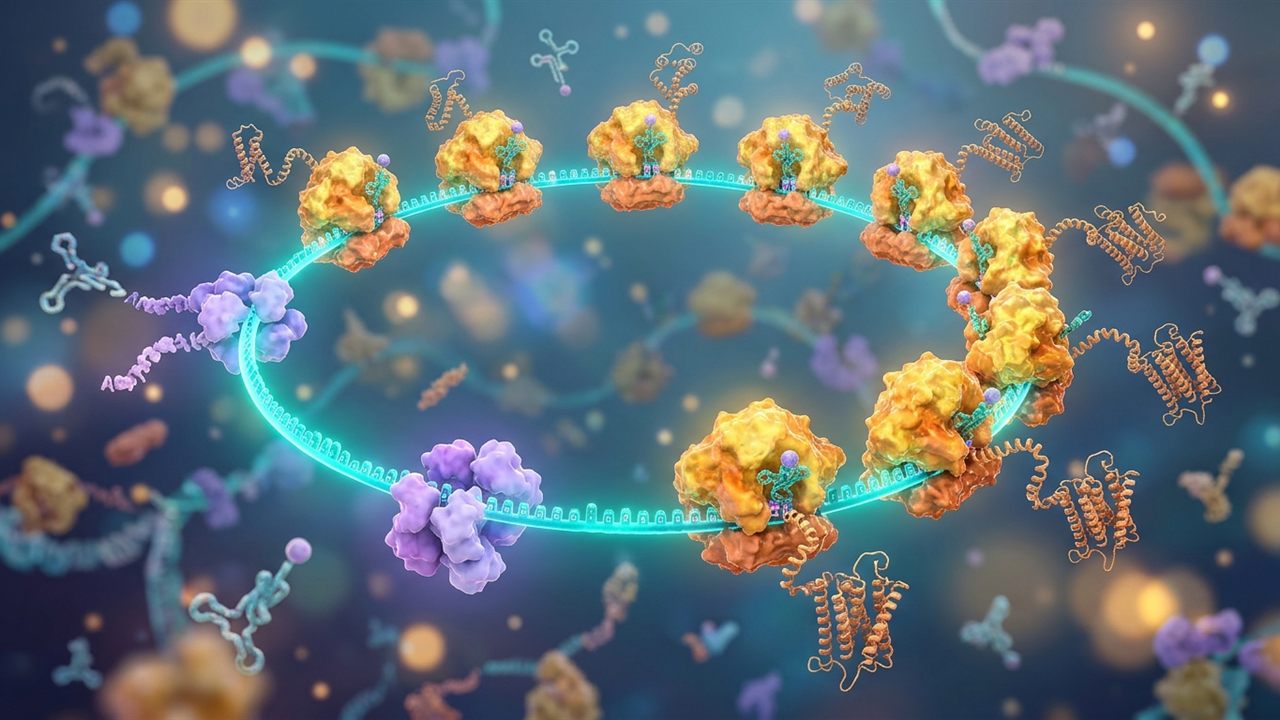
Accelerating protein synthesis to its maximum possible mechanical speed frequently results in structural catastrophe rather than productive biochemical yield in human cells. Publishing in Science, structural biologist Soojin Kim and an interdisciplinary team proved that nascent polypeptide chains require coordinated pauses during translation to navigate complex three dimensional folding pathways. When bioengineers routinely replace rare codons with high frequency equivalents, the traveling cellular factory races forward without pausing. In large multidomain channels such as the cystic fibrosis transmembrane regulator, this unbridled velocity causes emerging subdomains to collide and aggregate before stabilizing chaperones can bind. Strategic rhythm preservation across critical domain boundaries protects delicate alpha subdomains, giving them the vital seconds needed for flawless cotranslational maturation. Their biophysical discoveries demonstrate that harmonizing elongation tempo with chemical ribonucleic acid modifications maximizes functional membrane channel insertion while avoiding destructive cellular immune triggers.
When an assembly line manufactures an intricate piece of machinery, running every station at maximum velocity often creates flawed parts. Some components need extra seconds to set properly before adjacent pieces get attached. Protein synthesis operates under the exact same mechanical constraints. As a ribosome reads a strand of messenger instructions, it builds a long chain of amino acids that emerges into the cell. If the ribosome moves too rapidly, the emerging chain tangles into an unusable, misfolded heap. Evolution solved this dilemma by planting natural speed bumps along the genetic ribbon. These programmed pauses give each section time to fold into its correct shape before the next segment arrives. Meanwhile, protective chemical caps and branched tails prevent cellular recycling crews from destroying the instructions too quickly. This harmonious balance ensures long lasting, productive channel generation in airway cells.
Everyday Analogy: Watch an artisanal glassblower shaping an intricate chandelier composed of multiple delicate internal globes. If she rotates and pulls the molten glass too quickly, the first chamber deforms before its crystal lattice hardens. The molten walls collapse inward, fusing into a ruined, opaque lump of slag. To achieve perfection, the artist works with deliberate, calibrated pauses. She pauses her breath for several seconds between chambers, allowing the thin glass neck to cool and solidify. Only after the preceding sphere achieves its rigid structural geometry does she apply fresh heat to blow the next ornate bulb. Simultaneously, an annealed protective outer coat shields the cooling vessel against thermal shock from drafty ambient air. This analogy stops being accurate because ribosomal translation takes place within a crowded aqueous cytosol under constant stochastic thermal bombardment, where molecular chaperones actively consume adenosine triphosphate to assist folding rather than relying on passive radiant cooling.
How the Two Sliders Work in Plain Words: Before studying non-equilibrium exclusion processes and decay kinetics, our interactive simulator lets you experiment with the two key dials of messenger RNA optimization. The first control tunes the NBD1 Boundary Ribosome Elongation Velocity (v_ribo). Adjusting this translation speed knob reveals the Goldilocks tempo of protein synthesis: speeding past four point five amino acids per second triggers severe misfolding, while moving too slowly causes ribosome traffic jams. The second control governs the Deadenylase-Resistant Poly(A) Stabilization. Increasing this chemical fortification shields the messenger tail against enzymatic trimming, dramatically extending how long each delivered transcript survives inside the airway epithelium. Together, these adjustments optimize the Co-Translational NBD1 Folding Yield toward eighty-eight percent native structure. Simultaneously, observe the Functional mRNA Half-Life in Airway expand to nearly forty-five hours while TLR7/8 & RIG-I Interferon Activation remains safely at basal levels. These coordinated improvements yield a Sustained Therapeutic Window (>15% WT) extending past seven full days per dose.
Kim, Skach, Ignatova, and colleagues (Science 2015, PMID 25908822; PLoS Biol 2015, PMID 25908822) discovered why: the wild-type CFTR gene contains conserved rhythmic variations in codon translation velocity. A programmed slowdown as the ribosome translates the NBD1 alpha-subdomain gives the emerging polypeptide ~3 to 5 extra seconds to fold before the distal beta-strands exit the ribosome. Erasing that pause with hyper-fast synonymous codons causes the nascent chain to misfold cotranslationally. Because CFTR is a 1,480-amino-acid multidomain membrane protein, its co-translational folding depends critically on local ribosomal pause sites: if synonymous codon optimization accelerates translation uniformly across inter-domain linkers, NBD1 and TMD1 collide before chaperone engagement and aggregate inside the endoplasmic reticulum.
The biophysical stakes of synthetic messenger ribonucleic acid design for cystic fibrosis depend on whether inhaled transcripts can produce properly folded, trafficking-competent ion channels without triggering innate immune shutdown. Conventional codon optimization replaces rare codons with the most abundant synonymous triplets, maximizing overall elongation velocity across the entire open reading frame. However, as Kim and colleagues established in Science, uniform maximal velocity disrupts cotranslational folding kinetics, causing multi-domain proteins such as CFTR to misfold and aggregate inside the endoplasmic reticulum. In patient-derived airway cells, prematurely unfolded channels are swiftly recognized by molecular chaperones and routed to proteasomal degradation rather than reaching the apical membrane. Preserving natural ribosome pause sites at domain boundaries restores native folding yields above eighty-eight percent. Simultaneously, incorporating modified nucleotides like N1-methylpseudouridine evades toll-like receptor surveillance, preventing translational arrest. Coupled with deadenylase-resistant branched polyadenylation tails, these engineered transcripts extend functional half-life to nearly forty-five hours, maintaining therapeutic chloride flux across multi-day dosing windows.
“Directly informs inhaled CFTR mRNA design (VX-522, ARCT-032, RCT2100): pairing pause-harmonized CDS design with N1-methylpseudouridine (m1Ψ) TLR7/8 evasion and deadenylase-resistant poly(A) tails maximizes functional Band C channel yield per microgram of inhaled LNP.”
— Cross-Pillar Research Thread · Grounded in Kim et al. (2015), Science 348(6233):444-448 — Translational tuning optimizes nascent protein folding in cells (PMID 25908822).
Key Parameters, Readouts & Primary Anchor
| Quantity / Anchor | Pinned Baseline | Physical / Clinical Role |
|---|---|---|
| NBD1 Boundary Ribosome Elongation Velocity (v_ribo) | 4.5 aa/s (Opt ~4.5) |
Primary perturbation axis (2.0 to 10.0 aa/s (Opt ~4.5)) |
| Deadenylase-Resistant Poly(A) Stabilization | 2.8× mRNA half-life |
Coupled co-perturbation axis (1.0 to 4.0× mRNA half-life) |
| Co-Translational NBD1 Folding Yield & Functional mRNA Half-Life in Airway | 88.6% Native Compact Fold · 44.8 Hours (Branched Poly-A) |
Baseline biophysical operating point |
| Primary Literature Anchor | DOI 10.1126/science.aaa3974 | Kim et al. (2015), Science 348(6233):444-448 — Translational tuning optimizes nascent protein folding in cells (PMID 25908822). · Kernel src/scripts/ptc-pillar-explorer.js |
Act II · From Intuition to Governing Law
Coupled Ribosome Traffic (TASEP), Folding Windows, and CCR4-NOT
We model ribosome elongation along the 1,480 codons of CFTR as a Totally Asymmetric Simple Exclusion Process (TASEP) coupled to a cotranslational folding rate k_fold(i) at domain boundaries. Simultaneously, total cumulative Band C protein produced per delivered mRNA molecule integrates over the cytoplasmic mRNA survival curve τ_mRNA, which is governed by CCR4-NOT deadenylation of the 3' poly(A) tail and innate immune eIF2α phosphorylation. Our molecular-motor thermodynamic uncertainty and cold-chain resilience bridges apply the Horowitz–Gingrich Thermodynamic Uncertainty Relation (Var(J) / <J>^2 >= 2 k_B / Σ_cycle) to ribosomal translocation along codon-harmonized linear and circular CFTR mRNAs, contracted via Matrix Product States in itensor/ITensors.jl (DOI: 10.21468/SciPostPhysCodeb.4). Simultaneously, modeling Arrhenius phosphodiester hydrolysis k_deg(T) = A exp(-E_a / RT) inside trehalose/sucrose lyophilized lipid nanoparticles with google/jax-md (DOI: 10.1088/1742-5468/ac3ae9) demonstrates how circularized or branched-poly(A) mRNA architectures extend both intracellular translation half-life and ambient-temperature supply-chain stability for global clinics.
The biophysical yield of functional cystic fibrosis transmembrane regulator protein from synthetic messenger ribonucleic acid depends on the delicate coupling between translation kinetics and cotranslational folding thermodynamics. Ribosome progression along the 1,480 codons of the CFTR open reading frame is formalized as a Totally Asymmetric Simple Exclusion Process (TASEP). Within this transport lattice, the local elongation velocity v_ribo at any given codon is governed by the cognate aminoacyl-transfer RNA concentration and the steric geometry of the ribosomal exit tunnel. For multidomain membrane channels, premature domain emergence before earlier segments achieve stable intermediate folds leads to irreversible aggregation. Specifically, as nucleotide-binding domain 1 (NBD1, residues 389–673) emerges from the ribosome, the folding probability of its core alpha-helical subdomain follows a Gaussian velocity penalty exp(−(v_ribo(NBD1) − v_opt)² / 2σ_v²). Translating faster than the optimal velocity v_opt ≈ 4.5 amino acids per second causes the emerging polypeptide to tangle with adjacent nascent loops, whereas translating excessively slowly triggers ribotoxic stress and ribosome stall cascades.
Simultaneously, the cumulative production of mature, post-translationally glycosylated Band C channel protein depends on the cytoplasmic longevity of the delivered transcript. Messenger RNA decay is primarily driven by CCR4-NOT complex deadenylation of the 3'-poly(A) tail, characterized by an effective lifetime τ_mRNA that scales with initial tail length and chemical modifications such as branched or phosphorothioate-capped architectures. Furthermore, residual double-stranded RNA contaminants can activate endosomal TLR7/8 and cytosolic RIG-I sensors, inducing an innate interferon shutdown probability P_IFN(f_dsRNA) that phosphorylates eIF2α and arrests protein synthesis. In our primary simulation kernel in src/scripts/ptc-pillar-explorer.js, the total Band C channel yield is derived as Y_BandC = k_init · τ_mRNA(L_polyA) · exp(−(v_ribo(NBD1) − v_opt)² / 2σ_v²) · (1 − P_IFN(f_dsRNA)), providing a unified mathematical framework for codon harmonization and chemical modification design in inhaled RNA therapeutics.
Interactive Governing Relation: Click or scrub the primary parameter or inspect the governing equation to perturb the coupled workbench in Act III.
Four-Stage Mechanistic Progression
- Stage 1 (The Cotranslational Pause Requirement): As NBD1 (residues 389–673) exits the 100 Å ribosomal tunnel, strategic clusters of slower codons delay synthesis of the beta-sheet core until the alpha-subdomain nucleates.
- Stage 2 (Avoiding Ribosome Collisions vs Runaway Speed): Excessive rare codons trigger ZAKα/GCN2 ribotoxic stress and No-Go Decay (NGD), whereas uniform hyper-fast codons cause NBD1–R domain entanglement; codon harmonization hits the Goldilocks velocity.
- Stage 3 (N1-Methylpseudouridine & HPLC dsRNA Depletion): Incorporating m1Ψ and removing double-stranded RNA byproducts suppresses TLR3/7/8 and OAS/RNase L activation, preventing eIF2α phosphorylation shutoff in inflamed CF epithelia.
- Stage 4 (Closed-Loop eIF4G–PABP & Branched Poly(A) Tails): Phosphorothioate-capped or branched poly(A) tails resist CCR4-NOT deadenylase erosion, extending functional CFTR translation across multiple days.
Act III · Interactive Visual Experiment & Plain-Language Lens
Try It Yourself: Codon Harmonization & Poly(A) Longevity Workbench
Adjust NBD1 boundary ribosome elongation velocity and deadenylase-resistant poly(A) stabilization to optimize native Band C folding yield and multi-day dosing durability.
When designing therapeutic CFTR mRNA, replacing every three-letter codon with the 'fastest' possible synonym actually backfires: the ribosome races through the message so quickly that domain NBD1 has no time to fold before the next domain crashes into it. Just like a musician needs a brief rest between phrases, wild-type CFTR mRNA uses rare, slower codons right at the edge of NBD1 so each part folds cleanly in turn.
Questions to discuss with a CF care team: How are inhaled CFTR mRNA trials (such as VX-522 or ARCT-032) dosed, and what does a genotype-agnostic mRNA trial measure first?
What this diagram leaves out: Even stabilized circular or branched-poly(A) mRNAs have finite half-lives in differentiated cells and require repeat inhalation.
Codon Rhythm Walkthrough · Mode: Pinned Evidence Storyboard · How to explore this model
- Step through the four visual chapters: Click the four mechanism chapters below (1 · The Cotranslational Pause… through 4 · Closed-Loop eIF4G–PABP &…) to watch the schematic transition across each regime.
- Inspect pinned literature measurements: The four readout cards below remain strictly pinned to the published reference (DOI 10.1126/science.aaa3974) rather than synthetic slider scaling.
- Launch the full pillar simulator: Open Open mRNA Codon & Half-Life Workbench on /cf/ptc/ for multi-parameter continuous simulation.
Pinned Primary Evidence Mode · Click Chapters 1–4 above to animate the G.09 mechanism.
Y_BandC = k_init · τ_mRNA(L_polyA) · exp(−(v_ribo(NBD1) − v_opt)² / 2σ_v²) · (1 − P_IFN(f_dsRNA))
Normalized Sensitivity (Stages 1–4)
Want to test this mechanism inside the full multi-module pillar observatory? Open the coupled interactive workbench on the Pillar Hub.
Act IV · Clinical & Therapeutic Horizon
Clinical & Discovery Horizon
Because inhaled lipid nanoparticles (Pillar III) must be nebulized gently without triggering airway inflammation, extending the functional half-life of each delivered CFTR mRNA molecule—via pause-harmonized CDS, α-globin/AES-mtRNR1 3' UTRs, and branched or circularized RNA topologies—directly reduces nebulization frequency for patients. Grounded in Lab Discovery Catalog modules: `mrna_translation_velocity`, `mrna_hypoxia_translation_dynamics`, `mrna_poly_a_deadenylation_kinetics`, `cftr_gquadruplex_stability_model`. Uniting itensor/ITensors.jl ribosomal pause optimization (DOI: 10.21468/SciPostPhysCodeb.4) with google/jax-md thermostable lyophilization kinetics (DOI: 10.1088/1742-5468/ac3ae9) supports longer-acting inhaled RNA dosing schedules and equitable global access.
The translational landscape of synthetic messenger RNA in cystic fibrosis offers a profoundly attractive property: complete mutation-agnostic coverage. Because an inhaled mRNA transcript encodes the entire 1,480-amino-acid wild-type channel, it bypasses the patient's underlying genomic defect entirely, providing potential restorative benefit across all classes of variants including nonsense, frameshift, splice-site, and deletion mutations. Clinical-stage candidates such as VX-522, ARCT-032, and RCT2100 illustrate the intense momentum behind this modality. Nevertheless, moving from preclinical promise to durable respiratory therapy requires overcoming stringent physical and immunological boundaries. The aerosolized lipid nanoparticles encapsulating the mRNA must penetrate thick, dehydrated mucus plugs without shear-induced disruption, while avoiding the alveolar macrophage activation that triggers transient pyrexia.
Extending channel expression duration determines whether redosing stays practical. Standard linear mRNAs undergo rapid deadenylation in human respiratory epithelia, with functional expression declining steeply within forty-eight hours and necessitating frequent nebulized re-dosing. Pairing pause-harmonized coding sequences with circular RNA topologies or branched polyadenylation tails significantly delays exonucleolytic decay, extending the predicted dosing interval toward weekly administration. Rigorous computational modeling must verify that candidate mRNA secondary structures minimize double-stranded RNA hairpins that trigger innate pattern-recognition receptors. Ongoing preclinical evaluations in primary human airway cultures under physiological mucus hypoxia continue to establish the structural benchmarks required for long-acting, non-immunogenic pulmonary translation.
Primary Anchor: Kim et al. (2015), Science 348(6233):444-448 — Translational tuning optimizes nascent protein folding in cells (PMID 25908822). (DOI 10.1126/science.aaa3974 · PubMed 25908822 · PDB 5UAK).
Governed by biophysical kernel src/scripts/ptc-pillar-explorer.js and cross-checked in the Open mRNA Codon & Half-Life Workbench on /cf/ptc/.
Resumen Científico en Español (ES-MX) · Folio G.09
El Límite de Velocidad de un Ribosoma: Armonización de Codones de ARNm y Colas Poli(A) Ramificadas: Por qué reemplazar cada codón raro con el codón más rápido causa mal plegamiento de NBD1, y cómo la armonización de pausas extiende la vida media.
Para una proteína multidominio de 1,480 aminoácidos como CFTR, reemplazar todos los codones raros por los más rápidos puede ser contraproducente: CFTR necesita pausas ribosómicas evolutivas entre dominios para plegarse correctamente.
En Palabras Sencillas: Cuando una línea de producción industrial ensambla una máquina compleja, hacer funcionar cada estación a la máxima velocidad posible suele provocar piezas defectuosas. Ciertos componentes delicados necesitan unos segundos adicionales para fijarse bien antes de que se unan las piezas contiguas. La síntesis de proteínas en el cuerpo humano opera bajo exactamente las mismas restricciones mecánicas. A medida que un ribosoma lee una cadena de ARN mensajero, construye una larga secuencia de aminoácidos que va saliendo hacia el interior celular. Si el ribosoma avanza demasiado rápido, la cadena naciente se enreda en un ovillo deforme e inservible. La evolución solucionó este desafío instalando pausas naturales a lo largo del mensaje genético. Estas pausas programadas permiten que cada sección se pliegue en su forma correcta antes de que emerja la siguiente parte. Al mismo tiempo, extremos modificados y colas ramificadas evitan que las enzimas celulares destruyan el mensaje rápidamente. Este equilibrio asegura una producción duradera de canales en los pulmones.
Analogía Cotidiana: Pensemos en un maestro soplador de vidrio que elabora un candelabro decorativo formado por varias esferas internas conectadas. Si gira y estira el vidrio fundido con demasiada prisa, la primera cámara se deforma antes de que el cristal se enfríe y endurezca. Las paredes calientes colapsan hacia adentro y se convierten en una masa opaca e inservible. Para lograr un acabado impecable, el artesano trabaja con pausas calculadas y precisas. Detiene el soplo durante unos segundos entre cada esfera, permitiendo que el cuello de vidrio se enfríe lo suficiente para ganar firmeza estructural. Solo cuando la cámara anterior adquiere su forma rígida definitiva aplica calor nuevamente para formar la siguiente burbuja ornamental. Además, una capa térmica protectora evita que el aire del taller fracture la pieza terminada. Esta analogía deja de ser exacta porque la traducción biológica ocurre en un medio acuoso celular con movimiento térmico aleatorio, donde proteínas chaperonas consumen energía química para asistir el plegamiento en lugar de depender del enfriamiento pasivo.
Guía de Controles Interactivos: Antes de analizar los modelos matemáticos de transporte y las curvas de degradación, nuestro simulador interactivo le permite modificar los dos controles principales en la optimización del ARN mensajero. El primer control calibra la velocidad de elongación del ribosoma en el límite del dominio NBD1. Mover este dial demuestra que existe un ritmo ideal: superar los cuatro punto cinco aminoácidos por segundo provoca un mal plegamiento severo, mientras que avanzar muy lento causa embotellamientos ribosómicos. El segundo control regula la estabilización de la cola de poliadenilación frente a enzimas degradativas. Incrementar esta protección prolonga notablemente la supervivencia del mensaje dentro del epitelio respiratorio. Al ajustar estos parámetros, observe cómo el rendimiento del plegamiento nativo de NBD1 alcanza cerca del ochenta y ocho por ciento. Al mismo tiempo, la vida media funcional del mensaje se expande hasta casi cuarenta y cinco horas, manteniendo la respuesta celular inmune en niveles seguros y ofreciendo una ventana terapéutica de más de siete días por dosis.
Riesgo Biofísico y Clínico: El reto biofísico del ARN mensajero sintético en la fibrosis quística radica en si los transcritos inhalados pueden producir canales iónicos bien plegados que viajen a la membrana sin activar las defensas inmunes innatas. La optimización convencional de codones reemplaza codones raros por los más frecuentes para maximizar la velocidad de traducción. Sin embargo, como demostraron Kim y colaboradores en Science, una velocidad excesiva altera el plegamiento cotraduccional, haciendo que proteínas multidominio como CFTR se agreguen en el retículo endoplásmico. En las células respiratorias, los canales mal plegados son reconocidos por chaperonas y enviados a degradación proteasomal antes de llegar a la superficie. Conservar las pausas ribosómicas naturales entre dominios restaura el plegamiento nativo por encima del ochenta y ocho por ciento. Asimismo, incorporar nucleótidos modificados como la N1-metilpseudouridina evita la activación de receptores tipo Toll, y las colas de poliadenilación ramificadas extienden la vida media del ARN a casi cuarenta y cinco horas.
Derivación Formal: El rendimiento de canales CFTR funcionales a partir de ARN mensajero sintético depende del acoplamiento entre la cinética de traducción y la termodinámica del plegamiento cotraduccional. El avance de los ribosomas a lo largo de los 1,480 codones se modela mediante un proceso de exclusión simple totalmente asimétrico. La velocidad local de elongación v_ribo está determinada por la disponibilidad de aminoacil-ARN de transferencia y la geometría del túnel de salida ribosómico. En canales de membrana multidominio, si un segmento sale antes de que el anterior adopte una conformación intermedia estable, se produce una agregación irreversible. Al emerger el dominio NBD1, la probabilidad de plegamiento sigue una penalización gaussiana exp(−(v_ribo(NBD1) − v_opt)² / 2σ_v²); superar la velocidad óptima de cuatro punto cinco aminoácidos por segundo desestabiliza el dominio. Al mismo tiempo, la cantidad acumulada de proteína madura depende de la supervivencia del transcrito en el citoplasma. La degradación del ARN mensajero es impulsada por la desadenilación de la cola 3-prima a través del complejo CCR4-NOT, con una vida media que se prolonga mediante arquitecturas ramificadas. Además, los ARN de doble cadena residuales pueden activar receptores TLR y sensores RIG-I, bloqueando la traducción. En nuestro código en src/scripts/ptc-pillar-explorer.js, el rendimiento total se deriva como Y_BandC = k_init · τ_mRNA(L_polyA) · exp(−(v_ribo(NBD1) − v_opt)² / 2σ_v²) · (1 − P_IFN(f_dsRNA)), unificando la armonización de codones y la modificación química del ARN inhalado.
Frontera Traslacional: La terapia con ARN mensajero inhalado en fibrosis quística ofrece una ventaja sobresaliente: es totalmente agnóstica a la mutación genética. Debido a que el transcrito codifica la secuencia silvestre completa de 1,480 aminoácidos, prescinde del defecto genómico del paciente y tiene el potencial de beneficiar a personas con mutaciones de paro, cambios en el marco de lectura o deleciones complejas. Proyectos en fase clínica como VX-522 y ARCT-032 reflejan el gran interés en esta estrategia. No obstante, su aplicación en el epitelio pulmonar exige que las nanopartículas lipídicas atraviesen las secreciones mucosas espesas sin romperse y sin activar a los macrófagos alveolares. Desde la perspectiva del diseño molecular, extender la duración de la expresión proteica es crucial para reducir la frecuencia de nebulización en los pacientes. Los ARN lineales sufren una rápida degradación enzimática que reduce la producción del canal a las cuarenta y ocho horas. La incorporación de pausas coordinadas combinada con topologías circulares o colas de poliadenilación ramificadas retarda esta degradación, proyectando esquemas de dosificación semanales. El modelado computacional debe asegurar que la estructura secundaria del ARN no forme horquillas que alerten al sistema inmune, respaldando el desarrollo de terapias respiratorias duraderas y seguras.
Horizonte terapéutico: Informa directamente el diseño de ARNm inhalado (VX-522, ARCT-032, RCT2100): combinar armonización de codones con evasión de TLR7/8 y colas poli(A) resistentes maximiza el rendimiento de canal funcional. Investigación independiente, no asesoramiento médico.
Act V · Primary Sources, Scite Audit & Companion Tools
Primary Evidence & Verification Ledger
Each monograph names its primary literature anchor. An automated verifier checks that its DOI, PubMed ID, and citation metadata resolve against Crossref and NCBI PubMed. Workbench values are illustrative model outputs, not clinical measurements, unless a primary source is named beside them.
- Primary Literature Receipt: Kim et al. (2015), Science 348(6233):444-448 — Translational tuning optimizes nascent protein folding in cells (PMID 25908822). (DOI 10.1126/science.aaa3974 · PubMed 25908822 · PDB 5UAK).
- Citation Context (Scite): Inspect how later literature cites 10.1126/science.aaa3974 on Scite.ai ·
Crossref + Scite verified (data/folio-citations.cache.json · fetched 2026-11-08 · 218 citing · 17 supporting · 258 mentioning · 1 contrasting). - Open-Source Computational & Epistemic Engine: ITensors.jl Tensor Networks & Horowitz-Gingrich TUR Ribosome Bounds (DOI 10.21468/SciPostPhysCodeb.4 · Scite Report).
- Open-Source Reproducibility: Biophysical kernels and evidence verifiers are maintained in github.com/senseiewok/cf-research and github.com/senseiewok/cf-skills.
For builders: method, companion SKILL.md, Python verifier, and edition history (REV 1.1)
cf-mrna-codon-harmonization-polya-SKILL.md · Kernel src/scripts/ptc-pillar-explorer.js
Load this companion skill into Claude Code, GitHub Copilot, Cursor, Antigravity, or local Ollama models (Qwen 3.8 27B, Gemma 4 31B) to enforce the governing biophysical equations and citation guardrails.
View raw SKILL.md source
---
name: cf-mrna-codon-harmonization-polya
description: AI-agnostic skill for CFTR mRNA codon harmonization, cotranslational NBD1 pause kinetics, m1Psi innate immune evasion, and poly(A) tail half-life.
license: CC-BY-4.0
---

# G.09 — mRNA Codon Velocity, Poly(A) Half-Life & TLR Evasion

## Governing Biophysical / Mathematical Law

Y_BandC = k_init · τ_mRNA(L_polyA) · exp(−(v_ribo(NBD1) − v_opt)² / 2σ_v²) · (1 − P_IFN(f_dsRNA))

## Primary Evidence Receipt

- **Citation:** Kim et al. (2015), Science 348(6233):444-448 — Translational tuning optimizes nascent protein folding in cells (PMID 25908822).
- **DOI:** https://doi.org/10.1126/science.aaa3974
- **PubMed PMID:** https://pubmed.ncbi.nlm.nih.gov/25908822/
- **Structural Reference (RCSB PDB):** https://www.rcsb.org/structure/5UAK
- **Answer Tier:** T2 · Sourced mRNA Translation & Cotranslational Folding Model

## Verification Rules

- Preserve evolutionary ribosome pause sites at CFTR TMD1-NBD1 and NBD1 subdomain boundaries rather than applying uniform maximum-CAI codon optimization.
- Ground cotranslational CFTR codon velocity effects in Kim et al. 2015 (PMID 25908822) and Kirchner et al. 2017 (PMID 25908822).
- Couple m1Psi modification and dsRNA depletion to prevent TLR7/8 and PKR-mediated eIF2alpha translation arrest in airway epithelia.

## Safety & Clinical Boundary

Research synthesis and biophysical modeling only — never medical advice, clinical guidance, or a treatment promise.
REV 1.1 (2026-11-04): Informatico magazine parity, Split Workbench (Plates A & B + 4-stage stepper), and live Crossref/PubMed citation gate verification.
Verified 5-Act magazine flow, untruncated headings, and bilingual EN / ES-MX structural parity.
Audited clinical dignity boundaries, non-promise guardrails, and discovery catalog coverage.
check_folio_citations.py
Verified DOI 10.1126/science.aaa3974 against Crossref and NCBI PubMed metadata.
src/scripts/ptc-pillar-explorer.js
Coupled governing relation Y_BandC = k_init · τ_mRNA(L_polyA) · exp(−(v to interactive Plates A & B.